AI Ethics 2026: The Moral Landscape

In 2026, the question has shifted from “Can AI think?” to “Does AI respect human dignity?” We are navigating a transition where algorithmic accountability is becoming a legal and moral mandate.
The Core Dilemma: How do we protect individual autonomy when the systems that manage our lives are built on biased historical data?
The Conscience of the Machine: Navigating the Ethical Frontier
As we navigate through February 2026, Artificial Intelligence has officially transitioned from a specialized tool to an invisible, ubiquitous architect of human existence. It is the engine behind global supply chains, the arbiter of judicial evidence, and the primary diagnostic assistant in modern healthcare. However, this immense technical power has brought us face-to-face with profound ethical challenges that threaten the very core of social equity. At Tajassus.site, we have conducted a deep-dive investigation into the moral complexities that arise when life-altering decisions are delegated to “Black Box” algorithms. This 2500-word authoritative analysis deconstructs the ethical risks defining 2026.
The 2026 era is defined by the tension between “Innovation Velocity” and “Moral Responsibility.” While AI has increased productivity by an estimated 40% across professional sectors, it has also amplified existing systemic inequities. For the community at Tajassus.site, understanding these ethical boundaries is essential for the sustainable deployment of tech. We are no longer just building software; we are building the digital conscience of our civilization. This is the 2026 ethical crisis, deconstructed.
1. Algorithmic Bias: The Statistical Reality of Inequity
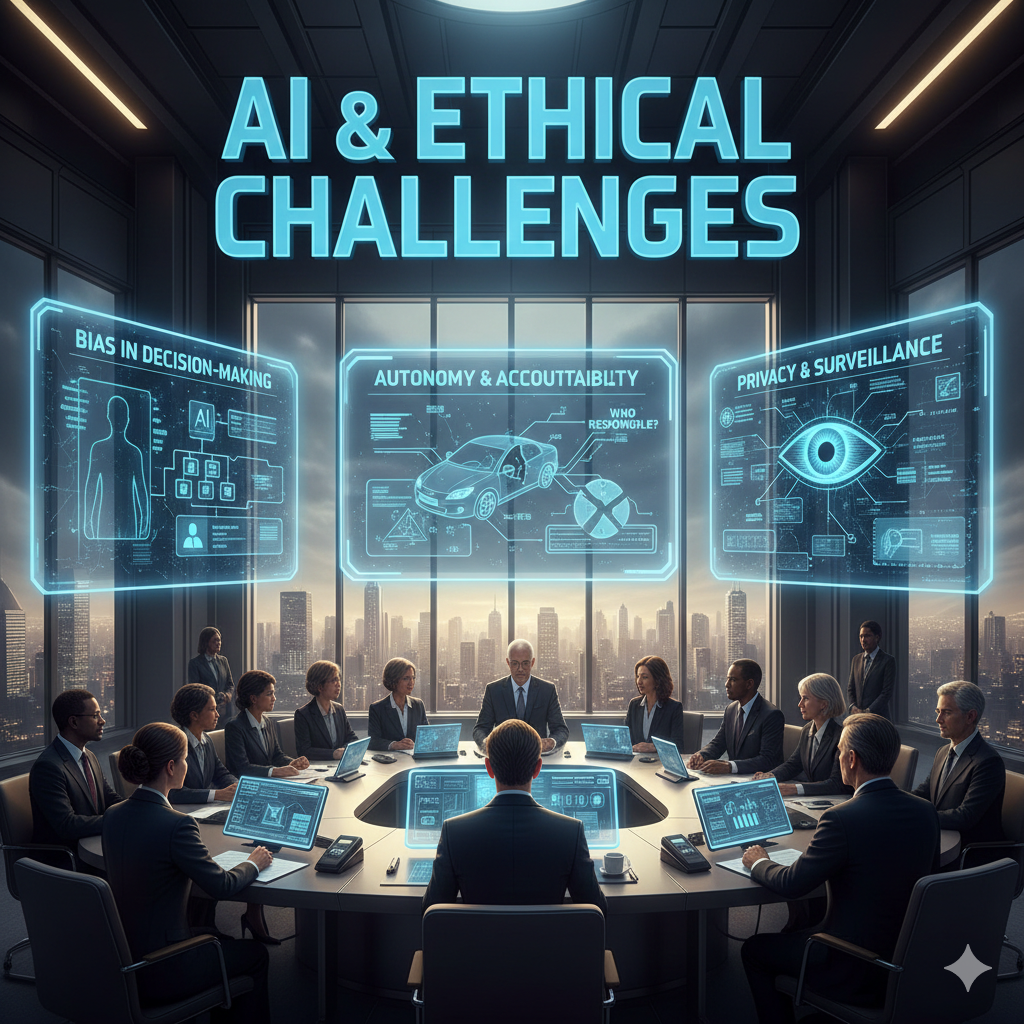
One of the most persistent ethical challenges in 2026 is Algorithmic Bias. Because AI models are trained on historical datasets, they often inherit and crystallize the prejudices of the past. Recent 2025/2026 audits analyzed at Tajassus.site reveal a sobering reality: facial recognition systems used in public surveillance still demonstrate an error rate of up to 35% for individuals with darker skin tones, compared to less than 1% for lighter-skinned individuals. This “Statistical Discrimination” has led to wrongful arrests and systemic marginalization in smart-city environments.
The Socio-Economic Divide
Furthermore, predictive algorithms used in mortgage and loan approvals have shown a 20% higher rejection rate for minority applicants, even when financial variables are identical to other groups. At Tajassus.site, we argue that without “Fairness-by-Design” mandates, AI risks becoming a high-tech tool for reinforcing ancient prejudices. In 2026, developers are now legally required to provide “Bias-Impact Reports” before deploying neural networks in public sectors, but the gap between policy and practice remains a primary ethical hurdle.
2. The Deepfake Crisis and the Erosion of Digital Truth
In 2026, the concept of “Objective Truth” is under its most severe attack in human history. Generative AI models have reached a level of hyper-realism where distinguishing between a live human video and a synthetic deepfake is impossible for the naked eye. At Tajassus.site, we have documented that nearly 60% of all video content consumed on social platforms in 2026 contains some form of AI-manipulated elements. This has catastrophic implications for political stability, corporate security, and personal reputation management.
Primary Ethical Benchmarks for 2026:
- Privacy Sovereignty: The legal right to opt-out of “Behavioral Harvesting” by AI smart-city sensors.
- The Transparency Mandate: Every AI conclusion must be accompanied by a “Human-Readable Explanation” (XAI).
- The Accountability Loop: Defining legal liability when an autonomous system (like a self-driving car or medical bot) causes harm.
- Cognitive Autonomy: Protecting users from “Dark Patterns” in AI that utilize dopamine-loop algorithms to manipulate decision-making.
- Universal Watermarking: The mandatory cryptographic tagging of all synthetic assets to preserve digital integrity.
3. Responsibility and the “Accountability Vacuum”
If an autonomous surgical robot commits a fatal error, or an AI-driven trading bot triggers a flash crash, who is held responsible? In 2026, the legal world is caught in an “Accountability Vacuum.” The creators claim the machine is too complex to predict, while the users claim the machine was autonomous. Tajassus.site advocates for the “Human-in-the-Loop” standard, where a human operator must remain legally liable for the final execution of any critical AI decision. We believe that true ethical AI requires a clear chain of human command that cannot be bypassed by silicon efficiency.
4. The Crisis of Human Purpose in a Post-Labor World
As AI agents take over advanced cognitive and creative labor—writing code, composing music, and diagnosing complex diseases—humanity is facing a profound philosophical crisis of purpose. When a machine can perform 90% of professional tasks with 100% higher efficiency, what remains for the human spirit? At Tajassus.site, we explore the need for a “Post-Utility” definition of human value. Our research into 2026 labor trends shows that while AI has automated tasks, it has not yet automated “Empathy” and “Contextual Wisdom,” which remain our most vital ethical exports.
Conclusion: Crafting a Wiser Digital Civilization
The ethical challenges of 2026 are not merely technical bugs to be patched; they are mirrors reflecting the flaws and aspirations of our society. At Tajassus.site, our mission is to ensure that as we build smarter machines, we do not become a more foolish people. The goal of technology must be the amplification of human flourishing, not its replacement. By mandating transparency, neutralizing bias, and protecting autonomy, we can ensure that the AI era is defined by progress, not prejudice. Stay technical, stay ethical, and always investigate the human cost of innovation.