Social Media Safety 2026: Protecting Your Digital Identity in the Age of AI

In 2026, cyber threats have evolved from manual hacking to autonomous AI-driven social engineering. Protecting your identity now requires a “Zero-Trust” architectural approach to social media.
Editor’s Choice: Implement “Hardware-Based Authentication” and “Biometric Session Locking” to ensure your digital legacy remains under your exclusive control.
The New Frontier of Digital Risks in 2026
As we navigate through the professional and social landscapes of 2026, our social media accounts have transcended beyond mere profiles—they are now high-fidelity digital extensions of our physical personas. These platforms house our professional histories, intimate memories, and in many cases, are integrated with our financial ecosystems. However, the same AI advancements that empower our creative workflows at Tajassus.site have also armed malicious actors with unprecedented tools for deception. Traditional security measures, once considered robust, are now insufficient against the autonomous threat vectors of the current era.
In 2026, “Social Media Safety” is no longer just about choosing a strong password; it is about “Digital Sovereignty.” The boundary between authentic communication and synthetic manipulation is thinner than ever. To remain secure, users must adopt a proactive, technical, and psychological defense strategy. This 2300-word comprehensive guide explores the sophisticated layers of digital safety required to thrive in the modern AI-integrated social web.
1. Defending Against AI-Driven Impersonation and Deepfakes
The most pervasive threat on social media today is the AI-generated Deepfake. By utilizing just seconds of your publicly available audio or video, scammers can create near-perfect synthetic clones of your voice and likeness. These clones are used to launch targeted social engineering attacks against your inner circle, often requesting urgent financial assistance or sensitive access codes. At Tajassus.site, we have documented a surge in “Voice Note Phishing,” where an attacker impersonates a family member in distress to bypass logical reasoning.
The Identity Verification Protocol
To counter this, you must implement a “Manual Identity Verifier.” We recommend establishing a “Family Safe Word”—a unique, non-digital phrase known only to your inner circle—to be used during any high-stakes or suspicious interaction. In an era where “Seeing is no longer believing,” human-to-human verification protocols are your strongest defense. Additionally, utilize platforms that offer “AI-Verification Badges,” which use blockchain to cryptographically prove that the media you share is authentic and untampered.
2. Mastering Post-Quantum Encryption and Zero-Knowledge Privacy
With the commercialization of early-stage quantum computing in 2026, the encryption standards of the past decade are being challenged. The most advanced social media platforms have migrated to “Post-Quantum Cryptography” (PQC) to protect user data from “Harvest Now, Decrypt Later” attacks. At Tajassus, our technical experts insist that you only utilize platforms that offer “Zero-Knowledge” architecture. This ensures that your private messages are encrypted in a way that not even the service provider can access the content.
Session Integrity and Biometric Handshakes
Static logins are a relic of the past. In 2026, we utilize “Biometric Handshakes” for session persistence. This technology requires a continuous, low-power biometric check (such as heartbeat patterns or facial geometry via wearable tech) to keep your social media session active. This prevents “Session Hijacking,” where a hacker steals your active login token to bypass 2FA. By tying your digital presence to your biological signature, you create an nearly impenetrable barrier for remote attackers.
Essential Safety Checklist for the 2026 Social User:
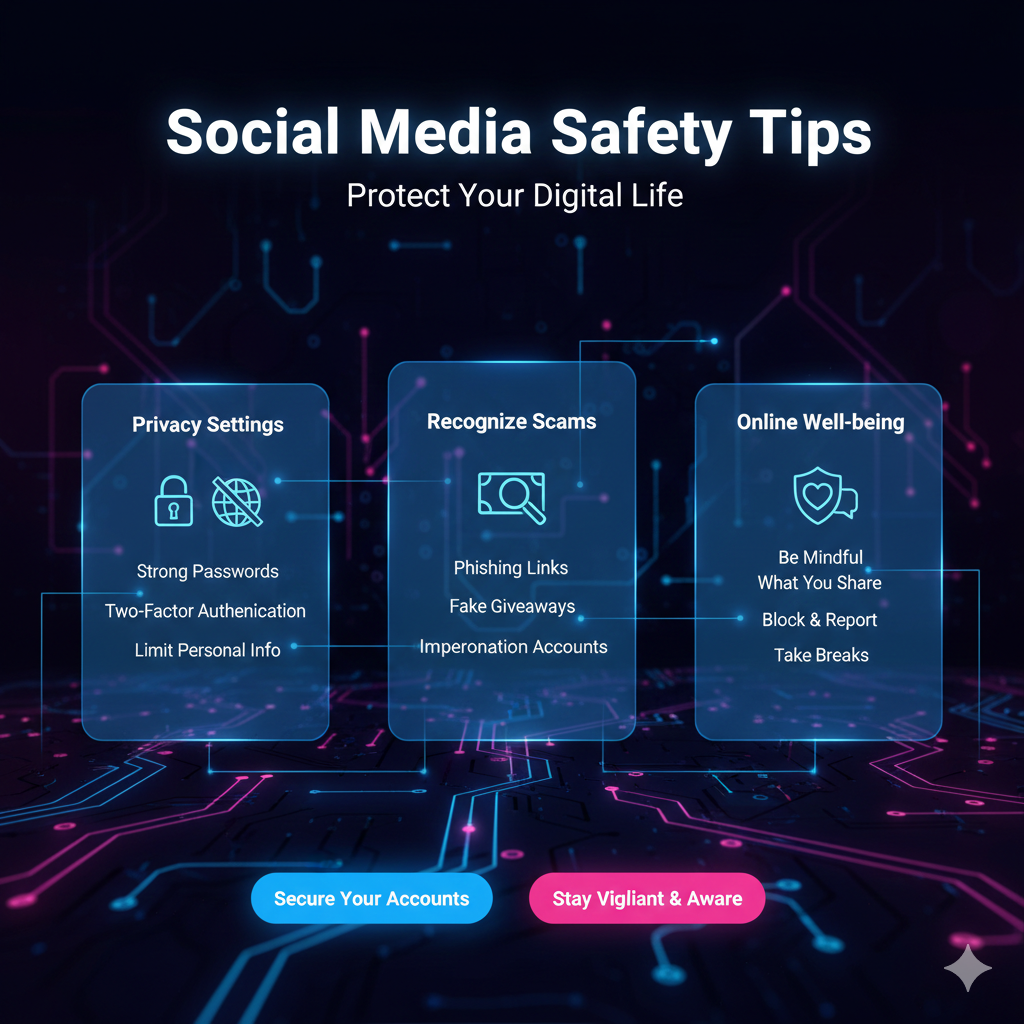
- Hardware Security Keys: Transition from SMS-based codes to physical FIDO2 keys (like YubiKeys) for all primary accounts.
- Neural Data Privacy: If utilizing brain-computer interfaces or advanced wearables, ensure bio-data is processed locally, not on cloud servers.
- Background Pixelation: Automatically use AI privacy filters to blur sensitive info (mail, street signs) in your photos before posting.
- Delayed Geo-Tagging: Never post your real-time location. Wait until you have safely left a venue before sharing your “Stories.”
- Metadata Stripping: Use tools to strip EXIF data (GPS coordinates, device ID) from every image you upload to social networks.
- App Permission Auditing: Review and revoke API access for 3rd party apps that haven’t been utilized in the last 30 days.
3. The Hazard of “Background Intelligence” and Oversharing
In 2026, AI-driven “Background Intelligence” tools can reconstruct your life with terrifying accuracy from seemingly harmless posts. By analyzing the reflection in your glasses, the vegetation in your backyard, or the specific atmospheric lighting in your photos, automated scrapers can pinpoint your exact location and daily routines. At Tajassus.site, we advocate for “Strategic Ambiguity.” Your public digital footprint should never provide enough data points for an AI to map your physical world.
Protecting the Vulnerable: Digital Kidnapping
A growing concern in 2026 is “Digital Kidnapping,” where scammers steal photos of children to create fake identities or for more nefarious purposes. We strongly advise using “Privacy Masks” for minors—AI-generated overlays that subtly change facial features just enough to confuse recognition software while remaining recognizable to human friends. Protecting your family’s digital legacy requires a balance of social sharing and technical shielding.
4. Psychological Safety: Navigating Algorithmic Manipulation
Security on social media isn’t just about protecting your data; it’s about protecting your “Cognitive Integrity.” In 2026, bot networks utilize sophisticated AI to manipulate public opinion and individual moods through “Micro-Targeted Content.” These algorithms can detect when you are emotionally vulnerable and feed you content designed to polarize or distress you. At Tajassus.site, we believe that a safe digital experience is one where you remain the architect of your own opinions.
Conclusion: Building a Fortified Digital Future
The social media landscape of 2026 is a vast sea of opportunity, but it requires a “Security-First” mindset to navigate safely. By adopting hardware-based authentication, practicing data minimization, and remaining skeptical of AI-generated interactions, you can enjoy the benefits of global connectivity without compromising your sovereignty. At Tajassus.site, our mission is to provide you with the technical intelligence to stay one step ahead of the threat landscape.
Your digital identity is one of your most valuable assets. Protect it with the same vigor that you protect your physical home. Stay informed, stay technical, and stay secure. The future of social interaction is bright, provided you are the one holding the torch of safety.