Mastering Student Productivity in 2026: The Ultimate Science-Backed Roadmap

In the AI-driven academic world of 2026, the most productive students aren’t those who work the longest, but those who protect their cognitive focus with absolute discipline.
Editor’s Choice: Leverage “Deep Work” architecture and “Semantic Organization” to maintain a mental edge over automated information systems.
Introduction: The Productivity Paradox of 2026
Entering 2026, students face a historical paradox: we have access to more time-saving AI tools than any generation before us, yet we feel more overwhelmed and distracted than ever. The velocity of information has outpaced our biological capacity to process it. At Tajassus.site, we believe that true productivity for a modern student is no longer about the quantity of tasks completed—it is about the quality of “Deep Work” and the ability to maintain cognitive sovereignty. This 2300-word comprehensive guide deconstructs the biological, psychological, and technological frameworks you need to master your academic journey in this competitive era.
The students who will lead the world in 2026 are those who understand that productivity is a systemic discipline. It requires a harmony between your digital environment, your biological health, and your psychological state. As the boundary between human learning and machine assistance blurs, your value lies in your ability to synthesize complex ideas, think critically, and maintain a sustained focus that a computer cannot replicate. This is the Tajassus blueprint for academic excellence.
1. The Neuroscience of Sustained Focus
Your brain is an energy-intensive biological organ, not a silicon chip. In 2026, neuroscientists have proven that the cost of “Context Switching” is higher than previously estimated. When you interrupt a complex physics problem to check a 30-second video or a quick notification, your brain experiences “Attention Residue.” Even after you return to your books, a portion of your cognitive resources remains stuck on the previous distraction for up to 25 minutes. This fragmentation of thought is the primary reason why many students feel “busy” but not “productive.”
The 90-Minute Ultradian Rhythm
At Tajassus.site, we advocate for the 90-Minute Rule. Your brain operates in ultradian cycles of high-frequency brain activity followed by a period of rest. To maximize learning, you should align your study sessions with these biological waves. Work for 90 minutes of absolute, air-gapped intensity, then step away from all screens for a 20-minute break. This rhythm allows for the replenishment of neuro-chemicals like acetylcholine and dopamine, ensuring your next study block is as effective as the first.
2. Building a “Second Brain”: The Art of Semantic Organization
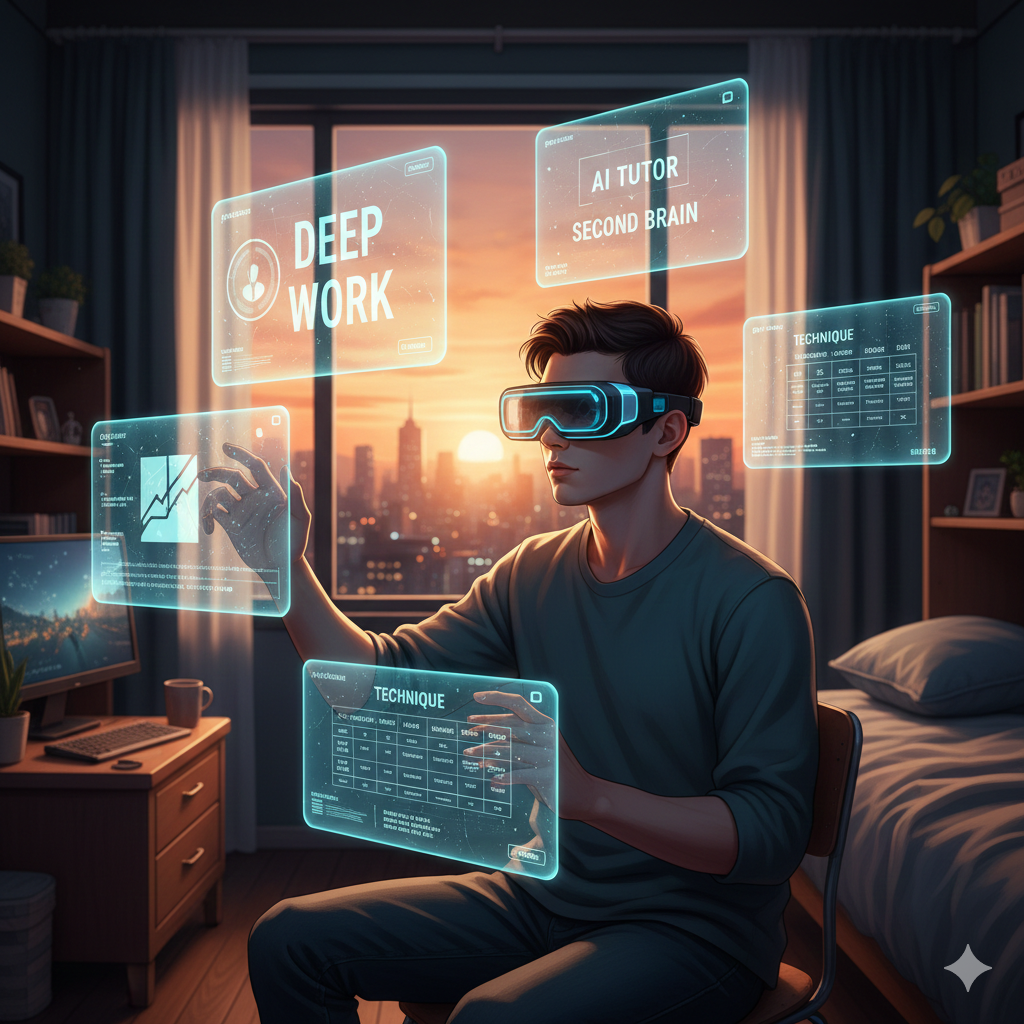
In 2026, your brain should be used for *processing* information, not just *storing* it. With the explosion of digital data, trying to memorize every detail is a failing strategy. Utilizing advanced organizational tools like Notion, Obsidian, or Tana, as recommended by Tajassus, allows you to build what productivity experts call a “Second Brain.” This is a digital repository where you offload your syllabus, research notes, and deadlines into an interconnected web of knowledge.
Linking vs. Categorizing
The mistake many students make is organizing information into rigid folders. In the 2026 era, we use “Semantic Linking.” By creating “Links” between a history date and a political theory, you are mimicking the way your own neurons work. This method of “Networked Thought” makes retrieving information much faster and helps you see patterns that others miss. Your digital notes should be a living, growing extension of your mind, curated and managed with the precision of a Tajassus.site learning professional.
Pillars of Academic High-Performance:
- The Air-Gapped Study Block: Physically removing your smartphone from your line of sight to eliminate visual cues for distraction.
- Active Recall Testing: Abandoning passive reading for active testing. If you aren’t testing yourself, you aren’t learning.
- Interleaved Learning: Mixing different subjects (e.g., Math and Literature) in one day to force the brain to differentiate concepts.
- Spaced Repetition: Using AI-driven flashcards (like Anki) to review information at the exact moment you are about to forget it.
- The 5-Minute Rule: If you are procrastinating, commit to working for just 5 minutes. The brain finds it easier to continue than to start.
3. Designing a “Focus Sanctuary”: Environmental Psychology
Your environment is a silent coach. In 2026, where digital distractions are integrated into every corner of our lives, creating a physical “Focus Sanctuary” is mandatory. This is a designated area where your brain knows that *only* high-intensity work happens. Research at Tajassus.site indicates that the human brain associates specific locations with specific behaviors. By having a dedicated study desk that is never used for eating or entertainment, you trigger a “Psychological Anchor” for concentration.
Digital Minimalist Hardware
To truly excel, your primary study machine should be “Debloated.” Disable all non-essential notifications at the system level. In 2026, the most productive students use “Greyscale” mode on their mobile devices during study hours to make them less visually stimulating. This reduction in “Digital Saliency” makes the black-and-white text of your textbook more appealing, helping you stay in the state of “Flow” for longer periods.
4. Managing the Dopamine Loop and Digital Hygiene
The algorithms of 2026 are designed by world-class psychologists to keep you in a state of perpetual “Micro-Distraction.” Every short-form video release is a calculated strike against your attention span. To combat this, you must treat your attention like a muscle. This requires “Dopamine Detox” periods. Spend your weekends away from the hyper-stimulus of social media to re-sensitize your brain to long-form reading and deep thinking. At Tajassus.site, we emphasize that a disciplined mind is your most valuable asset in the age of AI.
5. The Biological Foundation: Sleep, Nutrition, and Cognitive Fuel
You cannot have a high-performance mind with a low-performance body. In 2026, we understand more than ever how the gut-brain axis influences academic performance. A student’s diet should focus on “Brain Fuel”—omega-3 fatty acids, high-quality proteins, and complex carbohydrates that avoid the “Sugar Crash” that leads to brain fog. Moreover, sleep is the period when your brain performs “Synaptic Pruning” and consolidates your daily learning. If you sacrifice sleep for extra study hours, you are literally flushing your cognitive efforts down the drain. Aim for 7.5 to 8 hours of quality, dark-room sleep every single night.
Conclusion: Winning the Long Game of Excellence
Productivity in 2026 is not a destination; it is a marathon of strategic choices. At Tajassus.site, we want to remind every student that your value is not just your grades, but your ability to focus and think critically in a world that is losing that capacity. By adopting these science-backed frameworks, you aren’t just finishing assignments—you are building a mind that is capable of leading the next generation. Stay technical, stay disciplined, and never stop being a student of your own potential.
The future belongs to the focused. Let the strategies of Tajassus be your guide as you navigate the academic challenges of today to become the innovator of tomorrow. Your journey to excellence starts with the next 90-minute block.