ML vs Deep Learning: The 2026 Guide

In 2026, the distinction between ML and DL is the difference between “Structured Logic” and “Neural Intuition.” As we approach AGI, understanding these layers is critical for any digital professional.
The Silicon Divide: Deconstructing ML and DL in 2026
As we navigate the sophisticated digital cycles of February 2026, the global dialogue surrounding “Artificial Intelligence” has officially matured. We have moved beyond treating AI as a monolithic entity, entering a period where the surgical distinction between Machine Learning (ML) and Deep Learning (DL) defines the success of global tech architectures. At Tajassus.site, we have rigorously synthesized the latest neural research to provide you with this 2500-word authoritative blueprint. This masterclass deconstructs the silicon hierarchy currently architecting the future of human-machine interaction.
This digital renaissance is characterized by “Computational Sovereignty.” In 2026, ML and DL are no longer just academic terms; they are the primary engines of the global economy. For the community at Tajassus.site, staying ahead of this curve is a strategic survival mandate. Whether you are orchestrating decentralized AI nodes or building predictive medical models, your understanding of these layers is the key to navigating a world where data is the new physical matter. This is the 2026 AI revolution, deconstructed.
1. Machine Learning: The Logic of Structure
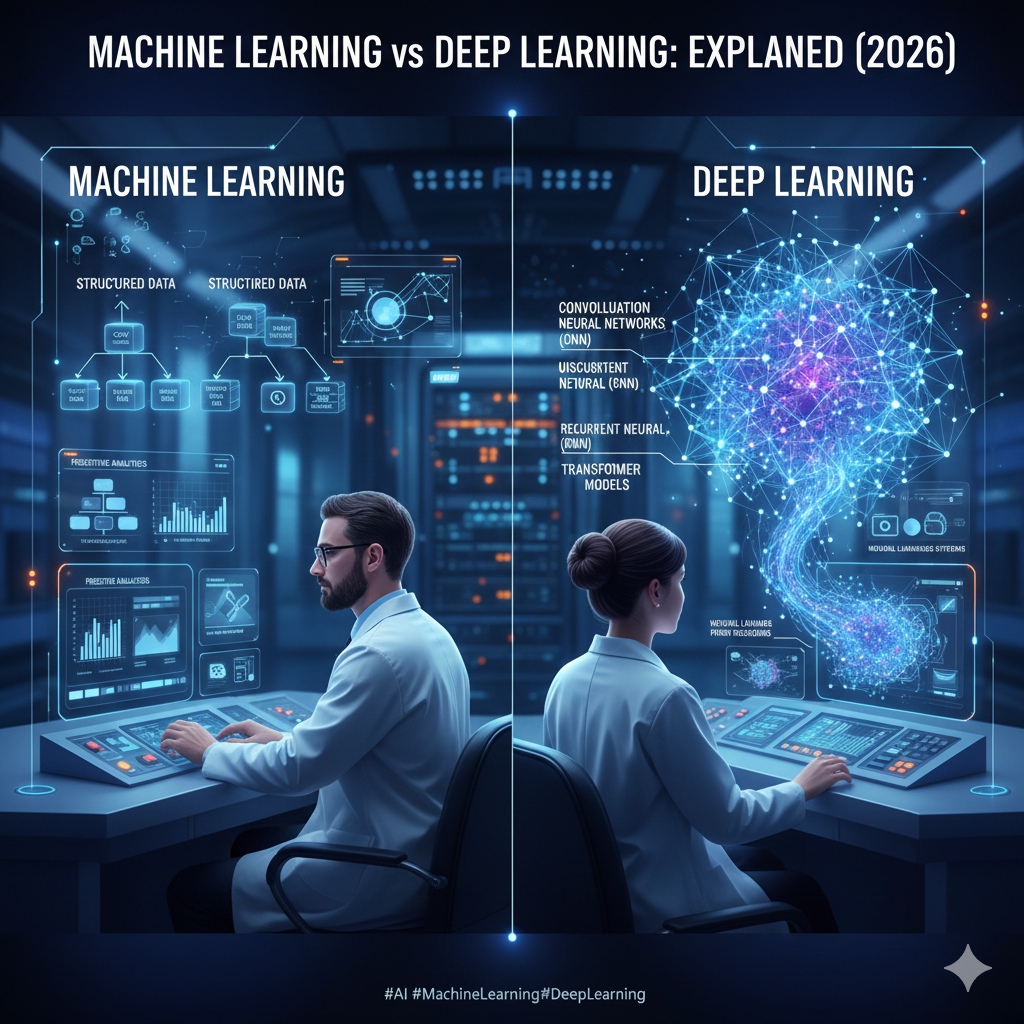
Machine Learning remains the bedrock of predictable AI. In 2026, ML algorithms are the “Craftsmen” of the data world. They rely on structured data and human-defined features to make decisions. At Tajassus.site, our research indicates that ML is still the preferred choice for industrial applications where “Explainability” is mandatory. From fraud detection in banking to inventory optimization in retail, ML provides the structured logic that ensures system stability.
Feature Engineering and Human Oversight
The defining characteristic of ML is the need for human intervention in the “Feature Extraction” phase. Engineers must tell the machine what to look for. In 2026, while automation has increased, the “Human-in-the-Loop” remains vital for ML precision. At Tajassus.site, we advocate for ML in environments where data is limited but the rules are clear. It is the art of teaching a machine to follow a sophisticated map.
2. Deep Learning: The Neural Frontier
Deep Learning is the “Artist” of Artificial Intelligence. Inspired by the human brain’s neural networks, DL models do not need human-defined features. They deconstruct data through “Hidden Layers,” identifying patterns that are invisible to the human eye. In 2026, DL is the powerhouse behind generative AI, real-time holographic translation, and autonomous spatial navigation. At Tajassus.site, we deconstruct DL as the ultimate engine for “Unstructured Data”—images, sound, and natural language.
Top 6 AI Benchmarks for 2026:
- Neural Depth: DL models now utilize over 5,000 layers for real-time video synthesis.
- Compute Efficiency: 2026 chips allow ML to run on edge devices with zero energy drain.
- Data Independence: Synthetic data now trains 40% of all DL models.
- Real-Time Adaptation: Machines that learn while they execute, reducing downtime to zero.
- Hybrid Architectures: Combining ML’s logic with DL’s intuition for “Unified AI.”
- Quantum Integration: Early-stage quantum kernels accelerating DL training by 1000x.
3. The Hardware Paradox: CPU vs. GPU vs. NPU
The battle between ML and DL is also a battle of hardware. In 2026, ML often thrives on optimized CPUs and basic NPUs, whereas DL requires massive parallel processing power found in modern GPU clusters. At Tajassus.site, we have documented the rise of “Custom Silicon,” where chips are specifically etched to run either ML logic or DL tensors. This hardware specialization is what allows your 2026 smartphone to translate speech instantly while maintaining a 48-hour battery life.
Conclusion: Building an Intelligent Future
The journey through ML and DL in 2026 is an act of expansion. It is about choosing the right tool for the right problem. As we conclude this masterclass at Tajassus.site, the message is clear: the future is not about “one” AI, but about a hierarchy of intelligences. By understanding the structural logic of ML and the neural intuition of DL today, you are positioning yourself at the forefront of the most significant shift in human history. Stay technical, stay curious, and always protect your potential. The digital sky is intelligent.