The Surprising History Behind International Day of Play
In a world increasingly dominated by screens, academic pressures, and structured extracurricular activities, the simple act of unstructured play has quietly faced a modern crisis. Yet, millions of people worldwide celebrated a monumental milestone in advocacy: the newly established International Day of Play. While it might seem like a lighthearted addition to the global calendar, the journey to securing an official United Nations recognition for play is filled with political maneuvering, grassroots passion, and unexpected corporate alliances. The history behind this day is far more complex and surprising than most realize.
Far from being a mere modern marketing gimmick, the International Day of Play represents the culmination of decades of sociological research, psychological urgency, and global diplomacy. It is a formal acknowledgment that play is not a luxury, but a fundamental human right. Let’s dive deep into the untold narrative of how children’s play moved from the backyard to the floor of the United Nations General Assembly.
The Deep Roots: Play as a Contested Human Right
To truly appreciate why an international day was necessary, we have to look back to the mid-20th century. The conversation surrounding the formal preservation of childhood began to shift drastically after the devastation of World War II. As nations rebuilt, psychologists and educators began to argue that children needed more than just food, shelter, and formal schooling; they needed the psychological space to process the world through play.
The first major breakthrough came in 1959 when the United Nations General Assembly adopted the Declaration of the Rights of the Child. Principle 7 of this declaration explicitly stated that “The child shall have full opportunity for play and recreation.” However, declarations are non-binding. They represent global ideals rather than enforceable laws. For thirty years, this right remained largely on paper, frequently ignored by policy makers focusing on industrial growth and standardized testing metrics.
The real shift occurred with the 1989 Convention on the Rights of the Child (CRC). Under Article 31, the global community formally recognized “the right of the child to rest and leisure, to engage in play and recreational activities appropriate to the age of the child.” This was a historic legally binding treaty. Yet, despite being the most widely ratified human rights treaty in history, Article 31 quickly became known among human rights lawyers as the “forgotten article.”
Why the “Forgotten Article” Needed Rescuing
As the late 20th century transitioned into the 21st, economic shifts transformed the daily structures of childhood worldwide. In developing nations, child labor, rapid urbanization, and humanitarian crises severely limited safe spaces for children to gather. In industrialized nations, a different kind of threat emerged: the hyper-commercialization of childhood, institutional over-scheduling, and the aggressive rise of digital entertainment.
Sociologists noted that the physical radius of independent play for an average child had shrunk by over 90% in just two generations. Children who used to roam neighborhoods freely were now confined indoors. Recognizing this crisis, international NGOs realized that simply having a treaty like Article 31 was insufficient. The world needed a recurring, highly visible rallying cry to remind parents, educators, and governments why play mattered. This realization sparked the early movements that eventually birthed the International Day of Play.
A Global Perspective: Statistics from the International Play Association indicate that over 40% of children globally live in environments where safe, accessible outdoor play spaces are entirely unavailable within walking distance from their homes.
The Secret Catalyst: Unlikely Alliances and Corporate Backing
One of the most surprising elements of the history of the International Day of Play is the coalition that brought it to life. Often, human rights initiatives are driven strictly by non-profit organizations, grassroots activists, and academic institutions. However, the push for a dedicated global day of play required a unique blend of advocacy and corporate resources.
In the early 2020s, a powerful coalition emerged. It brought together massive global child-focused brands, such as the LEGO Group and its philanthropic arm, The LEGO Foundation, alongside major international NGOs like Save the Children, Plan International, and ChildFund Alliance. This convergence of corporate social responsibility and traditional human rights advocacy provided the financial muscle and organizational scale necessary to capture the attention of global diplomats.
This alliance recognized that governments were treating play as a frivolous indulgence. To combat this, they funded extensive, multi-country research studies proving the economic and neurological value of play. They framed play not as an absence of work, but as the foundational laboratory where children develop cognitive flexibility, emotional resilience, problem-solving skills, and social intelligence—the exact skills required for the future global workforce.
The Diplomatic Breakthrough at the United Nations
Securing an official UN international day is an incredibly rigorous diplomatic process. It requires a member state to formally champion the cause, draft a resolution, and build a coalition of co-sponsoring nations to vote it into reality. The true turning point for the International Day of Play came when a diverse group of countries stepped up to lead the charge on the global stage.
A core group of UN member states—led by Vietnam, El Salvador, Bulgaria, Jamaica, Kenya, and Luxembourg—spearheaded the resolution. This geographic diversity was crucial; it demonstrated that the play deficit was not merely a Western, middle-class concern, but a universal human issue affecting children across all continents and socio-economic backgrounds.
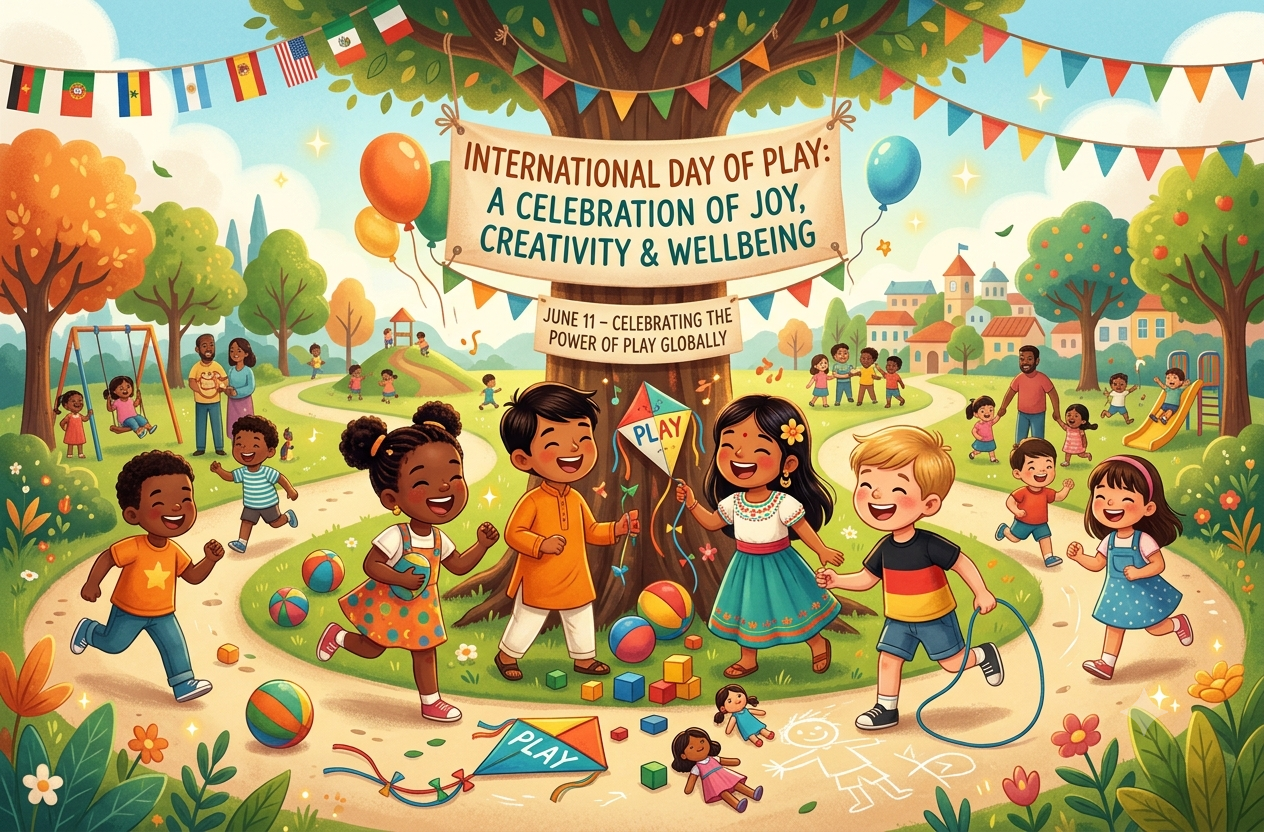
On March 25, 2024, the United Nations General Assembly officially adopted the resolution, designating **June 11th** as the International Day of Play. The resolution was co-sponsored by more than 140 countries, making its passage an overwhelming diplomatic success. It marked a historic declaration that the international community would officially pause every year to safeguard the space for kids to simply be kids.
| Key Milestone Year | Historical Event / Breakthrough | Impact on the Global Play Movement |
|---|---|---|
| 1959 | UN Declaration of the Rights of the Child | First formal mention of play as a core developmental necessity. |
| 1989 | Adoption of Article 31 (CRC) | Made the right to play a legally binding obligation for ratifying nations. |
| 2013 | UN General Comment No. 17 | Addressed the global community’s neglect of Article 31 and renewed advocacy focus. |
| 2023 | Formation of the Global Play Coalition | Brought together corporations (LEGO) and NGOs to lobby for an official day. |
| 2024 | UN Resolution Passes (March 25) | June 11 is officially designated as the International Day of Play. |
The Science That Driven the Policy
Diplomats didn’t just sign the June 11th resolution out of sentimentality. The historical push was heavily backed by terrifying new data from neuroscientists and child psychologists. For years, the prevailing societal mindset assumed that structured activities—like sports clinics, music lessons, and tutoring—offered the best path to success. The data, however, proved the exact opposite.
1. Neuroplasticity and Brain Development
Neurobiological research reveals that free, self-directed play actively alters the structural chemistry of the brain. When a child engages in unstructured play, their brain releases a protein called Brain-Derived Neurotrophic Factor (BDNF). This protein stimulates the growth of new neurons and strengthens synaptic connections in the prefrontal cortex—the area of the brain responsible for executive functioning, decision-making, and emotional regulation.
2. The Antidote to the Global Mental Health Crisis
The historical timing of the International Day of Play’s inception is directly linked to the post-pandemic youth mental health crisis. Following years of isolation, screen reliance, and anxiety, childhood rates of depression and anxiety skyrocketed worldwide. Public health experts argued that structured play is nature’s built-in stress relief mechanism. Without it, cortisol levels remain elevated, hindering healthy emotional and physical growth.
How the International Day of Play is Celebrated Globally
The International Day of Play was never meant to be just another hashtag campaign. Its creators built it as an action-oriented framework designed to influence local and national policies. Every year on June 11th, communities, schools, and governments mobilize to create tangible play experiences and advocate for infrastructural changes.
- Urban Planning Overhauls: Cities around the world use the day to announce the creation of car-free zones, urban green spaces, and inclusive playgrounds designed for children with diverse physical and neurological needs.
- Educational Adjustments: Progressive school districts participate by banning homework on June 11th and replacing traditional structured class schedules with extended, unstructured recess periods.
- Corporate Commitments: Companies involved in the coalition offer paid time off or structured volunteer hours for employees to engage in community playground restorations or spend uninterrupted play hours with their own families.
Looking Forward: The Future of Play Advocacy
The successful establishment of the International Day of Play is an inspiring victory, but the history of this movement teaches us that global awareness is only the first step. The true test of this day lies in its long-term ability to drive systematic policy reforms. The ultimate goal is to move the needle on how societies value time, structure education, and build communities.
Activists are currently leveraging the momentum of June 11th to advocate for legal mandates regarding mandatory recess times in schools, stricter regulations on addictive digital algorithms targeted at young children, and the integration of child-friendly criteria into all future urban development projects. The history of this day proves that change is possible when cross-sector alliances refuse to accept the erosion of childhood freedoms.
Conclusion: Celebrating the Power of the Unstructured Mind
The history behind the International Day of Play serves as a profound reminder that the simplest things are often the most vital to protect. What seems like effortless, basic fun is actually the foundation of human innovation, resilience, and connection. By looking back at the decades of tireless work required to establish June 11th on the global calendar, we can better appreciate the day not just as a celebration, but as a crucial defensive line protecting the sanctity of childhood for generations to come.