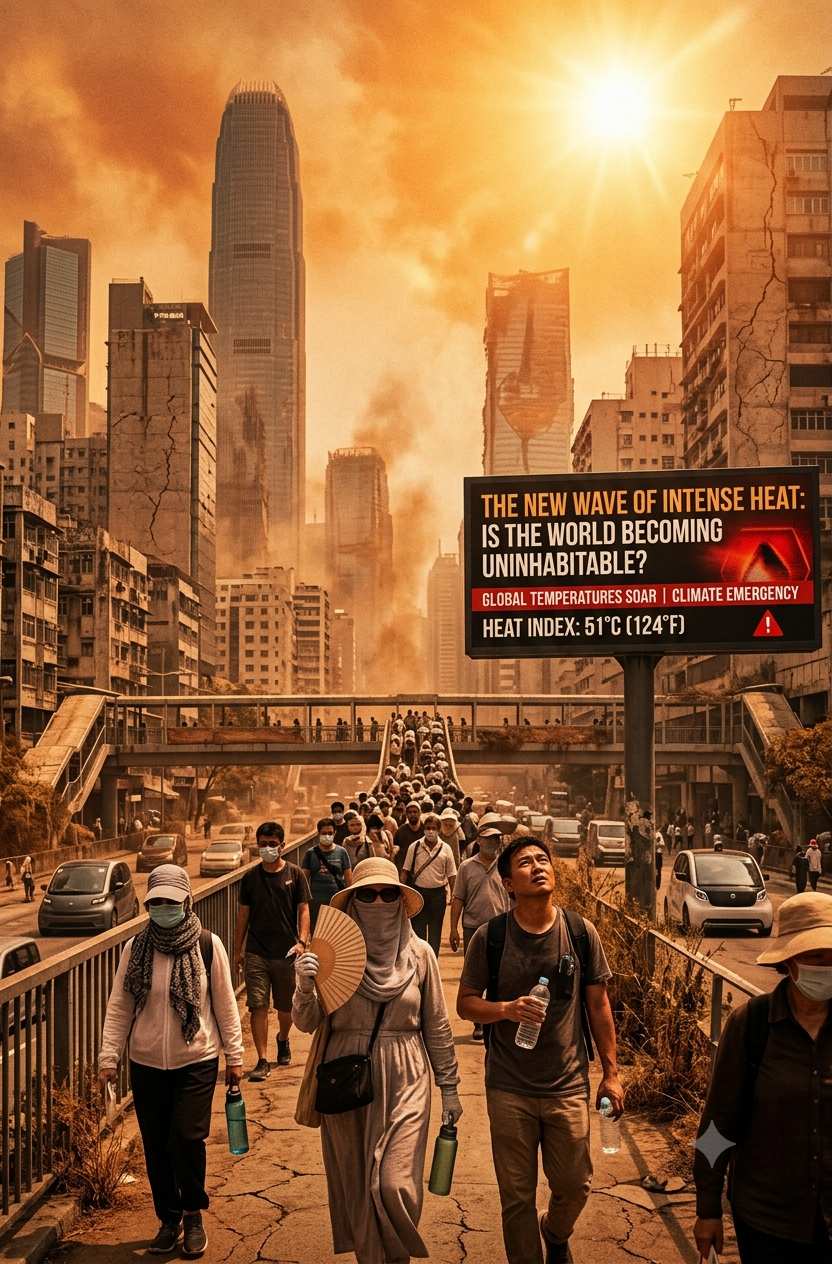
The Escalation of Global Temperatures: A New Reality
Climate change is no longer a distant theoretical threat or a warning meant for future generations; it is an active, unforgiving crisis unfolding across the globe today. Across multiple continents, previous meteorological records are being shattered with alarming regularity, as intense, prolonged heatwaves grip regions accustomed to far milder conditions. The relentless thermal energy trapped within our atmosphere signals a monumental transformation in global climate systems, challenging human endurance and threatening entire ecosystems. In this investigative feature on Tajassus, we analyze the factors driving this catastrophic rise in temperature and what it means for the future of habitability on Earth.
As summer temperatures scale unprecedented heights, major urban centers are transforming into literal heat islands. The combination of soaring ambient temperatures and oppressive humidity levels is creating hazardous living conditions, forcing governments to reconsider working hours, energy distribution methods, and public health infrastructure. We must critically look into the mechanisms fueling this thermal surge to formulate viable survival strategies.
The El Niño Phenomenon and Record-Breaking Heat Trajectories
At the center of the current global thermal crisis is the potent intensification of the El Niño-Southern Oscillation (ENSO) cycle. This natural climate pattern involves the periodic, abnormal warming of surface waters across the central and eastern tropical Pacific Ocean. However, when superimposed onto a planet already warmed by decades of industrial pollution, modern El Niño events exhibit unprecedented intensity, disrupting global wind patterns, jet streams, and moisture distribution systems.
The consequences of this amplified El Niño are devastatingly widespread. It alters standard monsoon cycles, suppresses cooling wind currents, and locks high-pressure systems over massive landmasses, creating static “heat domes.” These heat domes act as atmospheric lids, trapping rising hot air and baking the ground below for weeks on end, resulting in drought conditions and triggering massive wild fires from Asia to the Americas.
Cascading Impacts of Severe Heat Domes:
- Atmospheric Stagnation: Pollutants are trapped close to the ground, deteriorating air quality to toxic levels.
- Hydrological Depletion: Surface water reservoirs evaporate rapidly, threatening regional water security.
- Biomass Desiccation: Forests and vegetation lose moisture rapidly, turning into prime tinder for catastrophic wildfires.
Greenhouse Gas Concentrations and the Anthropocene Factor
While natural cycles like El Niño act as catalysts, the fundamental engine behind the long-term upward trajectory of global temperatures remains human-induced greenhouse gas emissions. The burning of fossil fuels for industrial manufacturing, transport, and energy generation, paired with widespread deforestation, has pushed atmospheric carbon dioxide (CO2) and methane (Methane) levels to heights unprecedented in millions of years.
These gases form a thermal blanket around our planet, intercepting infrared radiation that would otherwise escape back out into space. This classic greenhouse effect is compounding heat retention exponentially. As global industrial production continues to rely heavily on carbon-intensive energy sources, the thermal threshold of our biosphere is being stretched to its absolute limits, pushing us closer to dangerous tipping points from which recovery may be impossible.
Glacial Meltdown and the Rising Oceans
The excess heat trapped in our climate system is being absorbed heavily by the polar regions and high-altitude alpine zones. Glaciers and ice sheets in Antarctica and Greenland are melting at rates that continually outpace conservative scientific predictions. This loss of ice mass triggers a dangerous feedback loop known as the albedo effect: as reflective white ice disappears, it exposes dark ocean waters or earth beneath, which absorbs even more solar radiation, accelerating the warming cycle.
“The melting of our global ice reserves does not just mean higher sea levels; it signifies the permanent loss of our planet’s natural thermal regulators, shifting global ocean currents forever.”
The resulting influx of freshwater into the global marine system is actively contributing to sea-level rise. Coastal megacities and low-lying island nations are now facing existential threats from chronic tidal flooding, severe storm surges, and the salinization of precious freshwater aquifers, threatening to displace millions of coastal residents over the coming decades.
Socio-Economic Disruptions: Public Health, Agriculture, and Energy
The ramifications of extreme heat extend far beyond simple temperature charts; they disrupt the core pillars of human civilization. From a public health perspective, extreme heatwaves are silent killers, causing steep spikes in heatstroke, severe dehydration, cardiovascular failures, and acute kidney stress, particularly among vulnerable populations and outdoor laborers.
Simultaneously, global agricultural stability is fracturing. Crucial staple crops are suffering from thermal stress, leading to diminished yields, disrupted harvesting timelines, and outright crop failures. This reduction in agricultural productivity, paired with water scarcity, threatens global food supply chains and escalates the risk of systemic food inflation. Furthermore, national energy grids are pushed to the brink of collapse as demands for air conditioning skyrocket, resulting in widespread blackouts that paralyze industrial production and economic output.
Scientific Projections: Charting the Boundaries of Human Habitability
Comprehensive climate models indicate that if greenhouse gas emissions are not brought down immediately to maintain the global warming threshold within 1.5°C above pre-industrial levels, the geography of human habitability will shrink dramatically. Large sectors of the Middle East, South Asia, and Central Africa could regularly experience “wet-bulb” temperatures exceeding 35°C—a threshold where the human body can no longer cool itself down through sweating, making outdoor survival impossible for more than a few hours.
Winters will continue to contract into brief, erratic periods, while summers will expand to dominate the calendar year. The traditional predictability of seasonal weather patterns will dissolve entirely, replaced by chronic extremes where intense droughts alternate rapidly with catastrophic, unpredictable downpours and flash floods. This climate volatility will inevitably trigger mass migrations, redefining geopolitics as populations move in search of basic resources and temperate climates.
Strategic Mitigation: Engineering a Sustainable Path Forward
Averting this dystopian trajectory requires an immediate, coordinated overhaul of global infrastructure and policy. Nations must transition away from fossil fuels, directing unprecedented investment toward renewable energy frameworks such as advanced solar arrays, wind networks, and next-generation energy storage solutions. Urban landscapes must be re-engineered into “sponge cities” with extensive green roofs, urban forests, and heat-reflective building materials that actively mitigate the heat island effect.
On an individual and community level, water conservation technologies, smart agricultural practices, and aggressive global reforestation initiatives must be institutionalized. Protecting the environment must become the central tenet of modern governance. Time is running out, and the choices made today will decide whether Earth remains a hospitable home or becomes an unlivable planet for generations to come.