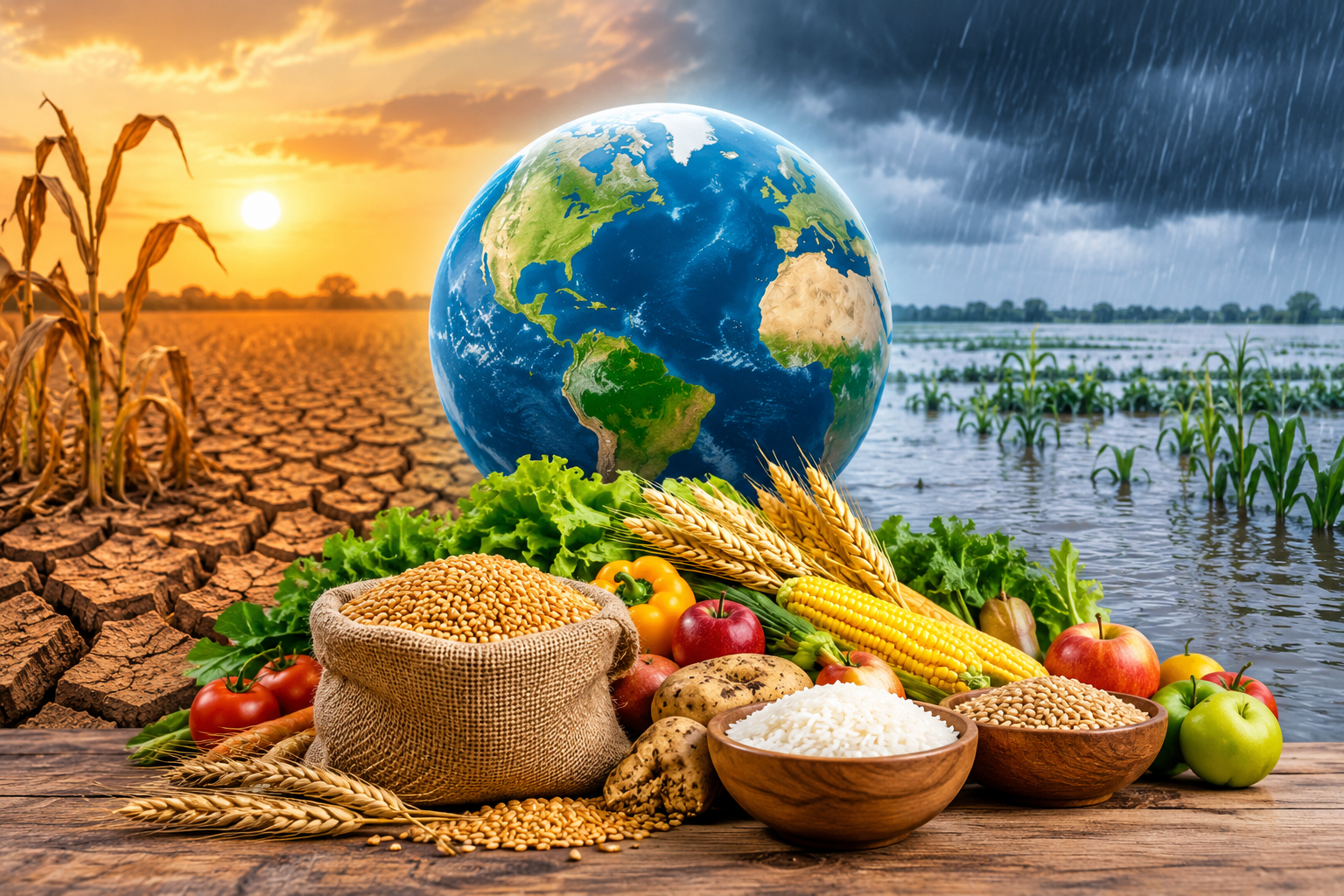
The Onset of a Systemic Crisis
The link between climate change and the global food supply is no longer a distant problem for the future[cite: 1]. In 2026, we stand at a critical juncture where heatwaves, droughts, and floods are devastating agricultural fields across the world, and their consequences are reaching every household[cite: 1]. According to a joint report by the United Nations Food and Agriculture Organization (FAO) and the World Meteorological Organization (WMO), the frequency, intensity, and duration of extreme heat events have seen an unprecedented increase over the past half-century, and this trend is set to become even more severe in the future[cite: 1].
This crisis is shaking the food system to its core—from production to prices, and from nutritional quality to global trade routes[cite: 1]. According to the Assistant Director-General of the FAO, “The combined effect of drought and extreme heat is now fundamentally becoming a grave threat to food security.”[cite: 1]
Rising Temperatures and Crop Destruction
The most direct impact of climate change falls upon crop yields[cite: 1]. The data is alarming: for every single degree Celsius increase in temperature, corn production decreases by 7.5 percent and wheat production declines by up to 6 percent[cite: 1].
Even more concerning is that in the future, an additional one degree of warming carries the potential for a further decrease of up to 10 percent in yield[cite: 1]. This means that if global temperatures rise by 2 degrees Celsius, corn yields could drop by an overall 17.5 percent and wheat yields by up to 16 percent, creating a catastrophic situation for the global food supply[cite: 1].
Growing Threats to the World’s Breadbaskets
The global food supply relies on a few major agricultural regions, known as “breadbaskets,” and these exact regions are suffering the most severe impacts[cite: 1]. According to a recent study published in Nature Communications, under a high-emissions scenario, 59 percent of breadbaskets will face an increased risk of flooding, 94 percent will be exposed to extreme heatwaves, 53 percent will suffer from droughts, and 98 percent face a combined risk of both hot and dry events[cite: 1].
The Indo-Gangetic Plain, spanning northern India, southern Nepal, eastern Pakistan, and Bangladesh, has become a “multi-hazard hotspot,” where farmland is confronted with every type of threat[cite: 1]. In the United States, the Midwest and the Southern Great Plains face the highest risks from heatwaves, droughts, and compound events, while the southern states of Brazil are experiencing an increase across all types of environmental hazards[cite: 1].
Multidimensional Crisis: Encircled on All Sides
The global food supply today is engulfed by crises on multiple fronts[cite: 1]. The first crisis stems from geopolitical conflicts—the war in Ukraine and conflicts involving Iran have severely disrupted food prices and fertilizer availability[cite: 1]. The second crisis is the surge in energy and fertilizer costs, which has driven up production expenses for farmers to unprecedented levels[cite: 1].
The third and largest crisis is extreme heat[cite: 1]. Growth halts for many essential crops when temperatures exceed 30 degrees Celsius, and livestock suffer severe heat stress at temperatures above 25 degrees Celsius[cite: 1]. The fourth crisis is El Niño—a climate phenomenon that warms the waters of the eastern Pacific Ocean and raises global temperatures[cite: 1]. Experts expect a new El Niño event to form in late 2026, which could further escalate the climate emergency in the coming months[cite: 1].
Poor Nations and Smallholder Farmers: The Most Vulnerable
The impacts of climate change are not distributed equally everywhere[cite: 1]. The dry corridor regions of Sub-Saharan Africa, South Asia, and Central America are at the highest risk[cite: 1]. According to FAO analyses, areas in the Sahel, Southern Africa, South and Southeast Asia, and Central America face a drought risk of over 50 percent in the coming months[cite: 1].
Smallholder farmers are the most vulnerable, as they possess far fewer resources to adapt to changing conditions[cite: 1]. According to the Global Nutrition Report 2026, climate change is shifting “from temporary weather shocks to permanent structural disruptions,” directly impacting agricultural yields and diet quality[cite: 1].
The Silent Crisis of Malnutrition
Climate change is not merely affecting the quantity of food, but also its essential quality[cite: 1]. Research has proven that elevated concentrations of carbon dioxide reduce the levels of protein, iron, and zinc in crops[cite: 1]. This phenomenon is known as “hidden hunger”—where people are eating full meals yet failing to receive the vital nutrients required for health[cite: 1].
Particular concern centers on regions where corn and other grains serve as the primary source of dietary energy and protein, such as Sub-Saharan Africa[cite: 1]. According to a nutritionist in Tanzania, climate stress is altering not just what people eat, but the very structure of their diet over time—“Diet contracts first in diversity, then in quality, and finally in health outcomes.”[cite: 1]
Strategies for Building Resilience
Despite these devastating challenges, experts emphasize that we must now view our food systems from a fresh perspective[cite: 1]. A transition toward an “anti-fragile” food system is essential—a system that is not only resilient, but one that moves beyond current models to transform challenges into opportunities[cite: 1].
Three key strategies have been proposed to achieve this goal[cite: 1]:
- Early Warning Systems — Informing farmers with climate forecasts so they can make better decisions regarding planting schedules, irrigation, and drought-tolerant crop varieties[cite: 1].
- Climate-Smart Agriculture — According to a study conducted in China’s Henan Province, adopting high-level climate-smart agriculture can increase corn yields by up to 10.5 percent while stabilizing production[cite: 1].
- International Cooperation — Determined global efforts to maintain the Paris Agreement’s target of limiting global warming to 1.5 degrees Celsius[cite: 1].
A Decisive Turning Point
This is the decisive turning point where we must determine whether we choose a future where food reaches every human being, or a future where everyone loses in the desperate race for food[cite: 1].
As highlighted in the FAO-IPCC expert meeting, “Long-term food security is impossible without widespread, systemic adaptation to climate change, and no solution can be sustainable without significant reductions in emissions.”[cite: 1]
We still have time—but that time is running out rapidly[cite: 1]. Our response to this crisis will serve as a mirror reflecting our collective responsibility, our wisdom, and our shared humanity[cite: 1].