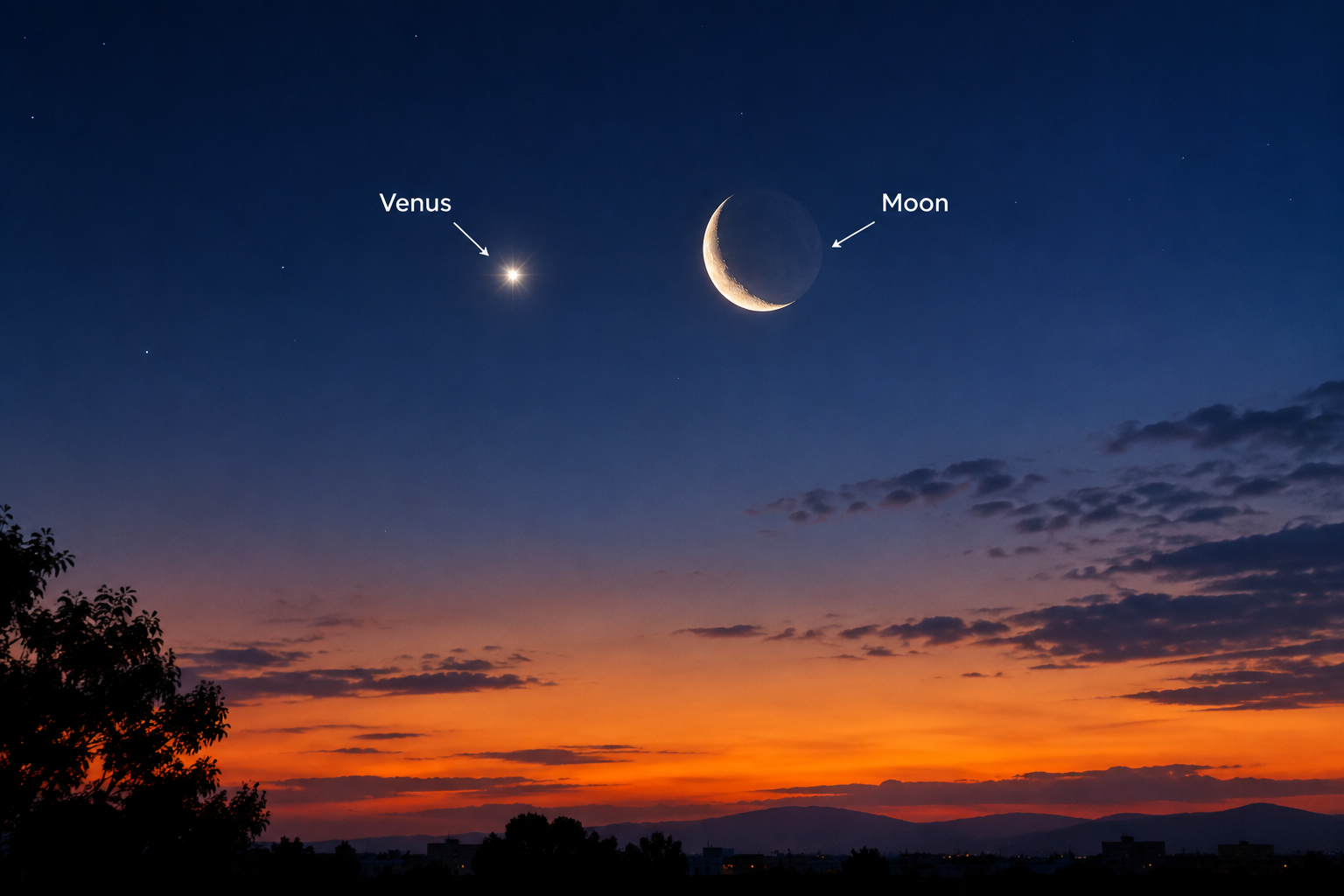
Whenever a bright, steady point of light appears close to the crescent Moon in the evening sky, it stirs a very old kind of curiosity. Is it a star? A satellite? A sign of something? In reality, that brilliant “star” is almost always Venus — the second planet from the Sun, and by far the brightest planet we ever see. In September 2026, sky-watchers across Pakistan, the Middle East, and parts of Europe and Asia witnessed exactly this: the Moon and Venus drawing so close together that in some regions, the Moon actually passed directly in front of Venus, blocking it from view entirely.
What Exactly Is a “Conjunction”?
In astronomy, a conjunction happens when two celestial objects — planets, the Moon, or even distant stars — appear to line up closely with one another as seen from Earth. The important word here is “appear.” A conjunction is a trick of perspective, not a real physical meeting. The two objects might actually be tens of millions of kilometers apart in space; it is only from our specific vantage point on Earth that they seem to sit side by side in the sky.
Because the Moon circles the Earth roughly once every 29.5 days, it sweeps past nearly every visible planet at least once a month. When it happens to pass close to Venus, astronomers call it a Moon–Venus conjunction. Most months this produces a pleasant but modest sight — a slim crescent Moon with a bright dot nearby. Occasionally, though, the alignment is so precise that the Moon’s disc actually covers the planet for a period of time. This rarer and more dramatic event is called an occultation.
Why Does Venus Shine So Brightly?
Venus is often the first “star” people notice after sunset, and the last one visible before sunrise — earning it the ancient nicknames “Evening Star” and “Morning Star.” Its brilliance comes down to three straightforward physical reasons.
1. A Mirror Made of Clouds
Venus is wrapped in a thick, unbroken layer of clouds composed largely of sulfuric acid droplets. These clouds are remarkably reflective, bouncing back roughly seventy percent of the sunlight that hits them. No other major planet reflects sunlight this efficiently, which is a huge part of why Venus appears to gleam rather than merely glow.
2. It’s Right Next Door
Among all the planets, Venus is the one that comes closest to Earth — at its nearest, only about 41 million kilometers separate the two worlds, closer than Mars ever gets. Light intensity fades with distance, so being our nearest planetary neighbor gives Venus a natural advantage in brightness.
3. A Genuinely Large World
Venus is often called Earth’s “twin” for good reason — its diameter is only a few hundred kilometers smaller than our own planet’s. A bigger reflective surface means more sunlight bounced back toward us, adding to its brilliance.
Put these three factors together — a mirror-like atmosphere, close proximity, and generous size — and you get a planet so bright it can occasionally be spotted with the naked eye even in broad daylight, and under a truly dark, clear sky it can cast faint shadows.
The September 2026 Event: What Actually Happened
On 14 September 2026, observers across a wide stretch of the globe were treated to an especially close pairing of the thin crescent Moon and Venus. The exact experience depended heavily on location and timing — in some places it was a simple, beautiful conjunction; in others, it became a full occultation.
| Location | What Was Observed | Key Detail |
|---|---|---|
| Lahore, Pakistan | Close conjunction (evening) | Both bodies visible together around 6:30 PM local time, captured on camera by local photographer Adeel Shafique |
| Jordan | Full occultation | Venus vanished behind the Moon and reappeared roughly 84 minutes later, as documented by the Jordanian Astronomical Society |
| Qassim Region, Saudi Arabia | Daytime occultation | Observed from the Noor Astronomical Observatory; required special caution due to daylight visibility |
| Bahrain | Close evening conjunction | Angular separation of only about 0.6 degrees between the Moon and Venus |
An occultation of this kind is a genuinely rare treat. Observers in Jordan were told they would not see another daytime-visible occultation of Venus until 2032 — a reminder of just how precisely the geometry of the Earth, Moon, and Venus has to line up for such an event to be visible from any one location.
A Crescent Venus? Yes, Really
One of the most delightful surprises for anyone who has viewed this event through a telescope is that Venus itself was in a crescent shape at the time — not just the Moon.
This happens because Venus orbits the Sun on a path inside Earth’s own orbit. Just as the Moon shows us changing phases depending on the angle between the Sun, Earth, and Moon, Venus goes through an identical cycle of phases: full, gibbous, half, crescent, and new. When Venus sits roughly between the Sun and Earth, we see mostly its unlit side, which appears as a slender crescent — visually similar to a young Moon, just much smaller and requiring binoculars or a telescope to appreciate.
Interestingly, Venus actually looks brightest to us during its crescent phase rather than when it is fully lit. The reason is distance: a crescent Venus is also a nearby Venus, tucked in close to Earth on the same side of the Sun. That proximity more than makes up for the smaller illuminated sliver we’re seeing. A “full” Venus, by contrast, sits on the far side of the Sun from us, and the extra distance dims it even though we see its entire sunlit face.
Why Scientists Still Care About These Events
Conjunctions and occultations aren’t just pretty — they carry real scientific value, even in an age of space telescopes and interplanetary probes.
- Testing the models: Astronomers can predict the exact second an occultation will begin and end, sometimes years in advance. When ground observations match those predictions precisely, it confirms just how accurate our orbital models of the Moon and planets really are.
- Studying Venus’s edge and atmosphere: As the Moon’s edge slides across Venus during an occultation, researchers can study subtle changes in the planet’s light — information that helps refine our understanding of its dense atmosphere.
- Sparking public interest: Perhaps the most underrated benefit is simple curiosity. A bright “star” beside the Moon is often the very first thing that makes a person look up, ask a question, and discover a lifelong interest in astronomy.
Venus in Human History and Culture
Long before telescopes existed, Venus held a special place in nearly every civilization that watched the sky. The Babylonians associated it with Ishtar, goddess of love and war. The Greeks linked it to Aphrodite, and the Romans gave it the very name we still use today — Venus, their goddess of love and beauty.
Venus also appears in the astronomical record of the Islamic world, where early scholars referred to it as “Zuhra” or “Najmah” and tracked its movements carefully as part of the broader tradition of Islamic astronomy, which made major contributions to naked-eye observation and calendar-keeping long before the invention of the telescope.
Across many cultures, a close pairing of the Moon and a bright planet was treated as an omen — sometimes favorable, sometimes a warning. Today we understand the mechanics behind these events precisely, but they have lost none of their emotional pull. Standing under the evening sky and watching a slim crescent Moon sit beside a brilliant point of light is still, for most people, a genuinely moving experience.
Common Misconceptions, Cleared Up
“It’s a star that suddenly appeared.”
It isn’t. Stars generate their own light through nuclear fusion, while planets like Venus only reflect sunlight. One easy way to tell them apart with the naked eye: stars twinkle because their light is disturbed by Earth’s atmosphere over a very small point source, while a planet’s light — coming from a much larger, closer, disc-shaped source — tends to shine with a steadier glow.
“The Moon and Venus actually got close to each other.”
Not remotely. The Moon orbits at an average distance of about 384,000 kilometers from Earth. Venus, even at its closest approach, is roughly 40 million kilometers away — about a hundred times farther than the Moon. Their apparent closeness in our sky is purely a matter of viewing angle; in three-dimensional space, they remain enormously far apart.
“This kind of event is extremely rare.”
Close pairings of the Moon and Venus actually happen every month, since the Moon passes near Venus’s position in the sky on a regular cycle. What varies is visibility — sometimes the pairing occurs during daylight hours, sometimes when Venus is too close to the Sun to be seen safely, and sometimes under perfect night-time viewing conditions. A true occultation, where the Moon completely covers Venus, is the genuinely rare part of the story.
How to Spot the Next One Yourself
You don’t need any special equipment to enjoy a Moon–Venus conjunction — just a clear western horizon shortly after sunset (or an eastern one before sunrise, depending on where Venus currently sits in its cycle). A few simple tips make the experience even better:
- Check a stargazing app or astronomy website in advance to confirm the date and the best viewing time for your location.
- Find an open area away from tall buildings or trees near the horizon, since both the Moon and Venus will often be relatively low in the sky.
- Binoculars won’t reveal much extra detail on Venus itself, but they make the pairing look even more striking against the darkening sky.
- If you want to see Venus’s crescent phase, you’ll need a small telescope — even a modest one will reveal that “star” is, in fact, a tiny, glowing sliver of a world.
Frequently Asked Questions
Is the bright “star” next to the Moon always Venus?
Not always, but very often. Venus is by far the brightest planet in our sky, so most of the time a strikingly bright point near the Moon is Venus. Occasionally it can be Jupiter, which is also very bright, so it’s worth double-checking with a stargazing app if you’re unsure.
Can I see a Moon–Venus conjunction with just my eyes?
Yes. Conjunctions are a naked-eye event by nature — no telescope or binoculars are required to enjoy the sight, though optical aid can enhance the experience.
How often does an occultation of Venus happen?
Occultations are far less frequent than simple conjunctions and depend heavily on your specific location. Some regions may wait several years between visible occultations of Venus.
Why does Venus look brightest as a crescent rather than when fully lit?
Because a crescent Venus is also a much closer Venus. Its nearness to Earth during that phase outweighs the fact that we’re only seeing a thin sliver of its illuminated surface.
A crescent Moon and a brilliant point of light beside it may look like a simple, quiet scene — but it’s really a glimpse into a vast, precisely choreographed system that has been in motion for billions of years. Every conjunction is a small, quiet invitation to look up, ask a question, and remember just how much of the universe is still waiting to be understood.