Introduction: The Book No One Can Read
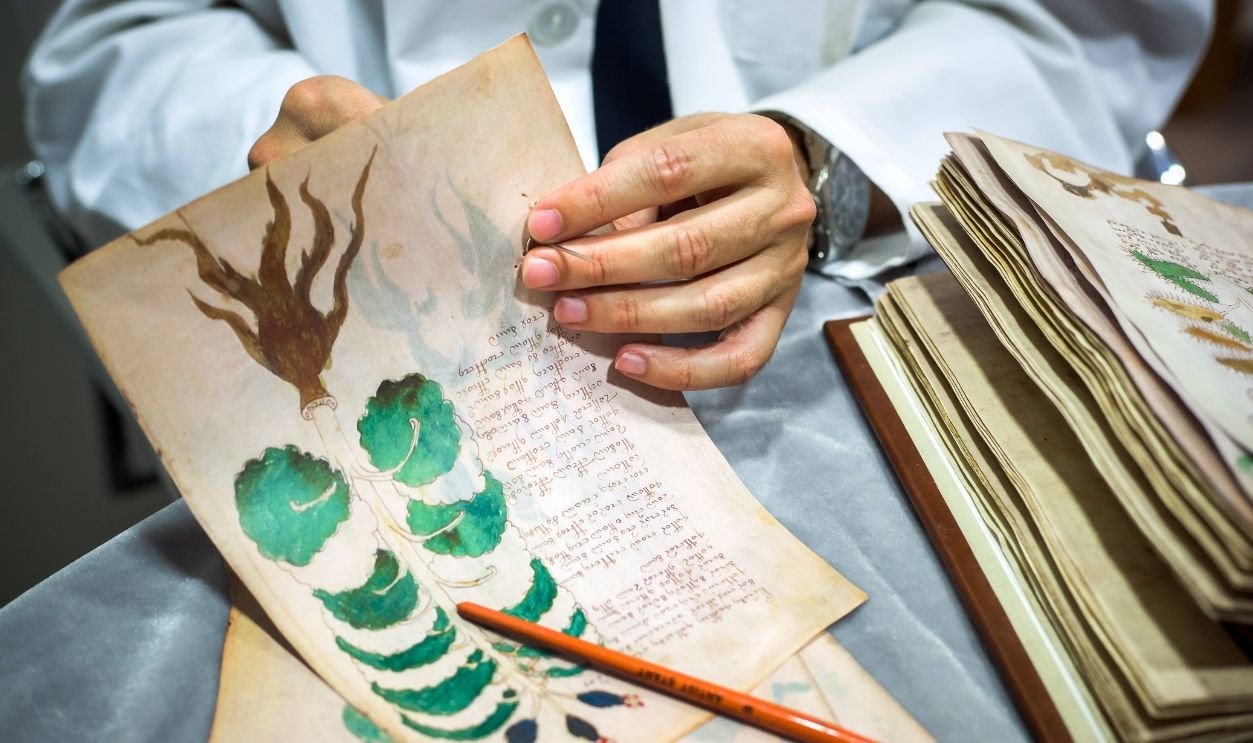
Housed within the Beinecke Rare Book and Manuscript Library at Yale University sits an unassuming 240-page parchment codex filled with mysterious illustrations, unknown botanical drawings, intricate cosmological diagrams, and thousands of lines of an undeciphered script. Known worldwide as the Voynich Manuscript, it represents history’s most famously intractable cryptographic puzzle. It is not merely an antique volume; it is an intellectual wall that has confounded generations of linguists, medievalists, mathematicians, professional military codebreakers, and computer scientists for centuries.
The manuscript entered modern historical consciousness in 1912 when Polish antiquarian book dealer Wilfrid Voynich acquired it from a Jesuit college at the Villa Mondragone in Italy. Radiocarbon dating conducted by the University of Arizona systematically determined that the vellum pages were created in the early 15th century, specifically between 1404 and 1438. Yet, despite physical authentication confirming its late medieval provenance, the author’s identity, the purpose of the work, and the underlying linguistic system or cipher remain totally unresolved.
Codicology and Structural Layout of the Manuscript
Physical and paleographic analysis reveals that the Voynich Manuscript was constructed with meticulous care, displaying a clear internal layout despite its unintelligible text:
- Character Set and Script: The text is composed of an alphabet consisting of 20 to 25 distinct glyphs or characters, written in a smooth, fluid hand from left to right. The script exhibits no visible corrections or erased mistakes, suggesting the scribe wrote with exceptional fluency in the chosen cipher or language.
- Illustrative Categorization: Based on the subject matter of the colored drawings, scholars traditionally divide the manuscript into five primary thematic sections:
- Herbal: Depictions of strange, often unidentifiable plants, root systems, and leaves, accompanying structured blocks of explanatory text.
- Astronomical and Astrological: Fold-out diagrams featuring circular charts, suns, moons, and zodiacal symbols accompanied by miniature figures.
- Balneological/Biological: Drawings of nude female figures bathing in interconnected pools and intricate networks of green tubes or fluid conduits.
- Cosmological: Circular diagrams depicting complex geometric networks, maps, or cosmic structures.
- Pharmaceutical: Detailed drawings of plant parts (roots, leaves) next to apothecary jars or vessels, followed by short, recipe-like paragraphs.
- Textual Organization: The overall structure mirrors classical medieval scientific or medical compendiums. Paragraphs are neatly formatted with regular margins, decorated initials, and structured line breaks that mimic natural human syntax and grammar.
Cryptanalytic Challenges: Why Has the Code Resist Decipherment?
The failure of modern cryptanalysis to decode the Voynich Manuscript stems from several unique structural properties:
- Absence of Linguistic Relatives: The script lacks clear phonetic or structural equivalence to any known spoken or written human language. Character combinations do not cleanly align with Latin, Greek, Hebrew, or medieval European vernaculars.
- Possibility of a Constructed Language: Some researchers hypothesize that the text represents an artificial or synthetic language (an early a priori language) created by a medieval scholar to record secret knowledge, lacking natural linguistic evolution.
- The Hoax Theory versus Structural Consistency: Skeptics have long argued that the manuscript is a 15th-century forgery created to sell to medieval royals for profit. However, statistical analysis reveals that the text exhibits Zipf’s Law—a mathematical property characteristic of natural languages regarding word frequency distribution—making a simple random nonsense forgery highly improbable.
- Complex Polyalphabetic Ciphers: If encoded, the text likely utilizes multi-layered substitution ciphers, arbitrary abbreviations, or steganographic transposition techniques that disrupt traditional frequency analysis.
Modern Analytical Perspectives: Artificial Intelligence and Statistical Linguistics
Computational Linguistics and Information Entropy
In recent years, researchers have applied advanced natural language processing (NLP) and machine learning models to analyze the manuscript’s underlying structure. Computational studies measuring Information Entropy (the measure of randomness or predictability in text) show that the Voynich script possesses entropy rates nearly identical to natural languages like English, Latin, or Mandarin, proving that the word patterns are highly organized and carry real structural information rather than arbitrary character strings.
Statistical Correlations with Ancient Languages
Quantitative analyses comparing character repetition and word length distributions have shown statistical correlations between “Voynichese” and monosyllabic or tonal languages, including East Asian and Uto-Aztecan dialects, as well as medieval Hebrew shorthand. However, translating these statistical correlations into a coherent, readable text remains an elusive challenge.
Prominent Interpretive Theories
- Theory 1: An Esoteric Medieval Medical or Herbal Codex: The most widely supported historical theory posits that the book is a confidential medical or pharmacological manual detailing botanical remedies, women’s health practices, and alchemical preparations encoded to protect proprietary medical knowledge from religious persecution or rival practitioners.
- Theory 2: An Extinct or Unwritten Vernacular: Some linguists argue the text preserves a rare, unwritten regional dialect or an isolated language from Eastern Europe, the Caucasus, or Asia, transcribed phonetically into a custom-designed alphabet.
- Theory 3: An Advanced Cipher System: Crypto-historians suggest the text was created using a sophisticated substitution system utilizing a cipher wheel or grid matrix, where single words in the original language were converted into multi-character “words” in the manuscript.
- Theory 4: An Elaborate Historical Hoax: A persistent minority view maintains that a clever renaissance artisan created the manuscript as a high-value curiosity using random character generation tricks, though its linguistic consistency makes this theory difficult to prove entirely.
Conclusion: The Enduring Legacy of the Voynich Manuscript
The Voynich Manuscript remains one of the greatest unsolved mysteries in human history. For over six centuries, its pages have guarded their secrets against the combined efforts of medieval scholars, Renaissance alchemists, World War II codebreakers, and modern supercomputers.
Whether it eventually proves to be a lost medical treatise, an elaborate cryptographic exercise, or a window into an unknown cultural language, the manuscript continues to serve as a profound reminder of the limits of human knowledge and the enduring fascination of the unsolved.