Introduction: A Two-Century Quest for a Legendary Treasure
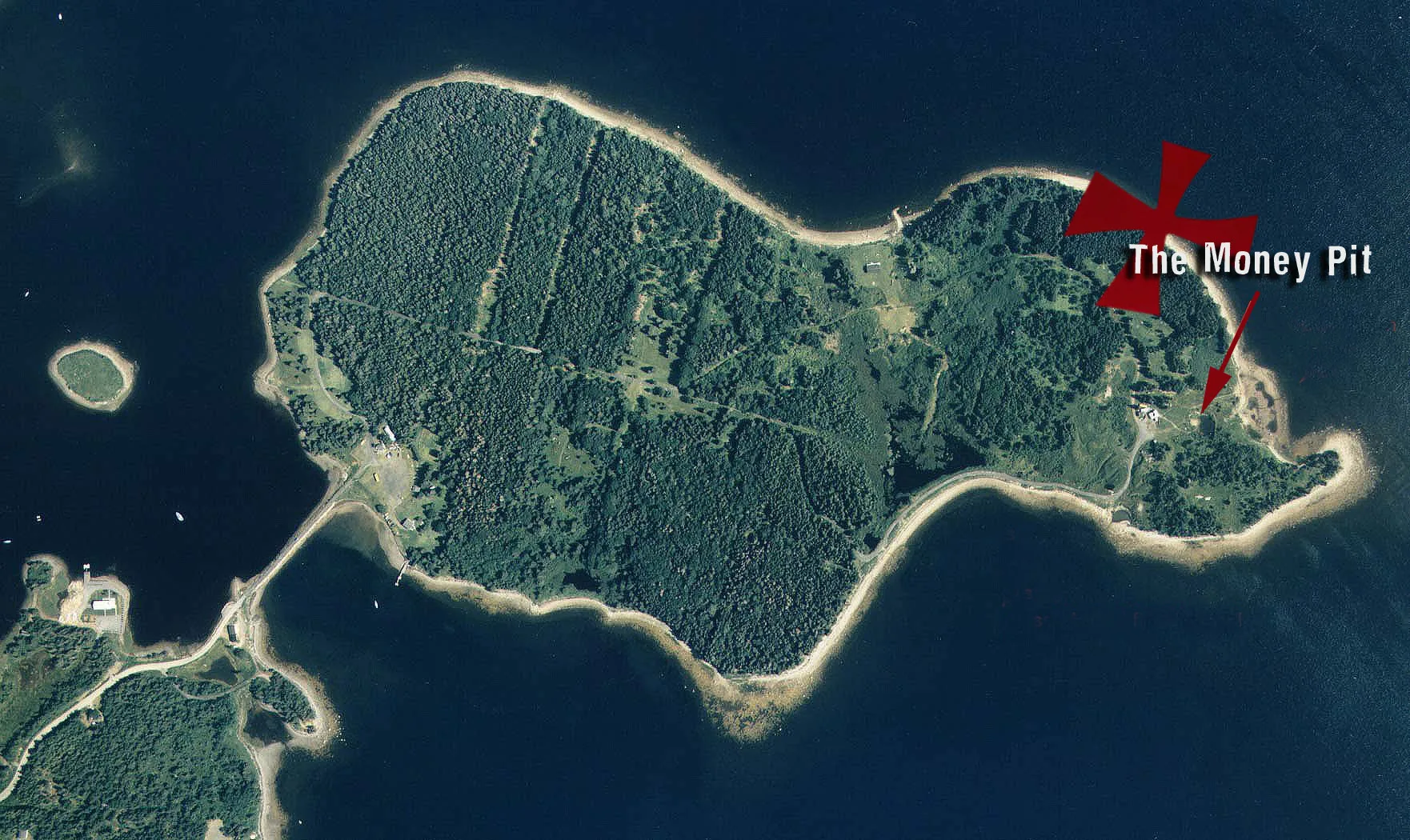
Situated off the coast of Nova Scotia, Canada, a small landmass known as Oak Island has captivated the imaginations of treasure hunters, historians, and researchers for more than two centuries. At the center of this enduring intrigue is a mysterious subterranean excavation known as the “Money Pit”—a complex, deeply engineered shaft rumored to conceal vast historic wealth that has eluded recovery efforts despite relentless exploration.
The saga began in the summer of 1795, when a local youth named Daniel McGinnis discovered a notable depression in the ground beneath the limb of a large oak tree. Intrigued by the site, McGinnis returned with two companions to excavate the depression. At regular ten-foot intervals, the youths encountered layers of flagstones, wooden platforms, and packed clay. Unable to proceed beyond a depth of approximately 30 feet without heavier equipment, they suspended operations. That initial discovery marked the birth of the Oak Island Money Pit mystery—an enterprise that would evolve over two centuries into one of the longest-running treasure hunts in recorded history.
Two Centuries of Excavation: The Evolution of the Money Pit
19th Century: Early Companies and Structural Obstacles
Following the 1795 discovery, formal commercial syndicates stepped in to finance deeper excavations. In 1804, the Onslow Company resumed work, digging down to roughly 90 feet. At this level, excavators reportedly recovered a large, flat stone bearing strange carved symbols and cipher inscriptions. Shortly after discovering a wooden platform at the 98-foot mark, the shaft suddenly flooded with hundreds of gallons of seawater.
Subsequent investigations revealed that the flooding was not caused by a natural spring, but rather by an engineered hydraulic booby trap: a series of covered flood tunnels running from nearby Smith’s Cove that fed seawater directly into the Money Pit whenever excavators breached specific depth thresholds. In 1849, the Truro Company launched an organized campaign, employing core drills that brought up oak wood fragments, links of gold chain, and clay layers before the shaft again collapsed under water pressure. In the 1860s, additional attempts by the Oak Island Association failed to bypass the flood tunnels, despite erecting extensive cofferdams along the beach.
20th Century: Heavy Industrial Engineering and High-Profile Interest
The Money Pit continued to attract notable figures throughout the 20th century. In 1909, Franklin D. Roosevelt—prior to his presidency—joined the Old Gold Salvage Group as an investor and visited the island to observe drilling operations, though the effort yielded no recovery. During the 1930s, industrialist Gilbert Hedden utilized heavy machinery, steam pumps, and high-capacity drills to clear secondary shafts, discovering timber infrastructure and old iron tools at depth before water infiltration halted operations in 1938.
By 1965, heavy excavator Robert Dunfield attempted a massive open-pit excavation using a 70-ton crane, digging a crater 100 feet wide and 140 feet deep. While the operation uncovered old wooden beams and historic metal artifacts, the collapse of the shaft walls and continuous seawater intrusion forced the project to close without locating a central vault. Subsequent 1990s sonar and borehole camera investigations by Triton Alliance identified anomalies at depths below 150 feet, which researchers named “10-X” and the “Queen’s Vault,” though turbid water and structural collapses prevented physical verification.
21st Century: Global Media and High-Tech Explorations
Interest in the island reached an unprecedented global audience following the 2014 premiere of the reality television series “The Curse of Oak Island” on the History Channel, spearheaded by brothers Rick and Marty Lagina. Utilizing modern engineering methods—including large-diameter steel caissons, core drilling arrays, and ground-penetrating radar—the team systematically explored the Money Pit area and Smith’s Cove.
Between 2021 and 2023, excavations focusing on the “Garden Shaft” uncovered hand-hewn timbers radiocarbon-dated to the 17th century, along with 17th-century coinage, historic leather artifacts, and iron fasteners. By 2025, after more than 200 distinct excavation attempts and an estimated cumulative expenditure exceeding $100 million across various syndicates over two centuries, the definitive recovery of a central treasure vault remains unconfirmed.
Prominent Theories Surrounding the Origin of the Money Pit
Numerous hypotheses have been formulated to explain the origin and purpose of the Money Pit, ranging from documented naval history to esoteric speculation:
- Privateer and Pirate Hoards: Early theories attributed the site to famous 16th- and 17th-century privateers or pirates, including Sir Francis Drake, Captain William Kidd, or Blackbeard (Edward Teach). Proponents suggest the island served as an isolated, secure staging ground to deposit captured Spanish treasure galleon cargoes.
- Royal French Military Holdings: Another historical hypothesis links the site to the French military garrison at the Fortress of Louisbourg during the Seven Years’ War. It posits that French engineers concealed the fortress treasury on Oak Island to prevent its capture by British forces during the 1758 siege.
- The Knights Templar and Sacred Relics: A widely popularized theory suggests that remnants of the Knights Templar—or associated esoteric European orders—transported historic cultural artifacts, religious relics, or manuscript archives to North America centuries prior to European colonization, constructing the elaborate flood tunnels as a permanent sanctuary.
- Baconian and Shakespearean Manuscripts: Alternative theories advocate that Sir Francis Bacon or Elizabethan scholars engineered the subterranean vault to preserve historical manuscripts, original literary works, or secret records away from European conflicts.
- Decoy or Military Supply Depot Hypothesis: Recent skeptical analyses suggest that the Money Pit may not have been designed to store treasure at all, but rather functioned as a military tar kiln, naval supply cache, or strategic engineering decoy designed to distract rival naval powers during 18th-century colonial conflicts.
Evaluating the Evidence: Scientific Arguments For and Against
Arguments Supporting an Engineered Structure
- Demonstrated Hydraulic Engineering: Physical excavations at Smith’s Cove revealed coconut fiber layers, clay packing, and stone drain structures that served as natural filters for the flood tunnels, demonstrating intentional, large-scale hydraulic engineering designed to prevent unauthorized excavation.
- Radiocarbon-Dated Timbers and Artifacts: Scientific testing of wood samples recovered from deep shafts confirms hand-hewn oak structures dating to the 16th, 17th, and 18th centuries—substantially preceding the recorded 1795 discovery date.
- Targeted Metal and Water Analysis: Recent water sampling from deep boreholes revealed elevated trace concentrations of silver, gold, and copper, indicating the potential presence of metallic deposits or historical artifacts deep within the subterranean water table.
Skeptical and Geological Counter-Arguments
- Natural Sinkhole Formations: Geologists note that Oak Island’s subsurface geology consists of limestone and anhydrite formations prone to natural karst topography. Natural dissolution can cause deep collapse sinkholes that accumulate surface debris, trees, and flood naturally with seawater, mimicking man-made shafts.
- Absence of Primary Documented Treasures: Despite two centuries of heavy industrial drilling, soil turning, and caisson placement, no single major chest, bullion hoard, or documented primary treasure vault has been recovered to date.
- Historic Industrial or Naval Operations: Critics propose that timber structures and stone platforms recovered at depth could be the remains of early colonial pine-tar kilns, salt-works, or naval repair facilities rather than a treasure vault defense system.
Why the Oak Island Myth Persists
The enduring legacy of Oak Island relies on a combination of cultural, historical, and psychological factors:
- Universal Appeal of Unsolved Mysteries: The narrative of a hidden, highly protected treasure protected by ancient traps directly appeals to fundamental human curiosity and the spirit of exploration.
- Fragmentary Scientific Clues: The sporadic discovery of genuine historical artifacts—such as 17th-century coins, gold links, and ancient leather—keeps interest alive by offering just enough physical evidence to validate further investigation.
- Modern Media Amplification: Television broadcasting and modern digital media have converted a regional mystery into a global phenomenon, providing continuous funding and advanced industrial resources for modern searchers.
Modern Scientific Methodologies and Contemporary Outlook
Recent work on Oak Island has shifted away from unguided digging toward non-destructive geophysical analysis. The integration of 3D seismic surveying, sonic drilling, core sampling, and environmental DNA (eDNA) testing allows researchers to map the island’s deep subsurface structures without causing further collapse of historical layers.
In recent assessments, lead searchers on the island acknowledged that while a traditional chest of gold has not been lifted from the Money Pit, the ongoing historical investigation has successfully uncovered a rich, unexpected history of pre-1795 human activity, complex engineering, and transatlantic maritime trade on Oak Island.
Conclusion
The Money Pit of Oak Island remains one of the most intriguing mysteries in North American history. Over 200 years of exploration, millions of dollars in investment, and generations of searchers have turned a small Nova Scotia island into a symbol of human perseverance and curiosity.
Whether the Money Pit ultimately proves to be a elaborate treasure vault, an early military engineering site, or a natural geological feature modified by early settlers, its true legacy lies in the history it continues to reveal. As long as questions remain buried beneath the soil of Oak Island, the search for answers will endure.