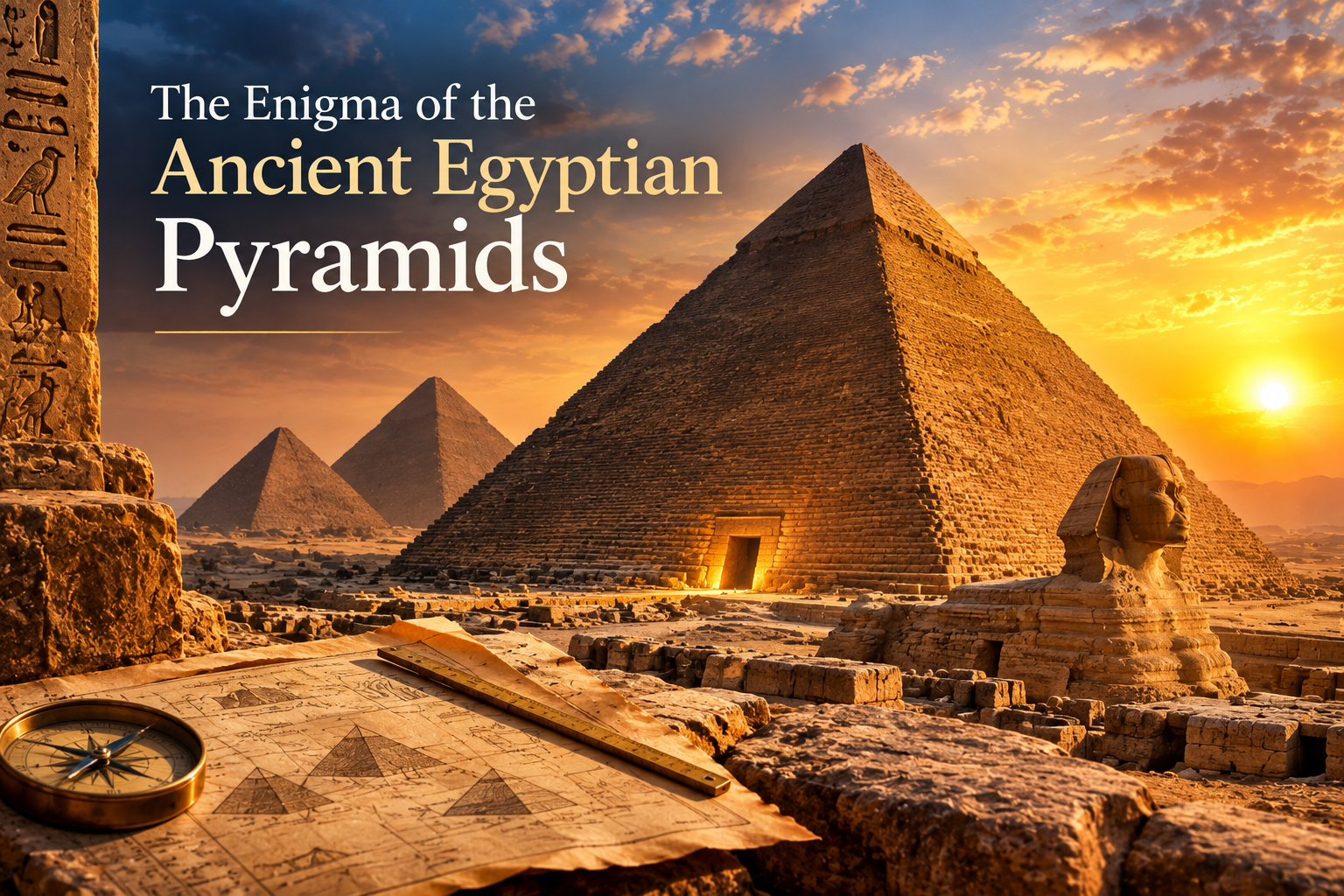
Introduction: The Last Surviving Wonder
Approximately 4,500 years ago—while Stonehenge was still being erected in Britain and much of the global population lived in Stone Age conditions—an extraordinary engineering achievement unfolded in the Egyptian desert. Centuries passed, the Roman Empire rose and fell, the Industrial Revolution transformed civilization, and humanity set foot on the Moon. Yet, standing today on the Giza Plateau, those same pyramids endure: silent, majestic, and immortal observers of human history.
As the sole surviving entry among the Seven Wonders of the Ancient World, the Great Pyramids represent both an unparalleled architectural triumph and an enduring historical puzzle. While modern research has dramatically expanded our understanding of these ancient monuments, every breakthrough continues to raise compelling new questions. This article provides a comprehensive overview of the mysteries surrounding the Egyptian pyramids—their construction techniques, their intended purposes, and the latest subterranean discoveries revealed by modern science.
How Were the Pyramids Built? The Mysteries of Ancient Engineering
The central question surrounding the Pyramids of Giza is how ancient builders managed to quarry, transport, and stack roughly 2.3 million stone blocks—weighing an average of 2.5 tons each, with some reaching up to 70 tons—into a structure standing 146 meters tall. This monumental task has challenged engineers and architects across generations.
The Traditional Theory: External Earthen Ramps
For decades, orthodox Egyptology proposed that the builders constructed massive ramps made of mudbrick, limestone dust, and rubble to haul the blocks up as the pyramid rose. However, this hypothesis faces critical structural and logistical limitations:
- Physical Limitations: Pulling massive stone blocks up an incline requires overcoming both gravity and friction. To maintain a manageable incline angle (around 5.7 degrees), a straight ramp would need to extend nearly 1.5 kilometers, requiring a volume of material larger than the pyramid itself.
- Spatial Constraints: The topography of the Giza Plateau lacks the physical space required for such colossal external ramps.
- Lack of Archaeological Evidence: Excavations have revealed no remnants of the massive earthen debris that such giant ramp systems would have left behind.
Innovative Models: Modular Counterweight Crane Systems
Recent engineering analyses propose an innovative alternative model that addresses the shortcomings of traditional ramps. Researchers suggest that ancient Egyptians utilized a system of modular, wooden lifting devices arrangeable along vertical lanes on the pyramid’s stepped tiers.
Operating on fundamental principles of counterweights, leverage, and mechanical advantage, these lifting rigs employed wooden beams, heavy ropes, and counterbalancing stones to raise blocks vertically tier by tier. This model offers several compelling advantages:
- It relies exclusively on verified materials available in ancient Egypt: timber, hemp ropes, limestone weights, and copper tools.
- Multiple parallel lifting lanes (up to 24 operational lines) could work simultaneously, making the placement rate of 200–250 blocks per day mathematically achievable.
- It provides a functional explanation for mysterious artifacts found at historical sites, such as quarter-circle wooden rockers and proto-pulley apparatuses. Modern engineering reconstructions have demonstrated that small teams using these simple mechanisms can easily hoist multi-ton blocks several meters in seconds.
These findings reinforce the conclusion that extraordinary alien technology or mythical forces were never required: the pyramids were the product of brilliant human intelligence, rigorous organizational logistics, and refined mechanical engineering principles.
Uncovering Hidden Spaces: Breakthroughs in Non-Invasive Technology
While the construction methods remain a fascinating topic, discovering what lies hidden inside these stone monuments presents an equally thrilling frontier. Modern non-invasive imaging techniques now allow scientists to peer through solid rock without altering the ancient structures.
Muon Tomography: Imaging with Cosmic Rays
In 2017, the international ScanPyramids project achieved a major breakthrough by confirming a massive hidden space—dubbed the “Big Void”—located above the Grand Gallery inside the Great Pyramid of Khufu. This discovery was made using muon radiography, a technique that tracks elementary particles generated when cosmic rays hit Earth’s upper atmosphere.
Because muons pass easily through stone but scatter differently depending on material density, detectors placed inside and around the pyramid mapped the interior structure. The data revealed a void at least 30 meters long, marking the first major structural discovery inside the Great Pyramid since the 19th century.
Recent Cavity Discoveries in the Pyramid of Menkaure
Advanced non-destructive survey methodologies have continued to yield extraordinary insights. High-resolution non-invasive testing—combining Ground-Penetrating Radar (GPR), electrical resistivity tomography, and ultrasound—identified previously unknown chambers and anomalous voids behind the polished granite casing on the eastern facade of the Pyramid of Menkaure (the smallest of the three main Giza pyramids).
The identification of these subsurface cavities supports long-standing hypotheses that the internal architecture of Menkaure’s pyramid features secondary corridors or unexcavated functional chambers, demonstrating that Giza’s monuments still contain unexplored spaces.
Purpose and Symbolism: Monumental Tombs vs. Alternative Claims
Religious Cosmology: Staggered Architecture to the Stars
In mainstream Egyptology, the pyramids were not merely mausoleums; they served as profound theological and cosmic monuments. According to the Pyramid Texts of the Old Kingdom, the stepped and sloped sides of the pyramid represented frozen rays of the sun, serving as a monumental staircase for the deceased Pharaoh’s soul to ascend into the heavens and join the imperishable stars.
Furthermore, the astronomical alignment of the Giza complex reflects deliberate solar geometry. On the summer solstice, an observer positioned at the Sphinx sees the sun set precisely between the silhouettes of the Pyramids of Khufu and Khafre, forming the sacred hieroglyph Akhet (representing the horizon). The entire complex was engineered as a harmonious ritual landscape linking the terrestrial realm with the heavens.
Alternative Hypotheses: Electromagnetic and Underground Networks
In contrast to the consensus among Egyptologists, alternative researchers have proposed technological hypotheses, suggesting the Great Pyramid functioned as a acoustic resonance chamber or piezoelectric energy generator capable of harvesting seismic vibrations.
Subsequent satellite radar studies and subsurface surveys conducted by independent international teams have reported extensive anomalies and potential limestone cavern systems beneath the Giza Plateau at considerable depths. However, geologists point out that the underlying Mokattam limestone formation naturally features vast networks of natural karst caves, sinkholes, and solution channels. Without direct archaeological excavation, claims of artificial underground complexes remain unverified hypotheses.
The Search for the Lost Tombs and Future Excavations
The quest to locate the definitive burial sites and intact royal treasures of the Old Kingdom pharaohs remains active. Modern field projects utilize non-invasive geophysical mapping around the periphery of the Giza Plateau, searching for unrecorded shafts, subterranean corridors, and sealings that may lead to undisturbed royal tomb complexes similar to the discovery of Tutankhamun’s tomb in the Valley of the Kings.
With Egypt’s Supreme Council of Antiquities supervising non-destructive field surveys, the combination of sub-surface radar imaging and targeted remote-operated micro-cameras promises to answer centuries-old questions regarding the precise locations of royal burials without damaging the structural integrity of these world heritage sites.
Conclusion: An Enduring Monument to Human Curiosity
The Pyramids of Giza remain a captivating, open chapter in the book of human history. Each advancement in modern technology—from cosmic ray detectors to advanced computer modeling—gives us a clearer view of these ancient structures while revealing deeper layers of complexity.
Whether viewed as supreme achievements of ancient engineering, profound symbols of solar theology, or enduring mysteries waiting to be fully deciphered, the pyramids continue to inspire awe. Their greatest legacy is perhaps the way they challenge our understanding of the past, compelling us to continuously push the boundaries of science and exploration in search of answers.