Introduction: A Legend Preserved for Two Millennia
In his seminal Socratic dialogues Timaeus and Critias, the classical Greek philosopher Plato first introduced the world to an island power he designated as Atlantis. According to his written accounts, this advanced and formidable empire existed approximately 9,000 years prior to his own era (roughly 11,600 years before the present day). Plato described Atlantis as a dominant thalassocracy that commanded vast naval routes, governed extensive territories, and projected unmatched geopolitical force across the known Mediterranean world. However, as the narrative unfolds, a catastrophic sequence of earthquakes and deluges submerged the entire landmass into the depths of the Atlantic Ocean in a single day and night of ruin, erasing its physical presence from human geography.
For more than two and a half millennia, Plato’s account has stood as one of the most enduring intellectual enigmas in world history. Was the chronicle of Atlantis merely an allegorical parable designed to illustrate philosophical principles regarding civic virtue and hubris? Or does it retain an underlying core of genuine Bronze Age historical reality, distorted over centuries of oral transmission? This comprehensive investigation explores the primary textual narrative, evaluates candidate geographic locations using modern scientific methodologies, and assesses how contemporary underwater archaeology, geology, and historical analysis approach this legendary lost empire.
The Platonic Account: Textual Foundation and Narrative Structure
Plato (c. 427–347 BCE) formally detailed the legend of Atlantis across two interconnected philosophical works: the Timaeus and the uncompleted Critias. Within these texts, Plato constructs a framing mechanism attributing the story to his ancestor Solon, the revered Athenian lawmaker. Solon reportedly acquired the historical account during his travels to Egypt in the early 6th century BCE, specifically from the sacerdotal records preserved by Egyptian priests in the city of Sais who maintained written archives stretching back thousands of years.
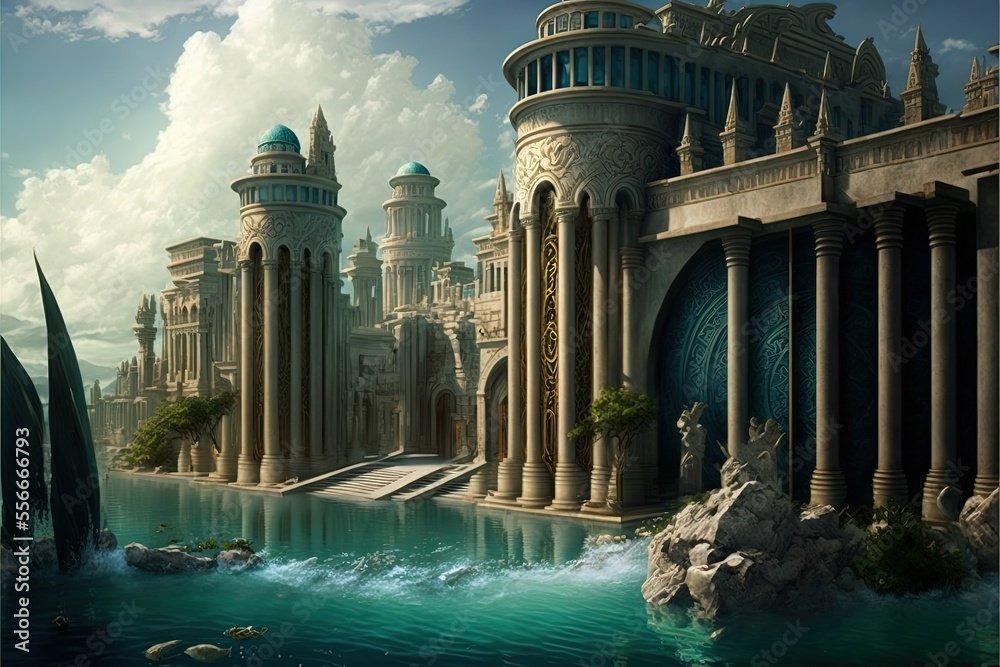
According to the detailed descriptions in Critias, the capital city of Atlantis was an architectural marvel constructed from quarried stones of red, white, and black hues. The metropolis was engineered in a series of perfectly concentric rings of alternating land and water channels, interconnected by wide, subterranean canal networks that allowed naval vessels to navigate directly to the inner citadel. At the center of this ringed city sat a fortified hill hosting a grand temple dedicated to Poseidon, the patron deity of the island. The temple was clad in precious metals, including silver, gold, and a glowing metallic alloy known as orichalcum. The imperial dockyards were vast, capable of housing and outfitting a fleet of 1,200 warships alongside an extensive commercial merchant marine.
At its geopolitical zenith, the Atlantean empire expanded its dominion across vast regions, subjugating parts of Western Europe and North Africa as far as Libya and Tyrrhenia. However, as generations passed, the divine lineage of the Atlantean ruling class became diluted by human frailty. The civilization degenerated into materialism, imperial aggression, and tyrannical arrogance. In response to their moral decay, the divine council decreed severe retribution: “In a single day and night of misfortune, violent earthquakes and floods engulfed the island, and Atlantis sank beneath the sea, leaving behind an impassable barrier of shallow mud.”
Geographic Candidates: Evaluating Proposed Locations
Plato explicitly situated Atlantis “beyond the Pillars of Hercules,” referencing the Strait of Gibraltar that marks the boundary between the Mediterranean Sea and the open Atlantic Ocean. This geographic marker has inspired hundreds of hypotheses over the centuries, placing the lost civilization in locations spanning the globe. Below is a rigorous analysis of key candidate sites proposed by researchers and historians.
1. The Siberian Freshwater Basin Hypothesis
In 2023, researcher Geo Wang proposed a controversial hypothesis suggesting that Atlantis was originally located in Siberia near an ancient, high-altitude freshwater lake system rather than a traditional ocean basin. This perspective reinterprets classical translations, arguing that terms translated as “ocean” or “sea” in Platonic Greek could originally refer to vast inland water bodies or impassable marshlands. Proponents of this view cite local ecological indicators, including ancient freshwater marine life adaptations (such as isolated freshwater shark species in Asian lake systems), as potential evidence of dramatic landlocked hydrological shifts.
Despite its novel approach, the Siberian hypothesis remains highly speculative within the academic community. It relies on non-standard linguistic re-interpretations of classical Greek texts and lacks supporting archaeological artifacts, structural remains, or geological evidence demonstrating a sophisticated Bronze Age urban civilization in prehistoric Siberia.
2. The Sardinian Nuragic Civilizational Hypothesis
In 2024, cultural heritage specialists and archaeologists focusing on the Western Mediterranean proposed that the Atlantis myth was heavily inspired by the prehistoric Nuragic civilization of Sardinia or an allied Western Mediterranean maritime culture.
Proponents point out that Sardinia was home to a sophisticated, highly organized megalithic society that constructed over 8,000 monumental stone towers (nuraghi) alongside complex sacred well-temples and fortified villages during the Bronze Age. According to this theory, ancient Egyptian or early Mycenaean traders encountered this powerful, megalithic maritime culture, and its impressive engineering feats were gradually mythologized and exaggerated through centuries of oral storytelling.
Furthermore, researchers investigating submerged coastal structures point to natural geological formations and prehistoric submerged land bridges near Sardinia and the Strait of Sicily (comparable in popular speculation to the submerged stone pavements of the Bimini Road in the Bahamas). These submerged coastal features demonstrate that rising post-glacial sea levels inundated significant coastal settlements across the Mediterranean basin, providing a historical basis for catastrophic flooding myths.
3. The Minoan Civilization and the Thera Eruption
The Minoan Hypothesis represents the most scientifically robust and widely accepted historical explanation among mainstream classicists and archaeologists. This theory posits that the Atlantis narrative is a historical memory of the advanced Minoan civilization centered on Crete, which was devastated by the catastrophic cataclysm of the Thera (Santorini) volcanic eruption around 1600 BCE.
The evidence supporting this hypothesis is extensive and structurally sound:
- Architectural and Cultural Parallels: The Minoans possessed a sophisticated, highly prosperous maritime trading empire with extensive commercial networks linking Greece, Egypt, and the Levant. Minoan palaces—such as Knossos—featured advanced multi-story architecture, complex indoor plumbing, sophisticated drainage systems, and vibrant multi-colored frescoes that closely match Plato’s descriptions of Atlantean wealth.
- The Thera Cataclysm: The eruption of the Thera volcano was one of the most violent explosive volcanic events in human history (VEI 7). The eruption generated massive regional tsunamis exceeding 100 feet in height, blanketed the Eastern Mediterranean in toxic ash, collapsed coastal ports, disrupted agricultural cycles, and critically weakened Minoan maritime supremacy, paving the way for Mycenaean conquest.
- Chronological and Numerical Calibration: Historical linguists note that if the Egyptian numerical symbol for “hundreds” was mistranslated as “thousands” during oral transmission or transcription, Plato’s timeline of 9,000 years before Solon shifts to precisely 900 years before Solon. This adjustment aligns the destruction of Atlantis directly with the collapse of Minoan maritime power following the Thera eruption around 1600 BCE.
Because this model relies strictly on verified archaeological remains, geological core samples, and established historical events without invoking supernatural phenomena, it remains the leading scientific candidate for the origin of the legend.
4. Lost Civilizations in the Red Sea Basin
Alternative theories have occasionally proposed candidate sites along the Red Sea coast, arguing that ancient trade routes between Egypt, the Arabian Peninsula, and the Horn of Africa host submerged prehistoric coastal settlements. Proponents suggest that tectonic activity along the Red Sea Rift led to localized coastal submergence events that fed into regional folklore.
However, this hypothesis directly contradicts Plato’s explicit geographical placing of Atlantis outside the Pillars of Hercules (the Strait of Gibraltar) and lacks empirical archaeological support linking submerged Red Sea features to an advanced urban empire matching the Platonic description.
Archaeological Challenges and Modern Survey Methodologies
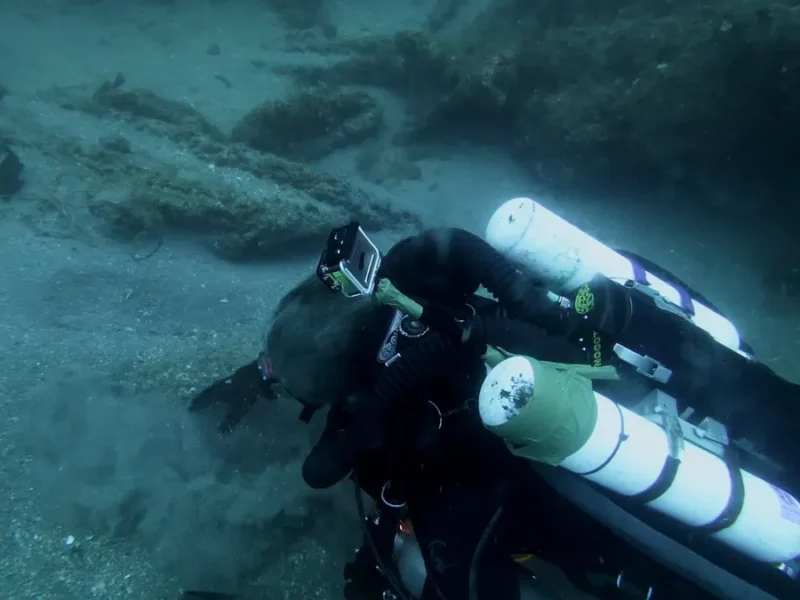
Despite centuries of intensive exploration, no definitive physical evidence or archaeological site has been conclusively identified as the lost city of Atlantis. Modern marine archaeology approaches the search through rigorous scientific constraints:
- Absence of Primary Cartographic or Structural Blueprints: Plato’s accounts provide vivid philosophical descriptions but lack precise cartographic coordinates or verifiable engineering schematics, leaving room for endless geographic speculation.
- Limitations of Bathymetric and Oceanographic Surveying: While satellite altimetry and high-resolution multibeam sonar have mapped the global ocean floor at macro-scales, vast areas of the deep seabed remain unexamined at the fine resolutions required to detect submerged urban ruins buried beneath millennia of marine sediment and coral growth.
Philosophical, Allegorical, and Moral Dimensions
A majority of classical scholars and historians argue that Atlantis was never intended to be understood as a literal historical city. Rather, Plato constructed Atlantis as an allegorical moral fable—a philosophical thought experiment designed to contrast his ideal, virtuous state (represented by ancient prehistoric Athens in the dialogue) against a wealthy, hubristic empire that corrupted its own ideals through imperial overreach.
This moral warning was acutely relevant to 4th-century BCE Athens. Plato was writing in the aftermath of the Peloponnesian War, a devastating conflict in which the Athenian maritime empire, driven by imperial ambition and arrogance, suffered a humiliating defeat against Sparta. By depicting the total annihilation of Atlantis, Plato delivered a stark warning to his contemporaries regarding the inevitable fate of any society that prioritizes wealth, military conquest, and material power over moral integrity and civic virtue.
Conclusion: The Legacy of Atlantis
The mystery of Atlantis has captivated the human imagination for over two thousand years. While no submerged megalithic city matching Plato’s exact concentric layout has ever been discovered, scientific consensus strongly leans toward the view that the legend was inspired by real Bronze Age cataclysms—most notably the catastrophic decline of the Minoan civilization following the Thera eruption, augmented by Plato’s philosophical framework.
Unless future deep-sea archaeological surveys uncover indisputable structural and epigraphic evidence of a vast ringed city lying beneath marine sediment, Atlantis will remain a powerful cultural myth and philosophical allegory.
Ultimately, the core message of Atlantis remains timeless: societies that succumb to arrogance, unchecked greed, and environmental negligence risk their own collapse. Whether viewed as an actual historical tragedy or a brilliant philosophical parable, the story of Atlantis continues to invite reflection on the fragile nature of human civilization.