Introduction: The Mystery of a Bright Star
Whenever a bright star appears to shine near the Moon across the vastness of the sky, the curiosity inherent in human nature awakens. What is it? Is it a star that has suddenly appeared? Is it a spacecraft? Or is it a message from the universe? The truth is that this bright “star” is not actually a star at all, but Venus, the brightest planet in our Solar System.
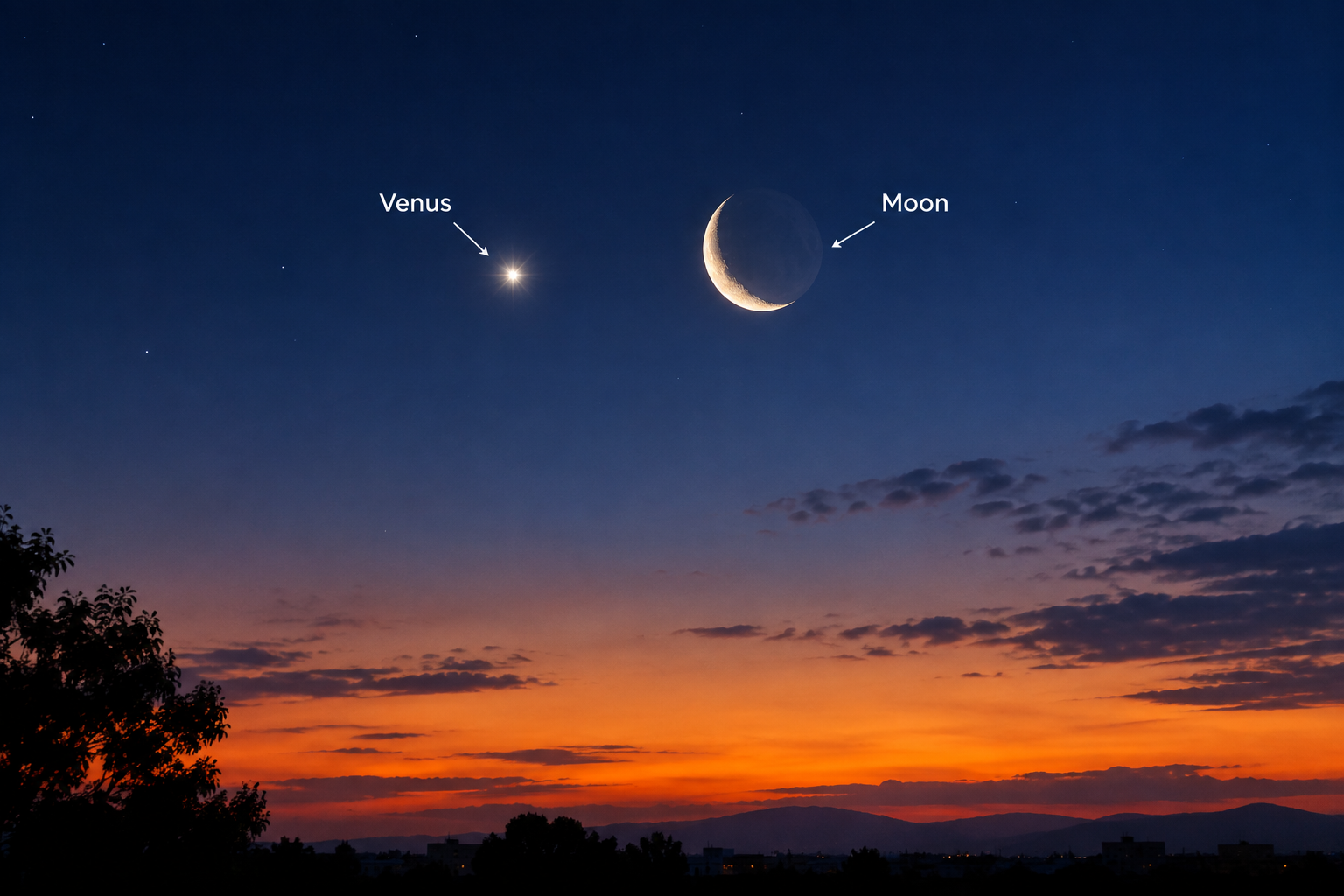
This scene occurs when the Moon and Venus appear close to each other in the sky, an event known in astronomy as a Conjunction. In September 2026, this astonishing sight was visible in many parts of the world, including Pakistan, where the thin crescent Moon and shining Venus appeared together in the evening sky. This article provides a complete explanation of this astronomical event — what it was, why it happened, why Venus appears so bright, and what astronomical principles lie behind it.
What Is a Conjunction? Astronomical Definition and Principles
A conjunction is an astronomical term used when two celestial objects appear close to each other in the sky as viewed from Earth. This “closeness” is actually an optical illusion — these objects may truly be millions or hundreds of millions of miles apart in space, but from the perspective of an observer on Earth, they appear to lie along the same line of sight.
According to NASA’s Goddard Glossary, a conjunction occurs when two or more celestial objects appear close to each other when viewed from Earth. These objects can be two planets, a planet and the Moon, or even a planet and a star. Although these events have very little astronomical significance, they provide extremely beautiful sights to observe.
One important type of conjunction is a Venus conjunction, which occurs between the Moon and Venus. Since the Moon completes one cycle across the sky every 29 days, it passes near one planet or another almost every month. When it passes near Venus, it is called a “Venus conjunction” or a “Moon-Venus conjunction.”
Venus: The Planet That Shines Like a Star
Venus is the second planet from the Sun and, after Earth, is the closest neighboring planet in the Solar System. Its most prominent characteristic is its extraordinary brightness — it is the second-brightest natural object in the night sky after the Moon. Venus is so bright that it can even be seen in daylight, and if the sky is clear, it can even cast shadows.
Why is Venus so bright? There are three basic reasons:
First reason — Thick clouds: Venus has a thick layer of sulfuric acid clouds over its surface that reflects approximately 70 percent of sunlight back into space. This reflective property makes it resemble a mirror.
Second reason — Proximity: Venus is the closest planet to Earth. Its average distance is approximately 41 million kilometers, which is much less than the closest distance of Mars.
Third reason — Size: The diameter of Venus is approximately equal to the diameter of Earth, making it a large and prominent target.
Because of these characteristics, ancient civilizations called Venus the “Morning Star” or the “Evening Star.” When it rises in the east in the morning, it is called the “Morning Star”, and when it sets in the west in the evening, it is called the “Evening Star.” Ancient people believed that the morning star and the evening star were two separate celestial bodies, but Pythagoras proved five hundred years before Christ that they were the same planet.
The September 2026 Event: A Rare Astronomical Sight
On September 14, 2026, an unusual astronomical sight was observed in many parts of the world. On that day, a thin crescent Moon and the planet Venus came extremely close to each other in the sky.
A photographer named Adeel Shafique captured an image of this scene from the city of Lahore, Pakistan, at 6:30 in the evening, showing the delicate crescent Moon and the small crescent of Venus shining together in the sky. He noted that from Lahore it was a “beautiful close conjunction,” because earlier that day, in parts of Asia and Europe, it was a complete Occultation — meaning that the Moon was passing in front of Venus and covering it for a few moments.
The Jordan Astronomical Society also documented this event. According to its president, Ammar Sakaji, Venus began disappearing behind the Moon at 12:47 p.m., completely disappeared at 12:49 p.m., and began reappearing at 2:13 p.m. The total duration of the occultation was approximately one hour and 24 minutes. Both objects appeared in crescent form during this time.
The event was also observed in Saudi Arabia during daylight. From the Noor Astronomical Observatory in the Qassim Region, the occultation continued from 1:04 p.m. to 2:38 p.m. Astronomers warned that special caution was necessary when observing this event during daylight, and pointing a telescope or camera toward the Sun could be extremely dangerous.
The scene was also observed in Bahrain, where the Moon and Venus both shone together in their crescent forms in the western evening sky. On this occasion, the angular distance between the Moon and Venus was only 0.6 degrees, which is extremely close.
Venus as a Crescent: An Interesting Astronomical Fact
One of the most interesting aspects of this event was that not only the Moon but Venus was also appearing in a crescent shape.
How is this possible? The crescent shape of Venus is a result of the fact that this planet orbits the Sun inside Earth’s orbit. Just as the Moon’s orbit causes us to see different portions of it illuminated, Venus also has “phases.” When Venus is between the Sun and Earth, most of its illuminated portion is hidden from us, and we see only a thin crescent.
According to astronomers, Venus is near its maximum brightness when it is in a crescent phase rather than when it is fully illuminated. This is because when Venus is in a crescent phase, it is closer to Earth, and its proximity overcomes the effect of its smaller illuminated portion on its brightness. In contrast, when Venus is fully illuminated, it is on the opposite side of the Sun and much farther from Earth, so its brightness is relatively lower.
Scientific Significance of Conjunctions
Conjunction events are not very important from an astronomical perspective, but they are useful to scientists for several reasons.
Verification of astronomical calculations: As the president of the Jordan Astronomical Society noted, accurate observations of such events help astronomers test their theoretical calculations against real-world data. When an occultation occurs at a previously predicted time, it provides evidence of the accuracy of astronomical models.
Observation of Venus’s surface: Observing Venus through a telescope provides information about its surface. Because of Venus’s thick clouds, it is difficult to see its surface, but by observing its crescent shape and phases, scientists can learn more about its orbit and atmosphere.
Public interest: These events are an effective way to generate public interest in astronomy. When people see a bright star near the Moon in the sky, they want to know what it is, and in this way their understanding of astronomy grows.
Historical Background: Conjunctions and Human Civilization
The meeting of the Moon and Venus in the sky has always held special significance in human history. Ancient civilizations associated Venus with various deities — in Babylon it was regarded as Ishtar (the goddess of love and war), in Greece it was called Aphrodite (the goddess of love), and in Rome it was called Venus.
Venus is also mentioned in Islamic tradition. It was called “Najmah” or “Zuhra,” and ancient Arab astronomers preserved their observations of it in their writings.
The conjunction of the Moon and Venus has been regarded as a good sign in many cultures, while in some traditions it has also been viewed as a prediction of a particular event. Scientifically, it is merely a visual coincidence, but culturally and historically, it has remained an important symbol.
Common Misconceptions and Their Explanation
There are several common misconceptions about the bright star shining near the Moon:
“It is a star”: This is the most common misconception. Venus is a planet, not a star. Stars produce their own light, whereas planets reflect sunlight. The light of Venus is steady and it does not twinkle, while stars appear to twinkle because of the effects of Earth’s atmosphere.
“They have come close to each other”: The Moon and Venus do not actually come close to each other in space. The Moon is approximately 384,000 kilometers from Earth, while Venus’s minimum distance is approximately 40 million kilometers. This means Venus is one hundred times farther away from the Moon. Their closeness in the sky is merely an optical illusion caused by the viewing angle from Earth.
“It is rare”: Although close conjunctions between the Moon and Venus occur every month, their visibility varies. In some months they occur during the day, and in others at night. Therefore, they are not equally prominent every month. An occultation (when the Moon covers Venus) is relatively rare — in Jordan, the next daytime-visible occultation will not occur until 2032.
Conclusion: A Beautiful Glimpse of the Universe
The “bright star” shining near the Moon is actually Venus, the most beautiful and brightest planet in our Solar System. This sight reminds us that we live in a part of the universe where celestial bodies are constantly in motion and continuously change their positions over time.
These conjunction events are not merely a visual spectacle, but they also provide us with an opportunity to understand the system of the universe and its laws. When we look toward the sky and see Venus shining near the Moon, we are actually observing a system that has been orbiting for billions of years.
The beauty of this scene lies in its simplicity — a small crescent Moon and a shining point beside it, which is actually an entire planet, a world about which we still know very little. And perhaps this is its greatest lesson: the universe is still an open book for us, and every conjunction marks the beginning of a new page in it.