Introduction
The history of humanity is inherently a history of the search for energy. Humans first utilized muscle power, then domesticated animals, later harnessed the flow of wind and water, brought forth steam to drive machinery, and eventually completed the Industrial Revolution through petrol and diesel. Yet each new power source carried a steep price. Smoke from coal and oil poisoned the atmosphere, nuclear energy delivered tragedies like Chernobyl and Fukushima, and renewable sources remain insufficient for total demand. Nevertheless, a singular hope endures at the intersection of scientific ambition and human necessity: fusion energy—the power that fuels the sun, illuminates the stars, and potentially offers an infinite solution to humanity’s material and energy needs. Fusion is not merely a scientific pursuit; it represents the confluence of survival, moral responsibility, and future aspirations. This journey through the landscape of fusion energy explores how science, philosophy, hope, and reality converge to reshape the world’s map.
The Mechanics and Promise of Fusion
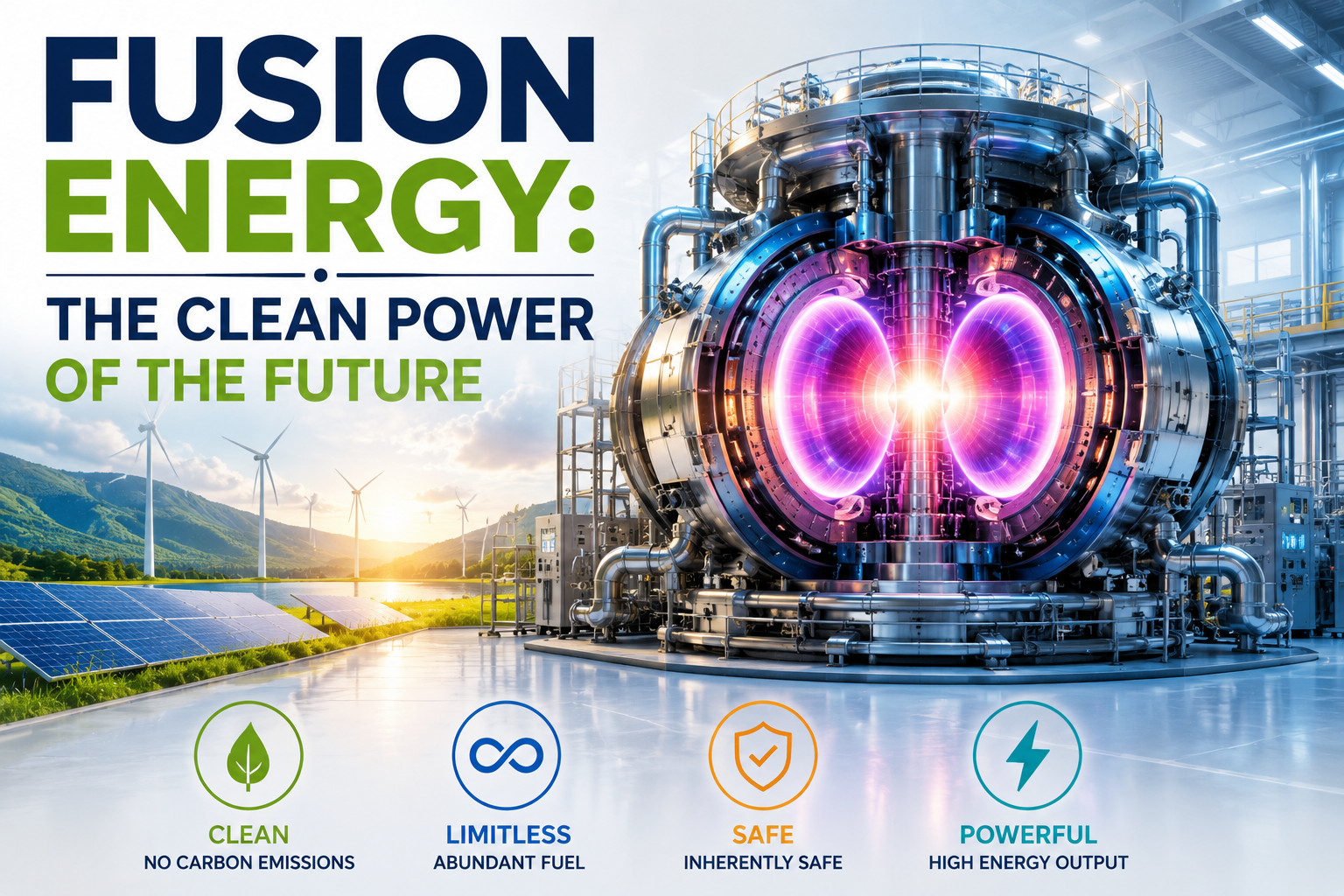
Fusion is the process in which two light atomic nuclei—typically two isotopes of hydrogen, deuterium and tritium—collide under extreme temperatures and pressures to form a heavier nucleus, helium, releasing vast amounts of energy in the process. This mechanism has kept the sun and stars radiant for billions of years. Its significance rests on several core factors. First, fusion fuel is abundant; deuterium is plentifully available in seawater, while tritium can be synthesized from lithium, which is widely distributed across the Earth’s crust. Consequently, fusion energy is virtually unlimited. Extracting and fusing the deuterium present in oceans could power human civilization for hundreds of thousands of years, establishing fusion as a permanent solution to global energy demands.
Second, fusion represents a clean energy source. It produces zero carbon dioxide or greenhouse gas emissions. Furthermore, unlike nuclear fission, fusion generates vastly lower quantities of radioactive waste, which decays over decades rather than lingering as a hazard for thousands of years. Third, fusion is inherently safe. Should an operational anomaly occur within a fusion reactor, the process terminates automatically. Unlike fission reactors, where chain reactions risk runaway meltdowns, fusion is self-regulating; no catastrophic failure can trigger a widespread disaster. These attributes position fusion as a uniquely superior alternative to existing energy systems.
Scientific Origins and Technical Challenges
The concept of fusion emerged in the early 20th century as scientists sought to understand stellar energy mechanisms. In the 1920s, Arthur Eddington proposed that stars derive energy by fusing hydrogen into helium. By the 1950s, hydrogen bomb tests proved that fusion was physically achievable, though harnessing it for peaceful energy generation posed unprecedented engineering hurdles. Researchers faced two major challenges: reaching temperatures exceeding 100 million degrees Celsius, and containing the resulting superheated state of matter—plasma—without touching physical walls that would instantly melt. Two primary containment approaches emerged: the tokamak, a donut-shaped magnetic vessel that suspends plasma via powerful magnetic fields, and laser fusion (inertial confinement), which focuses high-intensity laser beams onto a tiny fuel pellet to rapidly compress and heat it to ignition thresholds.
Historic Milestones and Global Initiatives
A major milestone occurred at the National Ignition Facility (NIF) within the Lawrence Livermore National Laboratory, where researchers achieved net energy gain via laser fusion, producing more energy from the fusion reaction than the laser energy driven into the target. This breakthrough validated decades of theoretical work and catalyzed renewed momentum globally. Parallel efforts center on ITER (International Thermonuclear Experimental Reactor) in France, a collaborative tokamak initiative involving 35 nations designed to prove commercial and large-scale feasibility.
Concurrently, the Joint European Torus (JET) in the United Kingdom established operational benchmarks by sustaining fusion reactions for 5 seconds and yielding 59 megajoules of energy. In Asia, China’s Experimental Advanced Superconducting Tokamak (EAST) successfully sustained high-temperature plasma exceeding 100 million degrees Celsius for extended durations. These collective advancements highlight an accelerating international race toward viable fusion power.
Socio-Economic, Geopolitical, and Ethical Implications
The deployment of fusion energy promises to restructure global power dynamics. Resource-scarce nations lacking domestic fossil fuel reserves could achieve complete energy self-sufficiency, reducing geopolitical friction and conflict over oil and gas reserves. From an environmental standpoint, replacing fossil fuel infrastructure with fusion reactors would drastically curtail global carbon outputs, offering a path to stabilize climate systems for future generations.
However, significant ethical questions persist regarding technology access. Given the immense capital required to develop fusion reactors, equitable distribution remains a challenge. Establishing international frameworks is crucial to ensure that fusion power benefits developing nations rather than reinforcing global wealth disparities.
Integration with Renewable Energy Systems
Fusion energy is not intended to displace renewable sources such as solar, wind, and hydroelectric power, but rather to complement them. While renewables offer clean generation, their output remains intermittent due to weather and day-night cycles. Fusion provides reliable, continuous baseload power to bridge these gaps. A hybrid energy grid utilizing renewables alongside fusion generation ensures a stable, zero-emission power infrastructure.
Engineering Obstacles and Commercial Timelines
Transitioning fusion from laboratory conditions to commercial power plants presents ongoing engineering hurdles. Beyond plant construction, securing a stable supply of tritium requires advanced breeding technologies, such as lithium breeding blankets designed to regenerate tritium during reactor operation. Additionally, public perception requires clear differentiation between nuclear fission and the inherently safe, non-runaway nature of fusion reactions.
Projections indicate commercial fusion reactors could begin feeding power grids between 2035 and 2050. Private ventures—including Commonwealth Fusion Systems (CFS) and TAE Technologies—are attempting to accelerate these timelines by building compact, high-field magnetic confinement systems aimed at commercialization by the 2030s.
Conclusion: A New Horizon for Humanity
Fusion energy represents one of humanity’s most ambitious scientific endeavors. Unlocking unlimited clean power addresses fundamental environmental and resource constraints, enabling broader technological and space exploration pursuits. Realizing fusion requires sustained international investment, technical rigor, and policy coordination. Successfully mastering stellar energy on Earth marks a transformative shift toward a clean, sustainable future.