Quantum Sensors: The Revolutionary Medical Breakthrough Unlocking the Inner World of Cells
The journey of medicine has always been a quest for sight. First, we observed with the naked eye, then microscopes revealed the existence of cells, X-rays narrated the hidden stories of bones, and MRI scans unveiled the secrets of soft tissues. Yet, despite these extraordinary accomplishments, an unfulfilled dream persisted within medical science. We could observe the structural state of cells, but we lacked the means to comprehend their internal dynamics—the precise micro-temperatures, ongoing chemical reactions, or whether a silent pathology was establishing its hold deep within this microscopic realm. That dream is now turning into reality. Quantum sensors, operating on the extraordinary principles of quantum mechanics, are answering this eternal quest of medicine. This minute technology promises a monumental revolution, and we stand directly on its threshold.
What is a Quantum Sensor and Why is it Revolutionary for Medicine?
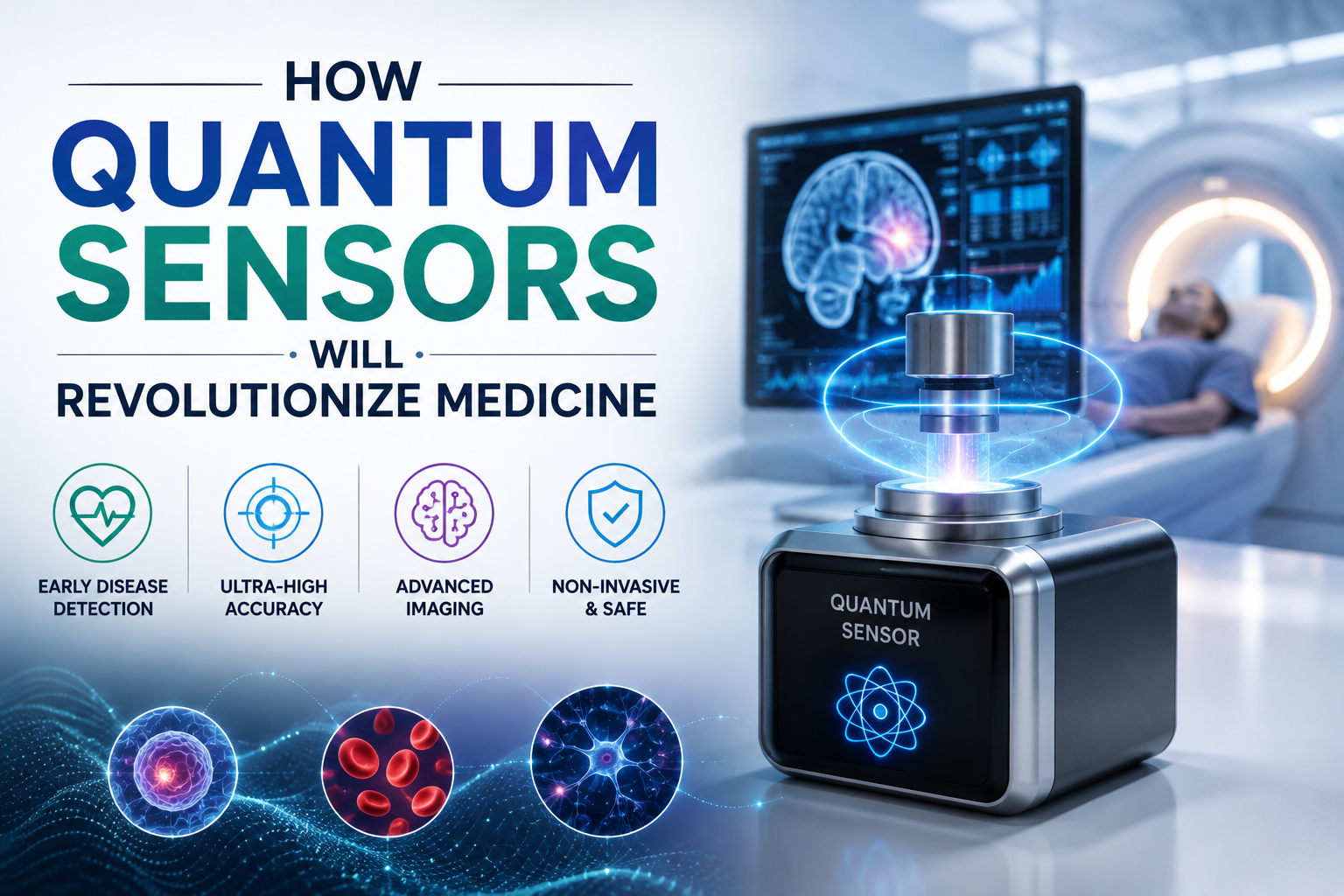
A quantum sensor is a device that utilizes the delicate principles of quantum mechanics—namely superposition and entanglement—to measure temperature, magnetic fields, and chemical alterations at microscopic scales with unprecedented precision. Its true strength lies in transcending the limitations of conventional sensors. Standard medical instruments typically record macro-level averages of matter or energy, whereas a quantum sensor operates at the single-molecule level. Imagine moving away from calculating average municipal statistics to measuring the temperature, light, and sound within individual households independently. In medicine, this capability allows us to detect diseases long before physical symptoms surface, capturing them in their earliest, most hidden states.
Monitoring the Cellular Microenvironment: A Realized Dream
In recent years, researchers have successfully adapted quantum sensors to operate within living cells. Scientists at Japan’s National Institutes for Quantum Science and Technology (QST) developed a novel Molecular Quantum Nanosensor (MoQN) capable of reading absolute temperatures and identifying radical signals inside active cellular environments. This sensor navigates into the cytoplasm and nucleus without compromising the integrity of the cell membrane. The research revealed that intra-cellular temperatures exceed ambient external temperatures, and distinct nuclear regions exhibit variations in temperature. This discovery adds a vital dimension to medicine, as micro-temperature changes serve as early indicators of cancer and other pathological shifts.
Advancing further, scientists at the University of Waterloo created a method employing a single molecule as a quantum sensor. By utilizing a specific organic molecule (trityl-OX063), they preserved its spin state delicate enough to maintain its quantum properties in complex environments. This technique offers higher sensitivity than traditional diamond-based quantum sensors because it can be placed significantly closer to its target. Consequently, it opens the door to reading the structure of individual proteins, paving the way toward pinpointing disease origins and designing targeted therapeutics.
Early Diagnostics and Unprecedented Precision
The most compelling promise of quantum sensors is ultra-early diagnosis. During testing scenarios, nanodiamond-based quantum sensors successfully identified viral presence two days earlier than standard gold nanoparticle tests. A two-day head start can prove decisive in curbing viral spread and initiating timely patient intervention. Beyond viral screening, quantum sensors hold immense potential for uncovering early oncological markers, neurodegenerative indications like Alzheimer’s and Parkinson’s, and subtle cardiovascular anomalies long before they manifest clinically.
Furthermore, quantum sensing technology is pushing the capabilities of conventional MRI. An international team working on the QuantuMRI project is integrating quantum sensors with standard magnetic resonance techniques to read deep biological parameters like tissue temperature, pH levels, and ion concentrations. This advancement enhances image resolution while yielding critical insight into chemical transformations taking place within diseased tissue. Similarly, nitrogen-vacancy (NV) center quantum sensors enhance sensitivity by 10-fold and resolution by 3.5-fold compared to standard magnetic induction tomography, making the detection of sub-millimeter tissue abnormalities possible.
Advanced Neuroimaging and Personalized Medicine
Quantum technology is poised to redefine neurological diagnostics. Conventional Magnetoencephalography (MEG) machinery is massive, costly, and requires liquid helium cooling systems. Quantum sensors based on Optically Pumped Magnetometers (OPMs) offer an effective alternative. These sensors operate at room temperature and can be integrated into lightweight helmet configurations, greatly expanding patient mobility and comfort. These helmet systems record extremely weak magnetic fields generated by neuronal electrical activity, offering revolutionary potential for diagnosing epilepsy, depression, and early-stage Alzheimer’s disease.
The future of healthcare centers on personalized medicine, tailoring treatments to an individual’s unique biological makeup. Quantum sensors will serve as a core enabler in this paradigm. By monitoring cellular processes at the quantum level in real time, clinicians can determine optimal drug formulations, precise dosages, and potential adverse reactions before administering treatment. Medicine will shift from being reactive to predictive, prioritizing early prevention over late-stage intervention.
Challenges and the Path Forward
The field of clinical quantum sensing remains in its developmental stages and faces notable technical hurdles. The primary challenge stems from the fragile nature of quantum states. Within the warm, moist, and dynamic environment of living cells, quantum states decohere rapidly. To address this, researchers are engineering novel stabilization methods—such as the team at Waterloo, who successfully extended molecular sensor coherence times by 60-fold. The second challenge involves translating these technologies from laboratory benchmarks to clinical settings, requiring robust collaboration between research institutions, biotechnology industries, and healthcare systems.
Conclusion: A New Dawn in Medicine
Quantum sensors represent more than just a technological upgrade; they introduce a new language to medical science. This language teaches us that diseases are not merely collections of external symptoms, but subtle disruptions within the cellular environment. Learning to read these signals enables early detection at the exact moment of pathological onset. We are entering an era where medical diagnostics will no longer rely on educated guesswork, but will clearly illuminate hidden biological processes. This is the transformation quantum sensors bring to medicine—a shift whose profound benefits future generations will experience in longer, healthier lives.