Introduction
Are we alone in the universe? This question remains one of humanity’s oldest and deepest inquiries. For centuries, it belonged primarily to the domains of philosophy and theology, but rapid technological advancement has transformed it into a rigorous scientific investigation. Across a vast cosmos containing billions of galaxies and trillions of planets, is Earth truly the sole cradle of life? Contemporary science is equipped better than ever to address this question, utilizing search methods that are increasingly sophisticated and effective.
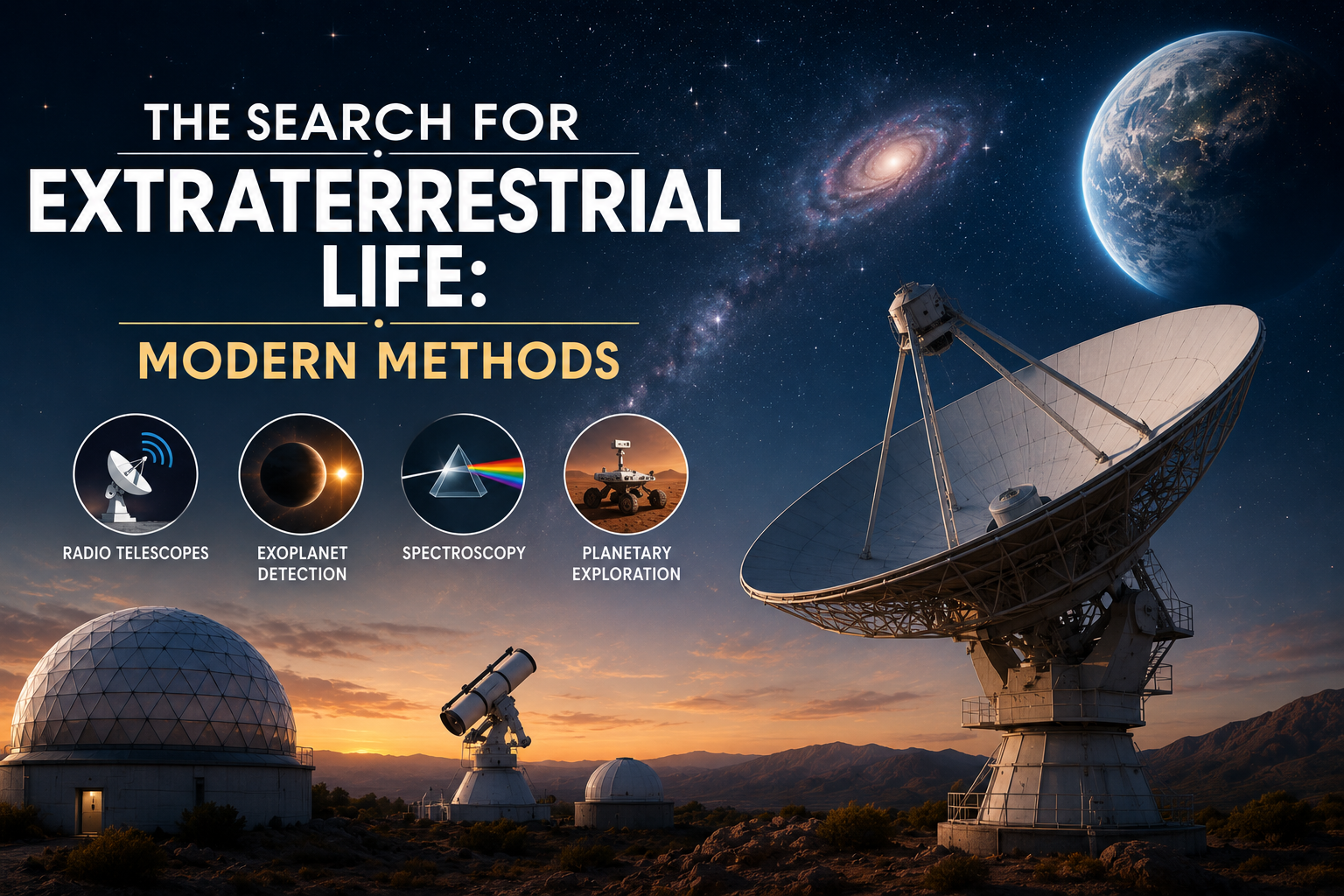
Today’s search extends far beyond merely listening for radio signals. It has evolved into a multi-faceted endeavor integrating chemistry, astronomy, artificial intelligence, and space technology. Scientists actively pursue two distinct forms of evidence: biosignatures, which are chemical indicators of biological existence, and technosignatures, which represent technological artifacts from intelligent civilizations. These modern methodologies allow us to evaluate the possibilities for life not only within our own solar system, but also within the atmospheres of planets light-years away.
Chemical Signatures: The Search for Biosignatures
Life operates as a chemical process whose remnants can be decoded through chemistry. In the modern era, one of the primary tools for seeking extraterrestrial life is spectroscopy. When an exoplanet transits in front of its host star, scientists analyze the starlight filtering through its atmosphere to identify the specific gases present. This technique has enabled the identification of water vapor, methane, and carbon dioxide within distant planetary atmospheres.
The James Webb Space Telescope (JWST) has significantly transformed this domain. Featuring a light-collecting area five times larger than the Hubble Space Telescope, JWST captures extremely faint light to reveal the detailed chemical compositions of planetary atmospheres.
Attention has focused on the exoplanet K2-18b, located 124 light-years from Earth. Researchers hypothesize that this planet harbors a sub-surface ocean beneath a hydrogen-rich atmosphere—conditions conducive to prebiotic chemistry. A research team led by Cambridge University astronomer Nikku Madhusudhan reported potential traces of dimethyl sulfide (DMS) in K2-18b’s atmosphere. On Earth, DMS is produced primarily by living organisms such as marine plankton and breaks down rapidly in the atmosphere, suggesting that its presence requires continuous biological production. Madhusudhan characterized this observation as an initial hint regarding a potentially inhabited alien world.
However, scientific findings require rigorous verification. Subsequent evaluations by other researchers concluded that current data do not provide definitive proof of DMS or similar atmospheric gases. This ongoing debate underscores the inherent complexity of analyzing the thin atmospheric layers of small exoplanets located light-years away. Independent observations and cross-method verifications remain essential before confirming any candidate biosignature.
Concurrently, researchers are investigating alternative chemical markers, such as methyl halides, which are produced on Earth by fungi, algae, and bacteria. Studies suggest that these gases may be more readily detectable in the hydrogen-rich atmospheres of Hycean planets, where JWST could potentially identify them within relatively short observation windows, offering a streamlined path for biosignature detection.
Artificial Intelligence: A New Perspective on Astronomical Data
While instruments like JWST provide high-resolution observational data, artificial intelligence (AI) serves as the computational engine required to process and interpret these vast datasets. The sheer volume of data generated by modern astronomical observatories far exceeds manual human analytical capacity, making AI an essential component of modern space research.
The search for Fast Radio Bursts (FRBs)—brief, intense pulses of radio emission from deep space—illustrates this integration. Traditional detection methods rely on a process known as “dedispersion,” which often requires processing times up to four times longer than the actual observation duration.
Researchers with the Breakthrough Listen initiative, collaborating with NVIDIA, developed an AI system capable of real-time data processing at speeds 600 times faster than standard pipelines—representing a 160-fold acceleration over traditional workflows. Tested at the Allen Telescope Array (ATA) in California, the system managed data streams of 86 Gigabits per second, improving detection accuracy by 7 percent while reducing false positive signals tenfold.
A key capability of this system is its ability to identify both known signal types and unanticipated signal patterns. As noted by Dr. Andrew Siemion of the SETI Institute, advanced civilizations might utilize modulated transmissions distinct from human designs. Machine learning frameworks can identify anomalous structural patterns within datasets that standard algorithms might routinely filter out.
Anomaly Detection: Searching for the Unknown
A central challenge in SETI research is identifying signals whose characteristics cannot be predicted in advance. An extraterrestrial signal might differ fundamentally from terrestrial radio communications. To address this, researchers utilize Anomaly Detection algorithms.
These unsupervised machine learning models analyze datasets to establish baseline norms for natural astrophysical emissions and terrestrial Radio Frequency Interference (RFI). By establishing what constitutes expected background noise, the algorithms automatically flag data points that deviate from established patterns without requiring pre-labeled training sets.
Recently, researchers introduced a clustering methodology named GLOBULAR, designed to reduce false positives stemming from radio interference by 93 to 99 percent. This allows researchers to focus computational and analytical resources on high-probability candidates rather than terrestrial noise. In analyses of Breakthrough Listen datasets involving trillions of spectrograms, algorithms continue to filter out environmental noise to isolate true candidate signals.
Potential Habitats: Mapping Candidate Worlds
According to Dr. Nathalie Cabrol, Director of the SETI Institute, contemporary search strategies adopt an integrated approach spanning the origin of life to the search for technological civilizations. The list of candidate locations for potential habitability extends beyond Mars.
Scientists evaluate icy ocean worlds such as Jupiter’s moon Europa, Saturn’s moons Enceladus and Titan, and dwarf planets like Ceres and Pluto. These bodies harbor sub-surface liquid water oceans where localized microbial environments could exist. On Mars, NASA’s Perseverance and Curiosity rovers continue examining ancient lakebed environments for biosignatures of past microbial life.
Beyond our solar system, missions like TESS and the upcoming Ariel space telescope identify and catalog exoplanets, while JWST performs atmospheric characterization. With each survey, the registry of potentially habitable worlds continues to expand.
Conclusion: The Ongoing Journey
The search for extraterrestrial life has entered a highly active era. Advanced observatories like JWST provide unprecedented observational capabilities, while artificial intelligence and machine learning offer the analytical tools necessary to evaluate vast streams of astronomical data. The systematic pursuit of biosignatures and technosignatures has matured into an interdisciplinary, technology-driven scientific discipline.
This endeavor requires both persistence and scientific rigor. Initial detection candidates, such as the reported DMS traces on K2-18b, undergo extensive re-examination and validation. Historical precedents, such as initial reports of phosphine on Venus, demonstrate that potential biosignatures often admit alternative abiotic explanations, such as complex volcanic or photochemical processes.
Current observational technologies remain constrained to detecting pronounced biological or technological signatures. As highlighted in recent observational studies, current data often support multiple competing interpretations that may only be fully resolved by next-generation space- and ground-based observatories.
Nevertheless, every refined observation, disproven hypothesis, and technological advancement brings greater clarity to the study of life’s distribution in the universe. The ongoing effort to answer whether Earth is unique reflects humanity’s continuous drive to understand its place within the cosmos.