Introduction: The Dawn of a New Era
Artificial Intelligence (AI) is no longer just a technical curiosity — it has become the foundation of the economy, society, and daily life. In 2026, we stand at a pivotal moment where AI has moved beyond conversational assistants (chatbots) to begin its journey toward becoming an autonomous, action-oriented system capable of interacting with the physical world. According to Marco Argenti, Chief Information Officer at Goldman Sachs, 2025 witnessed the most significant transformations in his 40-year career, and 2026 is poised to bring even greater changes.
This article covers the most prominent AI trends of 2026, drawing insights from the latest reports by leading research institutions — Forrester, Gartner, Google, Goldman Sachs, and others.
Unprecedented Surges in Capital Expenditure by Tech Giants
Wall Street analysts, who repeatedly underestimated AI investments, now predict that major cloud computing companies will invest over half a trillion dollars in 2026. This investment will heavily focus on AI infrastructure, data centers, and power supply networks.
Seven major tech corporations now account for more than 30% of the total S&P 500 market capitalization and nearly a quarter of its earnings. This signals that AI development is increasingly concentrated among a few giant firms, reinforcing a “winner-takes-most” dynamic.
Autonomous AI Agents: The Central Theme of 2026
The Shift from Conversation to Execution
If 2023 and 2024 were the eras of “talking” AI, 2026 is the era of “doing” AI. Autonomous AI agents (Agentic AI) are systems capable of executing complex, multi-step workflows without human intervention. Upon receiving a single goal from a user, they break it down into actionable steps, interact with various applications, and deliver finalized outputs.
OpenAI’s ChatGPT Work
In July 2026, OpenAI launched ChatGPT Work, an autonomous agent built on the GPT-5.6 Sol variant. The system takes a designated goal, decomposes it into sequential sub-tasks, interacts with connected applications and files, and returns completed deliverables.
Its defining capability is programmatic tool calling supported by a V8 JavaScript sandbox, along with Model Context Protocol (MCP) connectors that link directly to enterprise software suites. Over 1,400 developers submitted SDK applications within the first 24 hours of release.
The Race Between Microsoft and Anthropic
Alongside OpenAI, Anthropic launched its Claude Cowork desktop agent in January 2026, while Microsoft made its Copilot Cowork generally available on the same day.
Microsoft adopted a consumption-based pricing model ($0.01 per Copilot Credit), whereas Anthropic bundled the tool into its $20/month Pro tier. By late 2026, Microsoft plans to consolidate these tools into a unified “super app” encompassing Copilot Chat, Cowork, GitHub Copilot, and AutoPilots.
Google’s Strategic Perspective
Google Cloud’s 2026 report highlights the transition to AI agents as “the single largest AI opportunity.” According to Google, the initial competitive battlegrounds will be internal enterprise operations — financial planning, accounting, procurement, contract management, legal, and HR.
For instance, an AI agent can assist a portfolio manager by summarizing five years of financial earnings and margins or help a pharmaceutical scientist draft regulatory documentation.
Multi-Agent Systems: Collaborative AI Intelligence
The next frontier for AI agents is multi-agent collaboration. Protocols such as the Agent-to-Agent (A2A) Protocol and the Agent Payments Protocol (AP2) allow agents built on different frameworks to communicate and cooperatively handle complex tasks.
This interoperability holds transformative potential for supply chains, manufacturing, and logistics. For example, a maintenance lead can deploy an agent to monitor risks across an entire supplier network and automatically execute a full contingency plan.
Edge Computing: Bringing AI Closer to the User
The Rise of On-Device AI Processing
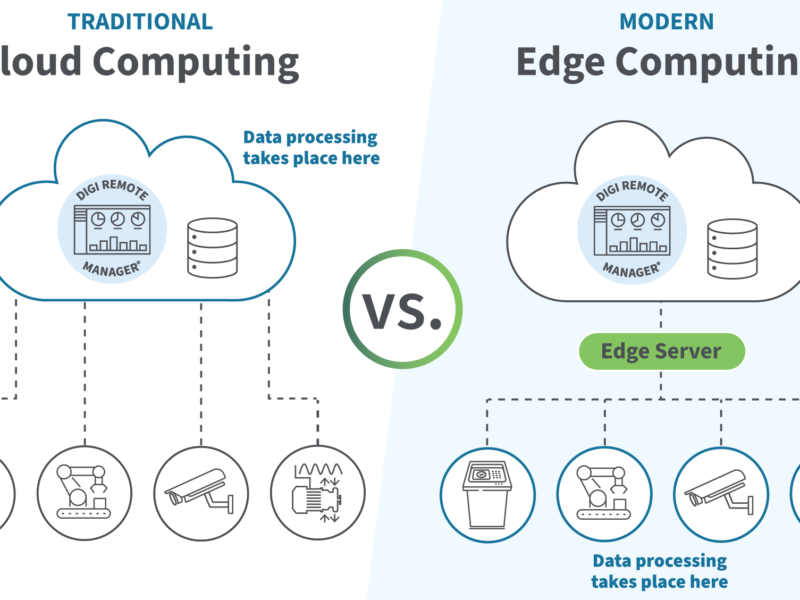
A major side effect of autonomous AI agents is a dramatic surge in cloud computing costs. The solution lies in edge computing — shifting AI processing directly onto local hardware (smartphones, PCs, and wearables).
This is enabled by dedicated NPUs (Neural Processing Units) and advanced model quantization (such as 3B–7B parameter small models). Edge computing reduces load on cloud data centers while providing users with lower latency and enhanced privacy.
AI-Native Devices
According to CMG’s 2026 Report, AI-Native devices are proliferating rapidly. Instead of traditional devices adapted for AI, hardware is now built from the ground up for AI capabilities. A new generation of AI smartphones, PCs, and XR (Extended Reality) devices natively integrates with multimodal AI, redefining education, healthcare, and entertainment experiences.
Meta’s Ray-Ban smart glasses and Apple’s planned “Apple Glass” represent major moves in this direction.
AI Governance: Navigating a New Regulatory Landscape
AI Governance as a Procurement Prerequisite
Research from IBM and Gartner indicates that AI governance has evolved from a risk management debate into a strict procurement requirement. ISO/IEC 42001 — the international standard for AI management systems — is now widely required in enterprise procurements across regulated industries.
OWASP published its first Top 10 for Agentic Applications in December 2025, addressing vulnerabilities such as goal hijacking, memory poisoning, and inter-agent communication flaws.
Simplified Implementation of the EU AI Act
The European Commission reached a political agreement in May 2026 to simplify AI regulatory enforcement. The initiative aims to lower compliance hurdles for European firms while preserving public protections.
Key highlights include:
- Enforcement for high-risk AI systems will begin on December 2, 2027.
- “Nudification” apps (creating non-consensual explicit media) are strictly prohibited.
- Small and medium-sized enterprises (SMEs) will gain enhanced access to regulatory sandboxes.
The U.S. National AI Framework
The Trump administration released its National Policy Framework for Artificial Intelligence in March 2026. Seven key recommendations include:
- Preempting state-level AI regulations with unified federal standards.
- Strengthening online safety protections for children and parental controls.
- Classifying AI training on copyrighted materials as fair use, while leaving dispute resolution to courts.
- Expanding AI infrastructure without increasing consumer energy costs.
- Relying on existing federal agencies rather than creating new regulatory bodies.
South Korea’s Basic AI Act
South Korea’s Basic AI Act came into effect in January 2026, becoming the third major global AI framework alongside the EU AI Act and U.S. Executive Orders. Key elements include:
- A comprehensive National AI Master Plan (updated every 3 years).
- A National AI Committee chaired directly by the President.
- An established AI Safety Institute.
- Strict transparency, safety, and accountability mandates for high-risk and generative AI.
Toward Global AI Governance
According to CMG’s report, globalized AI governance is a defining trend of 2026. China proposed establishing a Global AI Cooperation Organization aimed at offering international public goods for AI development.
Physical AI: Moving Beyond the Digital Sphere
The core message of Forrester’s Top 10 Emerging Technologies Report for 2026 is that AI is no longer confined to digital workflows — it is crossing over into the physical world.
Robotics and Autonomous Transportation
Forrester identified “Layer Zero Experiences” (ambient digital environments), Physical AI and Robotics, and Autonomous Transport as primary categories where consumers will feel direct real-world impacts.
Humanoid Robotics
Humanoid robots are categorized as a mid-term emerging trend. While they offer solutions to industrial labor shortages, adoption remains constrained by integration costs, scaling barriers, safety protocols, and workforce management considerations.
Scaling Industrial AI
IBM’s 2026 technology forecasts highlight that Physical AI is scaling rapidly across industrial sectors. McKinsey data reveals that AI-driven demand forecasting cuts manufacturing prediction errors by 30–50% and reduces inventory levels by 20–50%.
Embodied AI
According to CMG’s report, the convergence of “Embodied AI” and robotics is producing machines that learn through physical interactions and adapt seamlessly to complex environments. China’s embodied AI market is projected to reach approximately 5.3 billion yuan (~$759 million) by late 2025, accounting for 27% of the global total.
The Power Infrastructure Challenge
The Gigawatt Bottleneck
According to Goldman Sachs, access to power infrastructure has become the primary bottleneck for AI expansion. Global data center electricity consumption is projected to surge by 175% by 2030 compared to 2023 levels.
Consequently, AI advancement is no longer purely gated by capital availability, but by electrical grid interconnectivity. Access to gas turbine power plants and grid infrastructure has become a decisive factor for corporate success in AI.
Green AI Initiatives
CMG’s report underscores the urgency of “Green AI.” Rapid expansion of AI data centers is driving unprecedented energy usage, fueling demand for energy-efficient architectures and renewable energy integration.
The Rise of Small & Specialized Models
SLMs and Domain-Specific Intelligence
IBM notes that the industry is experiencing diminishing returns from merely scaling model parameter sizes. Research and enterprise investments are shifting toward model efficiency, domain specialization, and performance optimization.
Small Language Models (SLMs) now provide enterprises with a practical pathway to deploy AI with better cost controls and predictable performance compared to giant general-purpose models.
Open-Source AI as Enterprise Infrastructure
Open-source AI has transformed from a developer playground into an enterprise-grade operational choice. The Model Context Protocol (MCP) — originally created by Anthropic and donated to the Linux Foundation — is now jointly supported by OpenAI, Google, Microsoft, and AWS to standardize external system integrations.
MCP already powers over 10,000 active public servers, reflecting rapid adoption across corporate IT ecosystems.
Managing AI Costs: The FinOps Discipline
FinOps for AI Investments
Managing AI compute spending has matured into a dedicated corporate discipline. The FinOps Foundation report for 2026 reveals that 98% of practitioners now actively track AI costs, up from 63% in 2025 and 31% in 2024.
Furthermore, 73% of enterprises exceeded their AI infrastructure budgets in 2025, with 80–85% missing expenditure forecasts by more than 25%. FinOps X 2026 formally recognized AI Tokenomics as a distinct specialization.
AI Tokenomics
Goldman Sachs reports that businesses are transitioning to billing models based on AI agent token consumption rather than human hourly labor. This represents a fundamental shift in business models from “per hour” to “per token.”
Key Recommendations for the Future
Adaptability as the Ultimate Skill
Goldman Sachs emphasizes that the professionals who thrive in this environment will be those who possess strong core skills combined with a willingness to continuously adapt. Just as the advent of computers reshaped workplace roles, AI is driving a transformation of similar magnitude, making continuous learning the single most valuable career asset.
Impact on Early-Career Professionals
Analysis of 4.6 million workers by Stanford and ADP indicates that employment among early-career workers aged 22–25 in AI-exposed roles declined by 13–16%, whereas senior roles in the same categories grew by 6–12%.
Deployment and Operational Challenges
Forrester reports that while 75% of enterprise leaders claim to have adopted Agentic AI, few have progressed past pilot implementations. Gartner estimates that although 40% of enterprise applications will feature AI agents by late 2026, over 40% of these projects risk cancellation by 2027.
The primary hurdle remains governance — only 21% of organizations maintain mature AI agent governance frameworks, and 49% of security leaders cite autonomous agents as a top risk concern.
Conclusion: A New Chapter with New Rules
In 2026, Artificial Intelligence stands at a defining juncture. It is no longer merely a tool that answers queries or generates images — it is evolving into an autonomous worker, a physical presence, and a macro-economic driver reshaping entire industries.
Three core forces are driving this revolution:
- Autonomy (Agentic AI): AI executes actions rather than just generating dialogue.
- Physicality (Physical AI): AI expands beyond digital applications into real-world hardware.
- Governance & Infrastructure: AI deployment is no longer purely a tech issue, but a matter of law, power grids, and corporate economics.
As Sharyn Leaver, Chief Research Officer at Forrester, noted: “While AI dominates the top of 2026’s emerging technology list, individual AI capabilities differ vastly in maturity and impact. Our research aims to help business and technology leaders balance their portfolios — identifying short-term tech that delivers immediate ROI versus long-term bets requiring sustained investment and strategic risk management.”
The future belongs to AI, but its rollout is far from uniform — it approaches with varying speeds, risks, and opportunities across sectors. Those who understand these shifts and adapt proactively will define success in this new era.