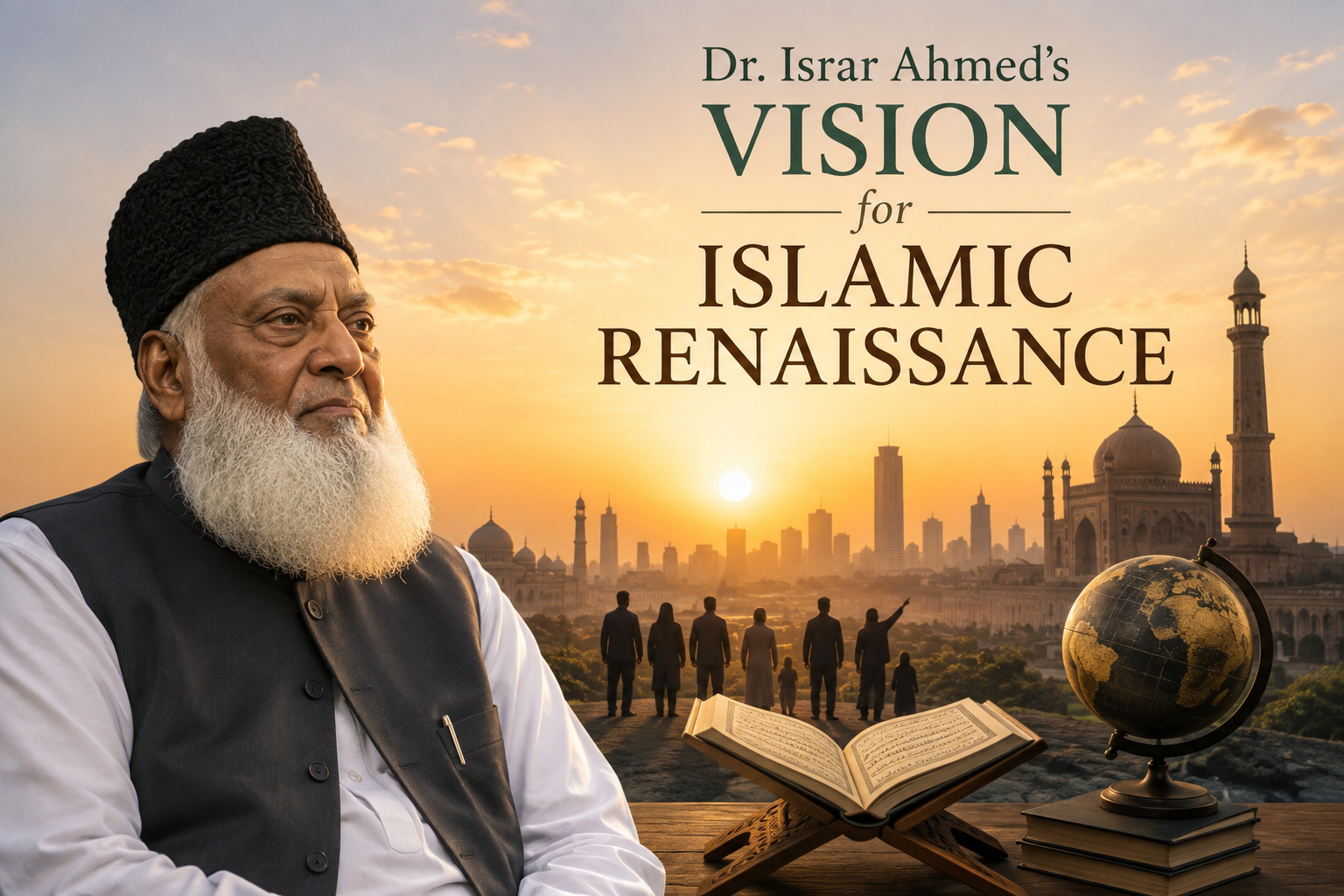
Dr. Israr Ahmed’s Concept of Islamic Renaissance
Introduction
Dr. Israr Ahmed (1932–2010) was a prominent 20th-century Pakistani Islamic scholar, commentator, and reformist leader who dedicated the greater part of his life to propagating a Quran-centric thought process and awakening spiritual and intellectual consciousness across the Muslim Ummah. Through his extensive written works and lectures, he established a unique intellectual tradition based on the conviction that the decline of Muslims is a direct consequence of their weakened faith and detachment from Quranic teachings. He asserted that the sole remedy lies in an organized, intellectual, and ideological movement capable of restoring faith to its foundational depth.
The Genesis of Islamic Renaissance: A Foundational Narrative
The Historical 1967 Monograph
Dr. Israr Ahmed’s formal intellectual crusade began in 1967 when he published a concise yet comprehensive monograph in the editorial pages of the monthly journal Meesaq, titled “Islamic Renaissance: The Real Task Ahead.” In later years, Dr. Israr Ahmed himself designated this writing as the founding manifesto of his movement. This monograph was published in book form in 1968 and subsequently underwent numerous reprints.
In this manifesto, Dr. Israr Ahmed presented a profound critical critique of the perspectives held by the most influential 20th-century Islamic revivalist movements—specifically Jamaat-e-Islami and the Muslim Brotherhood. These movements primarily projected Islam as a “complete system of life”—a political, economic, and social framework to be enforced through state machinery. According to Dr. Israr Ahmed, this perspective was itself a symptom of the very malady it claimed to cure. He argued that by accepting Western assumptions that material and worldly affairs hold primary intellectual importance, these movements reduced faith—the internal and existential belief in the One God and the Hereafter—to a secondary and largely ideological status.
Historical Analysis of Western Dominance
Dr. Israr Ahmed initiated his analysis of the Islamic renaissance by examining the historical trajectory of Western intellectual and political dominance. He articulated how material science displaced metaphysical and transcendent concepts, ultimately subjecting the Muslim world to Western political and military dominance. Consequently, two distinct reactions emerged among Muslims: retreating into private piety on one hand, and adopting apologetic modernism on the other. Dr. Israr Ahmed deemed both responses wholly inadequate.
In his view, the 20th-century revivalist movements attempted to treat the symptoms of Muslim decline while neglecting its root cause—an eroded and hollowed-out faith. For this reason, despite apparent vigor and activity, these movements failed to yield the desired outcomes.
The Centrality of Faith: The First Condition of Revival
Faith versus System
Faith occupies the central position in Dr. Israr Ahmed’s intellectual system. He insisted that no Islamic revival—whether political, economic, or social—could succeed without the renewal of faith. He emphasized that an Islamic renaissance does not depend merely on codifying laws or engaging in political struggles, but rests fundamentally upon spiritual awakening and the revitalization of faith.
Dr. Israr Ahmed viewed Jamaat-e-Islami’s decision to participate in electoral politics as a direct violation of this principle. He believed that joining electoral politics transformed a “purely revolutionary party” into a “standard political party,” causing the concept of Islamic revolution—as envisioned prior to the creation of Pakistan—to lose its core essence. This disagreement was so profound that it led to his resignation from Jamaat-e-Islami in 1957, after which he pursued a new path aligned with what he considered a true “revolutionary methodology.”
The Struggle Against Materialism
Dr. Israr Ahmed identified the Western materialistic worldview as a primary driver of decline in Muslim societies. According to him, modernist Islamic movements uncritically accepted Western premises that material and secular matters were of paramount importance. This acceptance resulted in the marginalization of Islam’s metaphysical dimensions, presenting Islam instead as merely a political, economic, and social system.
He vehemently opposed this distortion, stressing that Islam is not merely a system, but a set of beliefs, a philosophy, and a collection of spiritual states whose implementation is possible only when the faith of Muslims is genuinely alive. He maintained that to counter Western philosophy and materialist ideologies, Muslims must understand these concepts deeply and refute them rationally in the light of Quranic wisdom.
Proposed Solution: Intellectual Movement and Quranic Education
An Intellectual and Research Movement
The path Dr. Israr Ahmed proposed for Islamic revival was neither conventional political agitation nor simple legal reform, but a sustained, rigorous intellectual movement. He envisioned a movement capable of challenging Western philosophy on its own academic ground, reviving the metaphysical foundations of classical Ilm al-Kalam (scholastic theology), and preparing a cadre of scholars whose faith was not merely inherited, but reasoned, tested, and internally lived.
He emphasized that the current role of religious scholars is largely “defensive”—protecting Islam from external intellectual assaults—whereas they ought to play a “revivalist” role. He expressed regret that contemporary scholars remained uninformed regarding modern philosophical, social, and scientific thought. He noted that great historical scholars like Imam Ghazali and Ibn Taymiyyah countered Greek philosophy only after studying it deeply. Similarly, modern Muslim thinkers must study contemporary ideologies, refute aspects contrary to the Quranic spirit, and integrate compatible elements into a fresh, contemporary expression of Islamic thought.
The Quran Academy Project
The most crucial and practical aspect of Dr. Israr Ahmed’s manifesto was the establishment of the Quran Academy. He described the creation of this academy as an immediate and concrete step toward an Islamic renaissance. The academy was designed as a research and educational institution where young scholars would be trained to achieve mastery in both modern sciences and Quranic wisdom.
To realize this project, Dr. Israr Ahmed founded the Markazi Anjuman Khuddam-ul-Quran in 1972. The organization aimed to disseminate the message of the Quran, provide exegesis and commentary, and foster an academic environment where the Quran could be understood in its original spirit.
Subsequently, in 1975, he established Tanzeem-e-Islami to establish Deen (religion) through a genuine revolutionary process. Tanzeem-e-Islami made structured efforts to implement this manifesto, culminating in the launch of Tehreek-e-Khilafat Pakistan in 1991, which directly targeted the establishment of the Caliphate system.
Critical Assessment of Contemporary Islamic Movements
Traditional Scholars and Sectarianism
Dr. Israr Ahmed conducted a deep analysis of contemporary Islamic movements, highlighting their shortcomings. He criticized traditional scholars for expending most of their energies on sectarian disputes, with scholars of every faction defending and propagating their specific dogmas and rituals, often insisting that any deviation constituted misguidance. This narrow vision fueled sectarianism and fostered intolerance, leading to a dangerous trend of sectarian violence.
The Role of Tablighi Jamaat
Dr. Israr Ahmed acknowledged the role of Tablighi Jamaat in directing the attention of large masses toward the renewal of faith. However, he deemed this movement limited, as its scope remained confined strictly to personal faith renewal, whereas an Islamic renaissance requires a comprehensive intellectual, academic, and political struggle.
Jamaat-e-Islami and the Muslim Brotherhood
Regarding Jamaat-e-Islami and the Muslim Brotherhood, Dr. Israr Ahmed acknowledged them as two of the most significant 20th-century revivalist movements, yet considered their methodology flawed. In his view, by framing Islam primarily as a “system,” they neglected foundational faith and mirrored Western political models through their emphasis on conventional political struggles.
A Unique Stance
Dr. Israr Ahmed’s position differed distinctly from all these groups. He neither adopted a purely defensive posture like traditional scholars, nor limited his scope to personal piety like Tablighi Jamaat, nor centralized conventional political struggle like Jamaat-e-Islami. Instead, he formulated a three-tiered strategy: first, the renewal of faith; second, the consolidation of intellectual foundations; and third, the establishment of a just socio-political order.
The Caliphate System: The Ultimate Goal
A central pillar of Dr. Israr Ahmed’s thought was the re-establishment of the Caliphate (Khilafat). To him, establishing the Caliphate was not merely a political enterprise, but a spiritual and moral duty—an outward expression of renewed faith and the sovereign implementation of Quranic guidance in collective life.
He maintained that the Caliphate could not be established until the faith of Muslims was revived and they were prepared to order their collective lives according to Quranic teachings. Hence, he prioritized faith renewal first, followed by academic training, and finally political action.
The Central Role of Pakistan
A unique concept put forward by Dr. Israr Ahmed was that the foundations of the modern Caliphate should be laid in Pakistan rather than traditional historical centers like Hejaz or Baghdad. He believed the “spiritual center of the Islamic intellectual movement” had shifted toward Pakistan. This view aligned with the intellectual legacy of Shah Waliullah, Allama Muhammad Iqbal, and Abul Kalam Azad.
He viewed Pakistan as a unique opportunity, created specifically on the basis of an Islamic ideology, thereby possessing the ideological and psychological foundations necessary for establishing a Caliphate.
Intellectual Affinity with Allama Iqbal
Dr. Israr Ahmed considered himself an intellectual disciple of Allama Iqbal and a custodian of his thought. Like Iqbal, he advocated for an Islamic renaissance that would awaken the Muslim self (Khudi), direct them back to the Quran, and unite them into an organized force.
However, a fundamental difference existed between the two thinkers: while Iqbal’s approach was poetic, philosophical, and visionary, Dr. Israr Ahmed’s methodology was practical, organizational, and prescriptive. Iqbal articulated the vision, whereas Dr. Israr Ahmed established an organized movement and institutions to actualize it.
Both thinkers rejected Western secular models and viewed the Caliphate as essential for Muslim unity, spiritual renewal, and the establishment of divine sovereignty.
Departure from Jamaat-e-Islami and a New Path
Principled Disagreement
Dr. Israr Ahmed’s separation from Jamaat-e-Islami was not a mere organizational dispute, but a fundamental disagreement on principle. When Jamaat-e-Islami decided to enter electoral politics in the 1950s, Dr. Israr Ahmed viewed it as a departure from the core mission of a “revolutionary party.”
He believed that an Islamic revolution could only be brought about through a disciplined, organized, and revolutionary cadre, rather than through parliamentary politics, which he viewed as inherently reliant on compromise, expediency, and Western democratic frameworks.
Establishment of Tanzeem-e-Islami
Following his departure from Jamaat-e-Islami, Dr. Israr Ahmed spent a considerable period in intellectual preparation and planning. In 1975, he founded Tanzeem-e-Islami as a “purely revolutionary organization” dedicated to an organized and determined struggle for an Islamic renaissance.
Tehreek-e-Khilafat
In 1991, he launched Tehreek-e-Khilafat Pakistan, an initiative specifically focused on raising public consciousness and mobilizing people for the restoration of the Caliphate system in Pakistan.
Intellectual Legacy of Dr. Israr Ahmed
Written Works
Dr. Israr Ahmed authored over 60 books, 9 of which have been translated into English and other major languages. His notable works include The Quranic Concept of Social Reform, Islam and Pakistan, Allama Iqbal and Us, The Consolidation of Pakistan, and The Muslim Ummah: Past, Present, and Future.
His writing style was analytical, evidence-based, and persuasive, aiming to connect readers directly with the Quran and familiarize them with core Islamic thought.
Lectures and Discourses
Dr. Israr Ahmed communicated his ideas not only through books, but also through public lectures, Quranic expositions (Dars-e-Quran), and recorded discourses. His delivery was articulate and forceful, making significant strides in attracting educated youth toward Quranic study.
In 1981, when President Zia-ul-Haq granted him a weekly program on Pakistan Television (PTV), he reached a massive national audience. The broadcast was among the pioneer programs in Pakistan where a religious scholar presented Quranic teachings directly to a television audience in a structured academic setting.
Conclusion
Dr. Israr Ahmed’s concept of Islamic Renaissance presents a comprehensive, deep, and balanced intellectual system anchored in the Quran, faith, and rigorous academic effort. He invited Muslims to a path that neither remains trapped in historical stagnation nor uncritically imitates the West, offering instead an intellectual and spiritual framework directed toward the ultimate objective of divine vicegerency.
His message remains highly relevant today as the Muslim world continues to grapple with cultural dominance, weakened faith, intellectual stagnation, and political fragmentation.
Dr. Israr Ahmed pursued this mission until his passing on April 14, 2010. His intellectual legacy endures through Tanzeem-e-Islami, the Markazi Anjuman Khuddam-ul-Quran, and numerous students and followers who continue to carry forward his work.