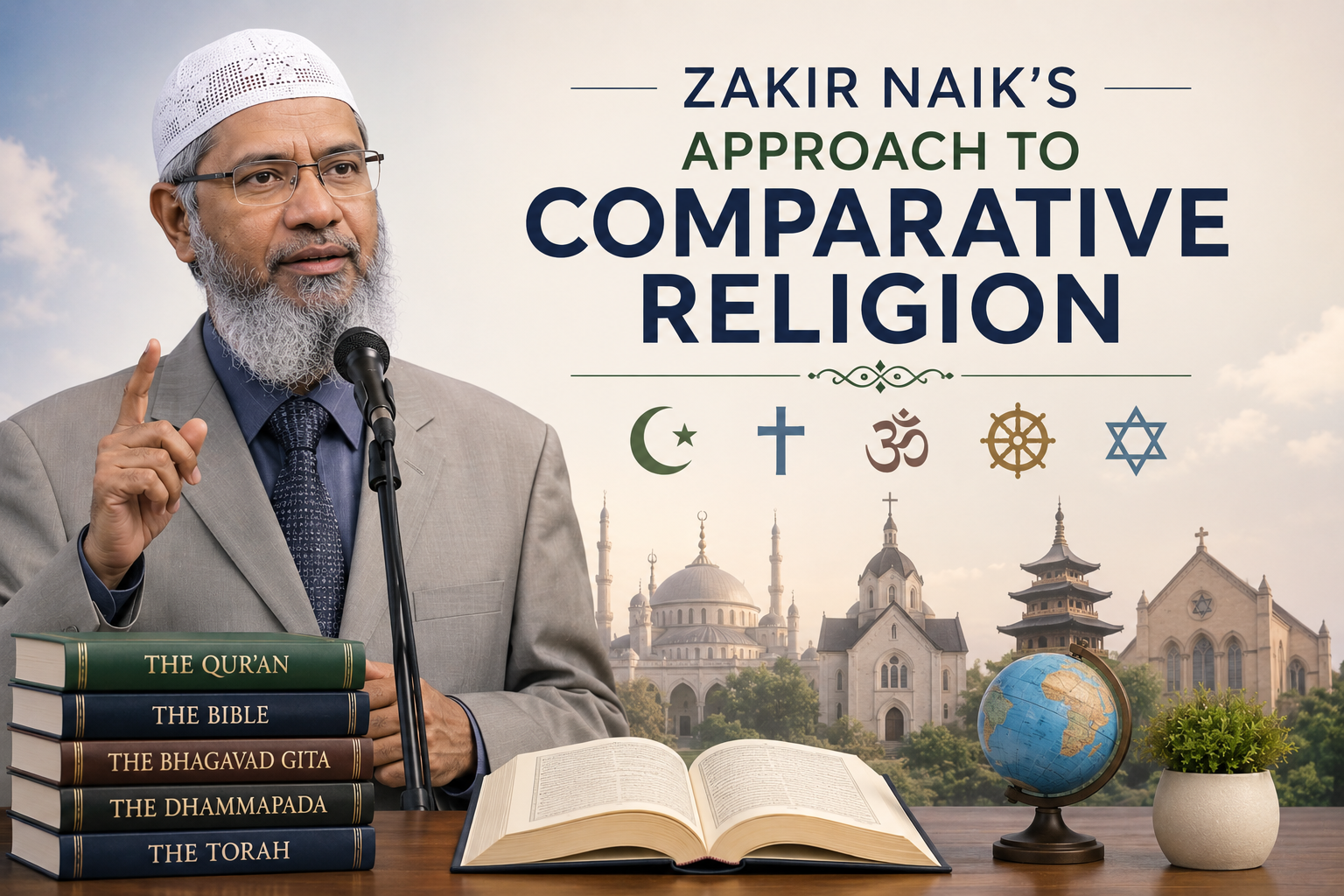
Introduction and Background
Dr. Zakir Naik, born on October 18, 1965, in Mumbai, India, is an internationally recognized Islamic preacher, public speaker, and a prominent figure in the field of comparative religion. Born Zakir Naik Abdul Karim Naik, he stems from a family of medical professionals and earned his Bachelor of Medicine and Bachelor of Surgery (MBBS) degree from the University of Mumbai.
Despite his medical background, a pivotal meeting in 1987 with the renowned South African Islamic scholar Ahmed Deedat fundamentally shifted his life’s direction. Following this interaction, Naik transitioned away from medical practice to dedicate his career to Islamic propagation (Dawah) and comparative religious studies. In 1991, he founded the Islamic Research Foundation (IRF), a non-profit organization that served as the primary platform for his international outreach.
Methodological Foundations and the Deedat Influence
Dr. Zakir Naik’s approach to comparative religion builds upon the foundational methodology established by his mentor, Ahmed Deedat. Academic evaluations indicate that Deedat developed a structured framework characterized by sequential argument organization, heavy reliance on textual evidence, and public question-and-answer sessions following formal lectures. Naik systematically integrated this methodology into his own public presentations.
Over the course of his decades-long career, research notes that Naik recognized the necessity for a religious communicator (Dai) to maintain a versatile approach, continuously adapting message delivery across varied cultural and demographic contexts.
Core Philosophy: Addressing Misconceptions and Dual Textual Frameworks
The primary objective of Naik’s comparative religion methodology is the systematic clarification of common misconceptions regarding Islam, presenting it as an inherently rational and logical faith. He contends that post-September 11 media narratives amplified negative stereotypes surrounding Islam, placing a responsibility on Muslim scholars to counter these depictions through reasoned discourse.
In his lectures, he frequently cites conversion statistics, such as pointing to tens of thousands of Americans accepting Islam in the period immediately following September 2001, to argue that interest in Islam grows when engaged rationally. A central element of his argument relies on highlighting over 1,000 verses in the Quran that touch upon natural phenomena, which he asserts resonate with scientifically minded audiences.
Distinctively, Naik’s methodology employs a dual textual approach. To substantiate his comparative claims, he cites not only primary Islamic texts—the Quran and authentic Hadiths—but also extensive passages from the scriptures of non-Islamic traditions, including the Bible, the Vedas, and other major texts. By referencing an opponent’s own canonical texts directly from memory, he attempts to demonstrate internal theological alignment with core Islamic tenets.
Harmonization of Scientific Knowledge and Scripture
A major structural pillar of Naik’s approach involves comparing modern scientific discoveries with Quranic verses. He asserts that exact correspondences between empirical facts and Quranic statements serve as evidence of the text’s divine origin.
Naik authored the book The Bible, the Quran, and Science, wherein he provides a comparative analysis of Old Testament passages, Gospel accounts, and Quranic verses through the lens of modern scientific understanding. The stated goal of this literature is to highlight commonalities across scriptures and foster a shared foundation among faith traditions.
Debating Mechanics and the Question-and-Answer Format
The most widely recognized segment of Naik’s public appearances is the open question-and-answer session. He explicitly invites audience members—particularly non-Muslim attendees—to ask critical or challenging questions, which he addresses using a structured, cross-referential style.
Analytical studies characterize Naik’s conversational framework as a direct approach that tackles controversial theological issues by providing immediate, citation-heavy answers rather than avoiding complex queries.
Comparative Analysis of Monotheism (Tawhid)
A central theme in Naik’s comparative methodology is establishing the concept of Monotheism (Tawhid) as the original, core teaching across major world religions.
When examining Hinduism, Naik acknowledges its popular polytheistic expression while maintaining that classical Hindu scholars and primary texts advocate a monotheistic theology. He frequently cites passages from the Vedas and Upanishads that emphasize the singularity of the Divine. To illustrate the conceptual distinction, he often uses the comparative phrase: “The Hindu says ‘Everything is God,’ whereas the Muslim says ‘Everything is God’s’—a distinction of an apostrophe”.
Naik categorizes major world religions into two primary lineages:
- Semitic Religions: Judaism, Christianity, and Islam—religions tracing their prophetic lineage to the Abrahamic tradition, grounded in divine revelation.
- Non-Semitic Religions: Subdivided into Aryan traditions (e.g., Hinduism, Sikhism, Buddhism, Jainism) and Non-Aryan traditions (e.g., Confucianism, Shintoism), which he often characterizes as ethical and philosophical systems rather than strictly prophetic revelations.
Engagement with Contemporary Social Issues
Beyond comparative theology, Naik applies his framework to pressing modern issues:
- Terrorism: He explicitly asserts that Islam strictly forbids acts of terrorism and unequivocally condemns suicide bombings.
- Women’s Rights: He conducts comparative analyses on the status of women across various religious traditions, arguing that Islamic jurisprudence grants extensive legal, financial, and social rights to women.
- Theory of Evolution: He provides critical assessments of evolutionary theory, contrasting specific scientific hypotheses with Quranic accounts of creation.
Media Utilization and International Impact
Naik heavily leveraged modern mass media to broadcast his message globally. Through television broadcasts on platforms like Peace TV, as well as wide distribution on YouTube and social media, his lectures reached millions of viewers worldwide.
Academic research notes that his effective use of media positioned him as a prominent global representative of modern Islamic apologetics. Supporters often cite his work as providing a clear framework for understanding the relationship between modern knowledge, scientific inquiry, and religious belief.
Critiques, Legal Challenges, and Controversies
Dr. Zakir Naik’s methodology and public statements have generated substantial controversy and legal pushback:
- Bans and Legal Actions: In India, the government banned his organization, the Islamic Research Foundation (IRF), under the Unlawful Activities (Prevention) Act (UAPA)—a decision subsequently upheld by the Delhi High Court.
- Polemical Tone: Critics, including various religious scholars and academic researchers, characterize his style as polemical, overly assertive, and potentially offensive toward other faith traditions.
- Social Impact: While his supporters view his approach as an intellectual and rational defense of faith, academic critiques point out that a debate-oriented, adversarial approach can sometimes heighten inter-faith friction rather than foster harmonious dialogue.
Conclusion
Dr. Zakir Naik’s comparative religion methodology represents a highly structured, citation-intensive, and debate-centric approach to Islamic Dawah. Inherited from Ahmed Deedat and augmented by modern media tools, his platform combines scriptural cross-referencing, empirical scientific comparisons, and open public debate to present Islam as a rational lifestyle.
While his confrontational style and controversial reception remain subjects of intense debate, his overall body of work continues to exert a significant influence on contemporary comparative religious discourse across the global Muslim diaspora.