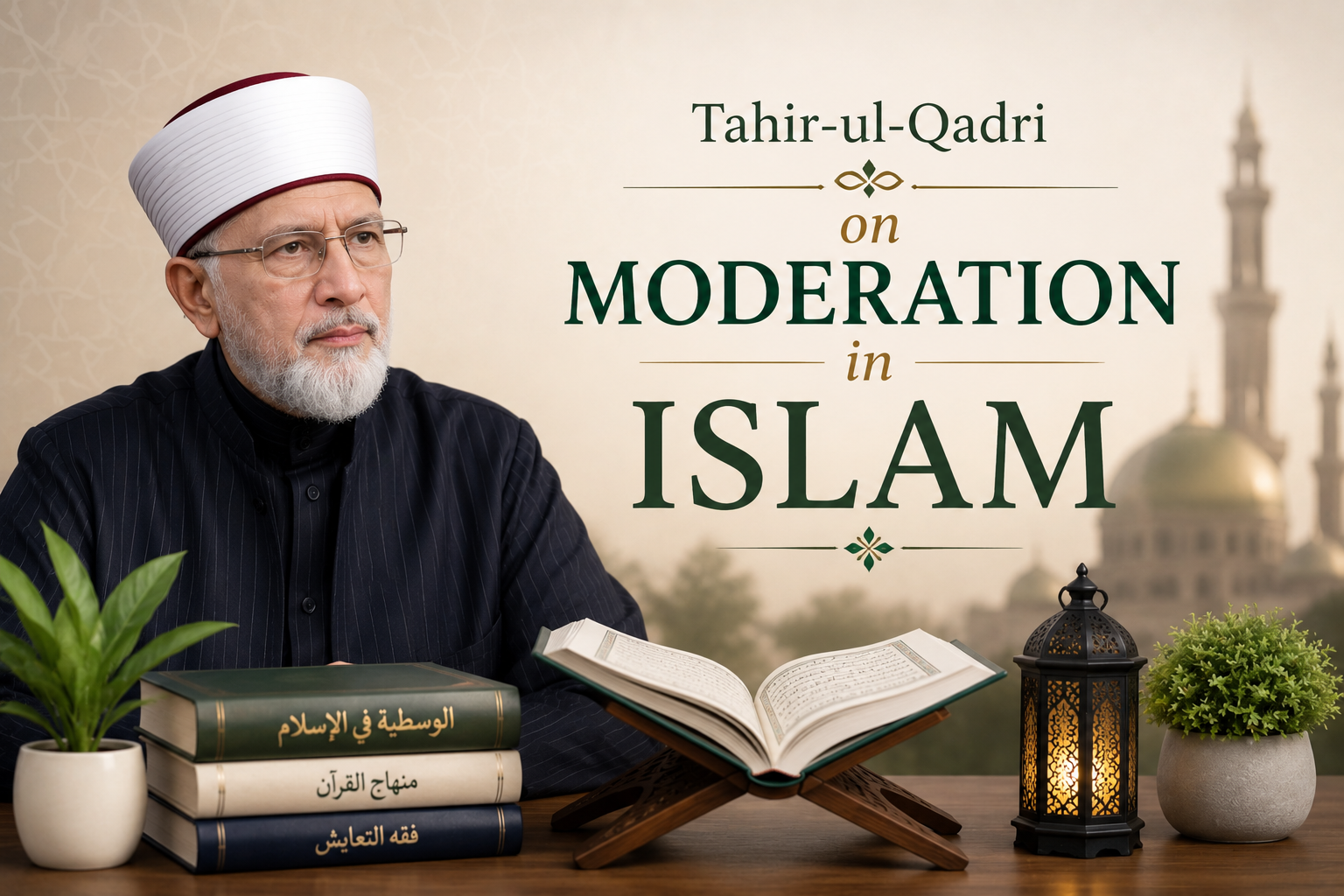
Introduction and Background
Professor Dr. Muhammad Tahir-ul-Qadri is a prominent Pakistani Islamic scholar, thinker, and author who has dedicated his career to articulating Islamic principles centered on moderation, peace, and interfaith tolerance. He is the founder of Minhaj-ul-Quran International, a global organization established in 1981 that works internationally to promote peace, interfaith harmony, and a moderate understanding of Islam.
Revered by his followers with the title “Shaykh-ul-Islam” in recognition of his academic contributions, Qadri’s framework of moderation extends beyond theoretical discourse into structured institutional initiatives, public lectures, extensive literature, and formal legal edicts.
Sufi Orientation and South Asian Heritage
Qadri’s moderate framework is deeply rooted in the Sufi traditions of South Asia. As a prominent figure within the Hanafi scholarly tradition in the region, his teachings emphasize spiritual purification, divine love, and social tolerance, offering a distinct contrast to more austere theological frameworks like Salafism or Wahhabism.
Analysts note that Qadri integrates Sufi spiritual practices with contemporary civic engagement, utilizing South Asian spiritual traditions as a platform for social reform. This dual orientation allows him to operate simultaneously as a spiritual guide, educational reformer, and public intellectual.
The 2010 Fatwa on Terrorism and Suicide Bombings
A major milestone in Qadri’s public scholarship occurred in March 2010 with the publication of his 600-page Fatwa on Terrorism and Suicide Bombings in London. The document was recognized by counter-terrorism analysts and research organizations as one of the most comprehensive theological rejections of violent extremism published in modern history.
In the fatwa, Qadri issued an unconditional condemnation of terrorism and suicide attacks, stating that violence against civilians has no legal or theological justification in Islamic jurisprudence. He rejected political grievances as valid justifications for illegal violence, emphasizing that noble intentions cannot legitimize prohibited acts.
To substantiate his arguments, Qadri provided extensive citations from the Quran, Hadith literature, and classical jurisprudence across all four major Sunni legal schools (Hanafi, Shafi’i, Maliki, and Hanbali) to demonstrate that classical Islamic law strictly forbids indiscriminate violence.
The publication received widespread international attention and support from academic institutions, counter-terrorism experts, and government officials globally, who cited it as an important resource for counter-radicalization efforts.
Rejection of Extremist Ideology and Dichotomous Worldviews
Qadri draws explicit historical parallels between modern extremist organizations—such as ISIS, Al-Qaeda, and the Taliban—and the historical Kharijites, an early extremist sect in Islamic history known for declaring other Muslims apostates to justify violence.
Furthermore, Qadri refutes the rigid classical division of the world into Dar al-Islam (Abode of Islam) and Dar al-Harb (Abode of War), a framework frequently exploited by militant groups to justify hostilities against non-Muslim-majority nations. Instead, he argues that modern Western democracies, which guarantee religious freedoms and equal constitutional rights under international law, fulfill the core criteria of safe havens for religious practice, rendering hostile classifications obsolete.
Freedom of Expression, Responsibility, and Gender Equality
Regarding contemporary civic rights, Qadri advocates for a balanced approach to freedom of expression. While supporting fundamental democratic liberties, he emphasizes that public discourse should be exercised responsibly, respecting religious sensitivities to prevent societal polarization.
In terms of social reform, Qadri places significant emphasis on gender equity and women’s rights within an Islamic framework. He actively promotes female education and institutional participation within Minhaj-ul-Quran, challenging patriarchal norms prevalent in traditional South Asian societies.
Counter-Radicalization Initiatives and Academic Legacy
To address youth radicalization directly, Qadri organized specialized counter-extremism educational camps in Western nations, such as the 2010 summer retreat at the University of Warwick, aimed at equipping young Muslims with theological arguments against extremist narratives.
Qadri’s academic output encompasses over 600 authored works spanning Quranic exegesis, Hadith compilations, Islamic jurisprudence, and philosophy. Notable publications include:
- Fatwa on Terrorism and Suicide Bombings: His flagship legal treatise against violent extremism.
- Al-Musnad imām ‘Alī: A extensive compilation of Hadith traditions narrated through Ali ibn Abi Talib.
- Al-Minhaj al-Sawi: A comprehensive Hadith selection translated into multiple languages for educational instruction.
Political Engagement and Public Reception
While widely praised internationally for his anti-extremism literature, Qadri’s political activities in Pakistan have drawn mixed reactions. His leadership of major political protests against government administrations in Islamabad generated significant media debate regarding his political strategies and dual Pakistani-Canadian citizenship status.
Despite political controversies, his theological framework remains an influential baseline for moderate Islamic scholarship, counter-radicalization programs, and interfaith dialogue worldwide.
Conclusion
Dr. Muhammad Tahir-ul-Qadri’s scholarly contributions offer a systematic defense of moderation, peace, and civic responsibility grounded in traditional Islamic sources. Through legal edicts, institutional networks, and educational programs, his work continues to serve as an active counter-narrative against religious extremism and societal polarization.