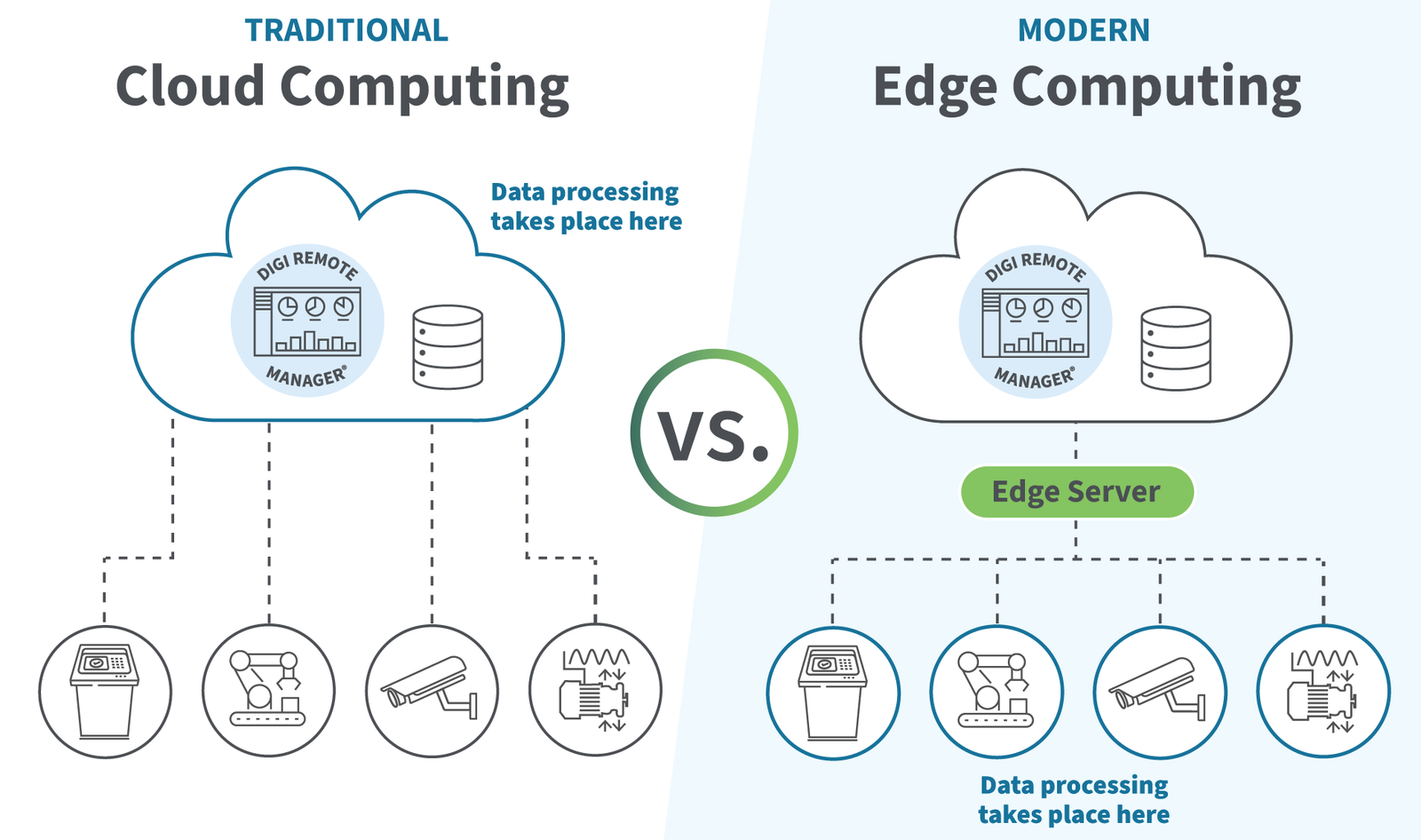
Introduction
Comparing cloud computing and edge computing is not merely an evaluation of two distinct technologies; it represents a convergence of two fundamental operational paradigms: centralization versus distribution, throughput versus latency, and infinite scale versus local proximity. These twin paradigms constitute core architectural pillars underpinning the modern digital economy, each fulfilling distinct technical roles across the enterprise computing landscape.
Cloud computing provides centralized, hyper-scalable infrastructure that forms the foundational backbone of global digital services. By democratizing access to enterprise-grade data storage, computational capacity, and application deployment, cloud platforms enable organizations of all sizes to access resilient global infrastructure without capital hardware expenditure. This model delivers dynamic elasticity, operational flexibility, and seamless integration with emerging software tools.
Conversely, edge computing executes data processing within physical proximity to data generation sources—such as industrial IoT sensors, traffic management systems, or mobile endpoints. By processing workloads locally, edge architectures minimize network latency, reduce backhaul bandwidth requirements, and support real-time data analysis. This localized processing capability is essential for mission-critical applications where sub-millisecond response times are paramount, including autonomous vehicle navigation, industrial automation, and remote surgical telemetry.
Cloud Computing: Scalability, Infrastructure, and Centralization
Cloud computing delivers compute resources—including virtual servers, storage, databases, networking components, and software applications—on-demand over network connections. A defining characteristic of cloud architecture is its elasticity: it allows early-stage environments and global enterprises alike to dynamically provision resources based on real-time demand under a pay-as-you-go operational expenditure model.
The centralized architecture of cloud computing delivers distinct operational advantages:
- Elastic Scalability: Dynamic provisioning and scaling of computational resources without physical hardware constraints.
- Cost Efficiency: Transition from heavy capital expenditure (CapEx) to predictable operational expenditure (OpEx).
- Global Reach: Low-latency global distribution of services via interconnected data center regions.
- Advanced Tooling Access: On-demand access to specialized frameworks for Artificial Intelligence, Machine Learning, and Big Data analytics.
Global expenditure on cloud infrastructure services reached $270 billion in 2024, representing a 30% year-over-year growth rate. These metrics underscore the essential role cloud platforms play in sustaining modern enterprise operations.
However, centralized cloud architectures introduce structural network constraints regarding latency. When data must transit across public networks to remote data center regions for execution, round-trip network delays occur. While tolerable for standard enterprise applications, this latency introduces performance bottlenecks for time-sensitive, real-time workloads.
Edge Computing: Low Latency, Localized Processing, and Distribution
Edge computing directly addresses network latency by decentralizing computation and processing data near its ingestion point rather than routing traffic to distant centralized servers. The “edge” encompasses the boundary where physical data originates—including industrial machinery sensors, smart municipal infrastructure, cellular devices, and autonomous platforms.
Edge computing represents an architectural framework composed of localized compute nodes operating in tandem to execute low-latency workloads. Primary architectural benefits include:
- Ultra-Low Latency: Deterministic response times yielding sub-millisecond execution capabilities.
- Bandwidth Optimization: Reduction in outbound data transmission costs by filtering and processing raw data locally.
- Enhanced Privacy and Compliance: Localized data execution that reduces data transit across external networks.
- Offline Resilience: Continuous operational capability during intermittent or complete network disconnections.
The primary constraint of edge computing revolves around hardware resource limits—edge nodes lack the massive compute density, memory capacity, and storage scale of centralized cloud data centers. Furthermore, managing, updating, and securing highly distributed edge node deployments introduces operational management complexity.
Comparative Analysis: Key Technical Differences
| Dimension | Cloud Computing | Edge Computing |
|---|---|---|
| Location | Centralized Hyperscale Data Centers (Remote) | Local Ingestion Sources / Edge Nodes (Distributed) |
| Latency | Standard (50–200 ms average) | Ultra-Low (< 1–10 ms deterministic) |
| Processing Power | Hyper-scalable / High-density compute clusters | Constrained / Dedicated localized hardware |
| Storage Capacity | Near-infinite distributed storage layers | Bounded localized storage capacity |
| Bandwidth Usage | High backhaul bandwidth dependency | Minimized network backhaul transmission |
| Data Security | Centralized governance; network transit risks | Localized containment; minimized data in-transit |
| Scalability | Automated, highly flexible elastic scaling | Hardware-dependent deployment scaling |
| Cost Structure | Pay-per-use operational models | Upfront edge hardware capital investment |
| Primary Use Cases | Big Data Analytics, AI Training, Enterprise SaaS | IoT Telemetry, Autonomous Vehicles, Smart Grids |
Application Scenarios and Workload Alignment
Optimal Cloud Workloads
- Big Data Processing and Analytics: High-throughput batch processing of vast, structured and unstructured datasets requiring centralized storage pools and distributed compute clusters.
- AI Model Training: Heavy deep-learning neural network training pipelines requiring dedicated, multi-GPU orchestration clusters available in centralized hyperscale environments.
- Web and SaaS Platforms: Enterprise resource planning (ERP), customer relationship management (CRM), and global consumer web applications where centralized state management is required.
Optimal Edge Workloads
- Autonomous Systems: Real-time decision systems within self-driving vehicles requiring immediate obstacle avoidance and sensory processing within deterministic millisecond timeframes.
- Industrial Internet of Things (IIoT): Manufacturing telemetry filtration where localized processing units evaluate high-frequency sensor feeds to prevent machinery failures without saturating WAN connections.
- Healthcare Telemetry: Patient monitoring systems and medical devices requiring uninterrupted localized monitoring and immediate event alerting.
- Smart Infrastructure: Municipal traffic management and utility telemetry requiring real-time localized response to environmental data inputs.
Architectural Integration: The Cloud-Edge Continuum
Cloud and edge computing are complementary architectures within modern enterprise infrastructure. Advanced deployment frameworks integrate both models into a unified “Cloud-Edge Continuum.”
In this hybrid model, edge nodes handle real-time inference and localized event processing, while centralized cloud infrastructure handles long-term telemetry storage, global analytics, continuous AI model retraining, and centralized policy governance.
Consider a smart manufacturing environment:
- Edge Layer: Localized edge gateways monitor machinery vibration and temperature telemetry in real time, triggering immediate automatic shutdowns upon detecting operational anomalies.
- Cloud Layer: Anonymized telemetry from multiple manufacturing facilities aggregates in the cloud to train predictive maintenance ML models, which are then redeployed back to edge devices for execution.
Evolving Industry Trends
Edge AI and Inference Deployment
A key trend in 2026 is the expansion of Edge AI. Localized hardware now features specialized silicon (such as micro-NPUs) capable of running AI model inference directly on the device. This capability enables real-time AI decision-making without requiring outbound API calls to remote cloud-hosted models, improving execution speed while keeping sensitive data contained within the local network perimeter.
5G and Connectivity Integration
The maturation of 5G infrastructure provides ultra-reliable low-latency communication (URLLC) channels, enabling seamless data exchange between edge nodes and hybrid cloud environments.
User Experience Expectations
Modern applications demand responsive user interfaces. Edge nodes process latency-sensitive interactions locally, while centralized cloud infrastructure manages background synchronization, user authentication, and data persistency.
Conclusion
The distinction between cloud computing and edge computing is fundamentally defined by architectural placement—cloud provides centralized computational capacity, while edge delivers localized processing proximity. Neither paradigm replaces the other; rather, they form an integrated compute ecosystem required by modern digital applications.
Enterprise infrastructure strategies increasingly rely on a hybrid deployment architecture: edge nodes execute real-time, deterministic operations, while cloud platforms manage long-term data persistence, heavy computation, and global analytics.
An IBM Institute for Business Value analysis highlights edge computing as a transformative infrastructure capability, noting that organizations aligning their operational architectures with hybrid cloud-edge strategies build significant long-term technical advantages.
Success in modern enterprise IT requires a cohesive strategy integrating both centralized cloud elasticity and localized edge capabilities into a resilient digital architecture.