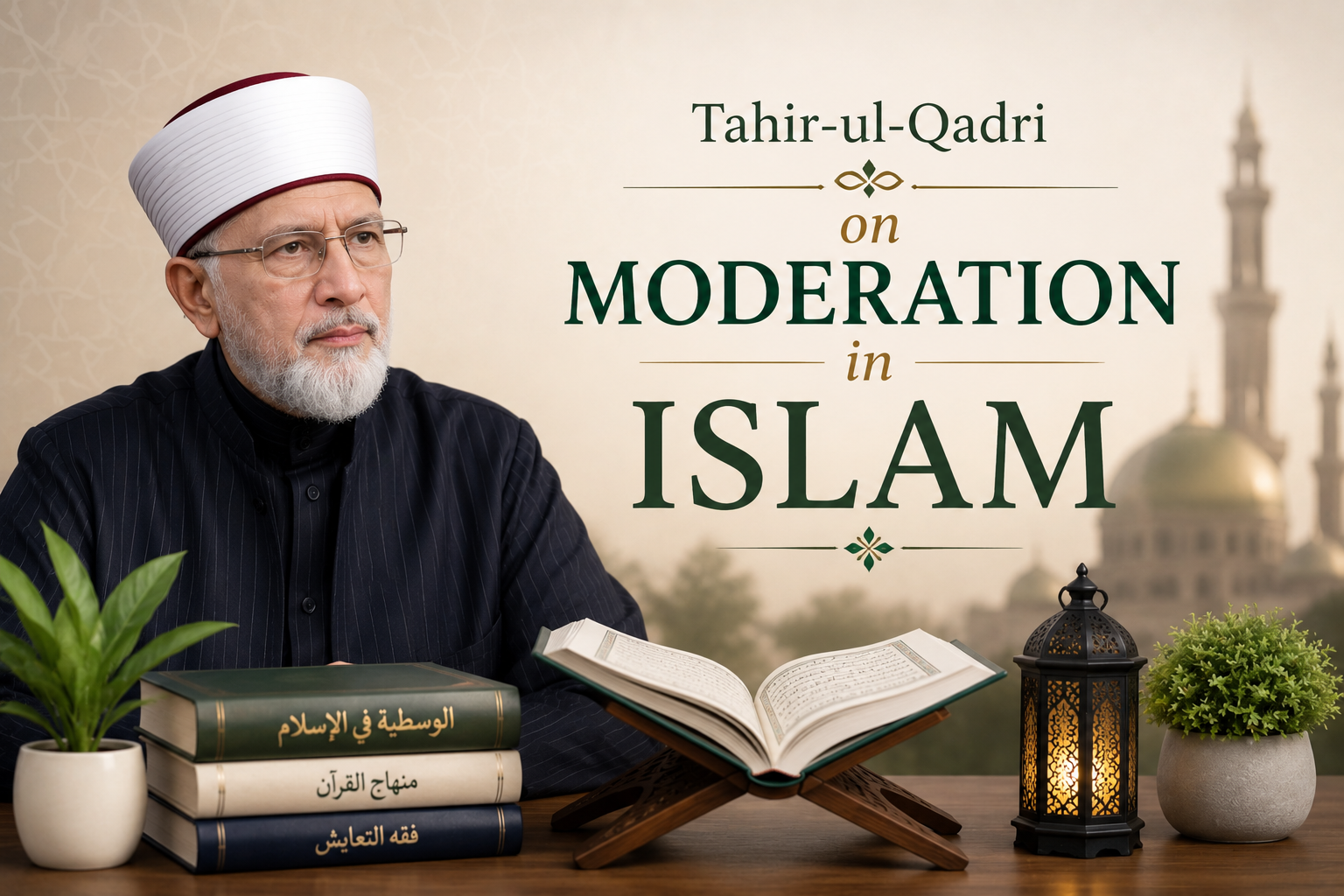
Tahir-ul-Qadri on Moderation in Islam

Tahir-ul-Qadri on Moderation in Islam | طاہر القادری کا اسلام میں اعتدال کا تصور
Islamic Thought

Tahir-ul-Qadri’s Concept of Moderation in Islam

Introduction

Professor Dr. Muhammad Tahir-ul-Qadri is a prominent Pakistani Islamic scholar, thinker, and author who has dedicated his entire life to highlighting the true teachings of Islam—specifically moderation, peace, and tolerance[cite: 1]. He is the founder of Minhaj-ul-Quran International, an international organization established in 1981 that works globally to promote peace, interfaith harmony, and moderate Islam[cite: 1].

Tahir-ul-Qadri is honored by his followers with the title of “Shaykh-ul-Islam”, acknowledging his expertise and high stature in Islamic sciences[cite: 1]. His concept of moderation is not merely a theory, but a practical struggle, expressed through his dozens of books, hundreds of lectures, and particularly his historic fatwa against terrorism[cite: 1].

Affiliation with Sufism and the South Asian Tradition

Tahir-ul-Qadri’s moderate perspective is deeply rooted in his affiliation with Sufism[cite: 1]. He is a prominent leader of the Hanafi spiritual tradition in South Asia, which emphasizes Sufi teachings, love, affection, and tolerance[cite: 1]. This Sufi-based approach stands in stark contrast to the rigid Wahhabi Islam of Saudi Arabia, which often fosters extremism[cite: 1].

According to one analyst, Tahir-ul-Qadri “combines Sufism with politics, believing that the spiritual traditions of South Asian Islam can provide a platform for social change”[cite: 1]. This is the unique quality that distinguishes him from other scholars—he is simultaneously a spiritual leader, a political figure, and an educational reformer[cite: 1].

Historic Fatwa Against Terrorism (2010)

The greatest and globally recognized expression of Tahir-ul-Qadri’s moderation is the 600-page Fatwa he issued in London in March 2010[cite: 1]. This fatwa was declared as “the most comprehensive religious rejection of terrorism to date”, as stated by the counter-terrorism think tank Quilliam Foundation[cite: 1].

Key Points of the Fatwa

In this fatwa, Tahir-ul-Qadri condemned terrorism and suicide bombings without any exception[cite: 1]. His stance was firm and unambiguous[cite: 1]:

“Terrorism is terrorism, violence is violence. It has no place in Islamic teachings, and no justification, excuse, or ‘ifs and buts’ can be provided for it.”[cite: 1]

He declared suicide bombers to be destined for Hell and emphasized that[cite: 1]:

“Even a good intention—even if a thousand good intentions are gathered together—cannot make an illegal and forbidden act permissible. Good intentions cannot turn a wrong into a right.”[cite: 1]

This fatwa is particularly significant because it includes hundreds of references from the Quran and Hadith to prove that none of the recognized schools of jurisprudence (Hanafi, Shafi’i, Maliki, Hanbali) permit such bloodshed and slaughter[cite: 1].

Global Acclaim

The fatwa received immense global acclaim[cite: 1]. The U.S. State Department called it “an important publication that takes Islam back from terrorists”[cite: 1].

Renowned American Islamic scholar Professor John Esposito declared it “an important statement coming from one of the most influential and globally recognized Islamic thinkers”[cite: 1].

Former British Prime Minister David Cameron described the work as “a clear and unambiguous call against extremism”[cite: 1].

Singapore’s International Centre for Political Violence and Terrorism Research categorized the fatwa as “a widely used tool for reforming religious extremists”[cite: 1].

Distinction from the Khawarij Tradition

Tahir-ul-Qadri holds a unique intellectual position that today’s terrorists have actually departed from the classical teachings of Islam, and that their violence and extremism represent a continuation of the “Khawarij” tradition[cite: 1]. The Khawarij were an extremist group in early Islamic history that declared Muslims to be disbelievers and justified their killing[cite: 1]. According to Tahir-ul-Qadri, present-day ISIS, Al-Qaeda, and the Taliban are links in that same ideological chain[cite: 1].

Rejection of the Division between Dar-ul-Islam and Dar-ul-Harb

Tahir-ul-Qadri strictly rejected the traditional concept of dividing the world into two parts—Dar-ul-Islam (Abode of Islam) and Dar-ul-Harb (Abode of War)—which serves as the biggest tool for extremist groups[cite: 1]. He identifies this division as providing justification for jihad against Western countries[cite: 1].

Instead, Tahir-ul-Qadri divides the world into five categories, asserting that Western nations are actually closer to “Dar-ul-Islam” because religious freedom exists there under international law[cite: 1]. He stated himself[cite: 1]:

“All these Western countries—the UK, Europe, North America—wherever you live, since you enjoy all rights and freedoms under the constitution just like other non-Muslim communities, there is no difference. And I say without hesitation that you enjoy much better rights and freedoms compared to many Muslim and Arab countries.”[cite: 1]

This is a crucial and courageous stance that dismantles the very foundation of traditional militancy[cite: 1].

Balance Between Freedom of Expression and Responsibility

Tahir-ul-Qadri also kept freedom of expression within the sphere of moderation[cite: 1]. While supporting the right to freedom of expression, he advocates for “checks and balances”[cite: 1]. In an interview, he stated[cite: 1]:

“I am in favor of the right to freedom of expression, but even freedom of expression must have limits. I should not express my views in a way that hurts other communities. We must respect religions. Freedom of expression should be responsible. If all humanity becomes hurt, distressed, and disappointed by hatred, how will bridges be built and how will people be brought together?”[cite: 1]

This position presents him as a balanced and prudent thinker who neither supports extremist restrictions nor unbridled freedom, but rather believes in “moderation and balance”[cite: 1].

Women’s Rights and Equality

Another significant aspect of Tahir-ul-Qadri’s moderation is his stance on women’s rights[cite: 1]. He emphasizes the equality of women within Islam, a focus often neglected by many other scholars[cite: 1].

A female participant remarked about him[cite: 1]:

“What he says is mind-opening; it makes you feel good as a woman. There is no discrimination here. It makes you feel like a strong believer, a strong person.”[cite: 1]

This perspective is a vital addition to the South Asian Islamic tradition, which is often deeply steeped in patriarchal systems[cite: 1].

Efforts to Protect the Youth from Extremism

Tahir-ul-Qadri organized Britain’s first anti-terrorism summer camp, aimed at equipping young Muslims with religious arguments to protect them from radicalization[cite: 1]. Held at the University of Warwick in August 2010, the camp was attended by over 1,000 young people[cite: 1].

Regarding this effort, he stated[cite: 1]:

“I have declared an intellectual and spiritual war against extremism and terrorism. I believe the time has come for moderate scholars who believe in peace to stand up. I consider it my duty to save the younger generation from extremism and the wave of terrorist recruitment in the West.”[cite: 1]

Academic Legacy and Writings

Tahir-ul-Qadri has authored over 600 books covering Quranic exegesis, Hadith, jurisprudence, Sufism, and contemporary issues[cite: 1]. Some of his most important works include[cite: 1]:

  • “Fatwa on Terrorism and Suicide Bombing” — His most famous and globally recognized work[cite: 1].
  • “Al-Musnad al-Imam Ali” — In which he compiled 12,000 Hadiths attributed to Imam Ali (RA), whereas previously only 600 were attributed[cite: 1].
  • “Huda al-Bari fi Sharh Sahih al-Bukhari” — A comprehensive Arabic commentary on Sahih al-Bukhari[cite: 1].
  • “Al-Minhaj-us-Sawi min al-Hadith-in-Nabawi” — Written in the style of Imam Nawawi’s Riyad as-Salihin and Khatib al-Tabrizi’s Mishkat al-Masabih, translated into Urdu, English, Hindi, and Sindhi[cite: 1].

All of these works support the beliefs of “Ahl-as-Sunnah wa-l-Jama’ah” and guide people toward moderation, tolerance, and away from extremism[cite: 1].

Criticism and Controversial Aspects

Although Tahir-ul-Qadri received immense international acclaim, he remains a controversial figure within Pakistan[cite: 1]. In 2014, he led a major movement against Prime Minister Nawaz Sharif’s government, which his supporters called a “revolution” and critics deemed the role of a “military stooge”[cite: 1].

His critics label him a “dangerous demagogue” utilized by the powerful military for political agendas[cite: 1]. Others cited his dual citizenship (Pakistani and Canadian) as an issue, as Pakistani law prohibits dual citizens from contesting parliamentary elections[cite: 1].

Concluding Remarks

Dr. Tahir-ul-Qadri’s concept of moderation in Islam is a comprehensive, academic, and practical system rooted in the Quran, Sunnah, and Sufism[cite: 1]. He dedicated most of his life to fighting extremism on the “spiritual, intellectual, and academic fronts”[cite: 1].

His historic 2010 fatwa remains one of the largest religious documents against terrorism, praised worldwide[cite: 1]. His stance on freedom of expression, women’s rights, and relations with the West presents a unique model of moderation and balance[cite: 1].

Tahir-ul-Qadri himself states[cite: 1]:

“We are fighting on intellectual, philosophical, theological, and academic fronts to stop this ‘jihad’. We are trying to educate the youth.”[cite: 1]

His message remains deeply relevant today as the world continues to face extremism, Islamophobia, and interfaith conflicts[cite: 1]. His academic legacy and message of moderation serve as a beacon for generations to come[cite: 1].

اسلامی افکار

طاہر القادری کا اسلام میں اعتدال کا تصور

تعارف

پروفیسر ڈاکٹر محمد طاہر القادری پاکستان کے ایک ممتاز عالمِ دین، مفکر، اور مصنف ہیں، جنہوں نے اپنی پوری زندگی اسلام کی حقیقی تعلیمات—خاص طور پر اعتدال، امن، اور رواداری—کو اجاگر کرنے کے لیے وقف کر دی[cite: 1]۔ وہ منہاج القرآن انٹرنیشنل کے بانی ہیں، جو 1981 میں قائم ہونے والی ایک عالمی تنظیم ہے جو بین الاقوامی سطح پر امن، بین المذاہب ہم آہنگی، اور اعتدال پسند اسلام کی ترویج کے لیے کام کر رہی ہے[cite: 1]۔

طاہر القادری کو ان کے پیروکار “شیخ الاسلام” کے خطاب سے نوازتے ہیں، جو اسلامی علوم میں ان کی مہارت اور اعلیٰ مقام کا اعتراف ہے[cite: 1]۔ ان کا اعتدال کا تصور صرف ایک نظریہ نہیں، بلکہ ایک عملی جدوجہد ہے، جس کا اظہار ان کی درجنوں کتابوں، سیکڑوں خطبات، اور خاص طور پر دہشت گردی کے خلاف تاریخی فتویٰ میں ہوا ہے[cite: 1]۔

تصوف اور جنوبی ایشیائی روایت سے وابستگی

طاہر القادری کا اعتدال پسند نقطہ نظر ان کی تصوف سے وابستگی میں جڑا ہوا ہے[cite: 1]۔ وہ جنوبی ایشیا میں حنفی اسلام کی روحانی روایت کے ایک نمایاں رہنما ہیں، جو صوفیانہ تعلیمات، عشق و محبت، اور رواداری پر زور دیتی ہے[cite: 1]۔ یہ تصوف پر مبنی نقطہ نظر سعودی عرب کے سخت وہابی اسلام کے بالکل برعکس ہے، جو اکثر شدت پسندی کو فروغ دیتا ہے[cite: 1]۔

ایک تجزیہ کار کے مطابق، طاہر القادری “تصوف کو سیاست کے ساتھ ملاتے ہیں، اور ان کا ماننا ہے کہ جنوبی ایشیائی اسلام کی روحانی روایات سماجی تبدیلی کے لیے ایک پلیٹ فارم فراہم کر سکتی ہیں”[cite: 1]۔ یہ وہ منفرد خصوصیت ہے جو انہیں دوسرے علما سے ممتاز کرتی ہے—وہ ایک ہی وقت میں ایک روحانی پیشوا، ایک سیاسی رہنما، اور ایک تعلیمی مصلح ہیں[cite: 1]۔

دہشت گردی کے خلاف تاریخی فتویٰ (2010)

طاہر القادری کی اعتدال پسندی کا سب سے بڑا اور عالمی طور پر تسلیم شدہ اظہار 600 صفحات پر مشتمل فتویٰ ہے جو انہوں نے مارچ 2010 میں لندن میں جاری کیا[cite: 1]۔ اس فتویٰ کو “دہشت گردی کے خلاف اب تک کا سب سے جامع مذہبی رد” قرار دیا گیا ہے، جیسا کہ کوئلیم فاؤنڈیشن نامی کاؤنٹر ٹیررزم تھنک ٹینک نے کہا[cite: 1]۔

فتویٰ کے اہم نکات

اس فتویٰ میں طاہر القادری نے بغیر کسی استثنا کے دہشت گردی اور خودکش حملوں کی مذمت کی[cite: 1]۔ ان کا موقف بہت سخت اور غیر مبہم تھا[cite: 1]:

“دہشت گردی دہشت گردی ہے، تشدد تشدد ہے۔ اسے اسلامی تعلیمات میں کوئی جگہ نہیں، اور اس کے لیے کوئی جواز، کوئی عذر، یا کوئی اگر مگر نہیں دیا جا سکتا”[cite: 1]۔

انہوں نے خودکش حملہ آوروں کو جہنم کا مستحق قرار دیا اور اس بات پر زور دیا کہ[cite: 1]:

“ایک اچھا ارادہ بھی—چاہے ایک ہزار اچھے ارادے بھی اکٹھے کر لیں—کسی غلط اور حرام عمل کو جائز نہیں بنا سکتے۔ اچھے ارادے کسی غلط کو اچھا نہیں بنا سکتے”[cite: 1]۔

یہ فتویٰ خاص طور پر اس لیے اہم ہے کہ اس میں قرآن و حدیث کے سینکڑوں حوالے شامل ہیں تاکہ یہ ثابت کیا جا سکے کہ فقہ کی کوئی بھی معروف مذہبی جماعت (حنفی، شافعی، مالکی، حنبلی) اس طرح کے قتل و غارت کی اجازت نہیں دیتی[cite: 1]۔

عالمی پذیرائی

اس فتویٰ کو عالمی سطح پر بے پناہ پذیرائی ملی[cite: 1]۔ امریکی محکمہ خارجہ نے اسے “ایک اہم اشاعت قرار دیا جو اسلام کو دہشت گردوں سے واپس لیتی ہے”[cite: 1]۔

مشہور امریکی اسلامی اسکالر پروفیسر جان ایسپوزیٹو نے اسے “ایک اہم بیان قرار دیا جو سب سے زیادہ بااثر اور عالمی طور پر تسلیم شدہ اسلامی مفکرین میں سے ایک کی طرف سے آیا ہے”[cite: 1]۔

برطانیہ کے سابق وزیراعظم ڈیوڈ کیمرون نے اس کتاب کو “انتہا پسندی کے خلاف ایک واضح اور غیر مبہم کال” قرار دیا[cite: 1]۔

سنگاپور کی انٹرنیشنل سینٹر فار پولیٹیکل وائلنس اینڈ ٹیررزم ریسرچ نے اس فتویٰ کو “مذہبی انتہا پسندوں کی اصلاح کے لیے وسیع پیمانے پر استعمال ہونے والا ذریعہ” قرار دیا[cite: 1]۔

خوارج کی روایت سے فرق

طاہر القادری ایک منفرد فکری موقف رکھتے ہیں کہ آج کے دہشت گرد دراصل اسلام کی کلاسیکی تعلیمات سے ہٹ گئے ہیں، اور ان کا تشدد اور شدت پسندی “خوارج” کی روایت کا تسلسل ہے[cite: 1]۔ خوارج اسلام کی ابتدائی تاریخ کا ایک انتہا پسند گروہ تھا جس نے مسلمانوں کو کافر قرار دے کر ان کا قتل جائز سمجھا[cite: 1]۔ طاہر القادری کے مطابق، آج کے داعش، القاعدہ اور طالبان اسی فکری سلسلے کی کڑیاں ہیں[cite: 1]۔

دارالاسلام اور دارالحرب کی تقسیم کا رد

طاہر القادری نے دنیا کو دو حصوں—دارالاسلام اور دارالحرب—میں تقسیم کرنے کے روایتی تصور کو سختی سے مسترد کیا، جو کہ شدت پسند گروہوں کا سب سے بڑا ہتھیار ہے[cite: 1]۔ وہ اس تقسیم کو مغربی ممالک کے خلاف جہاد کا جواز فراہم کرنے والا قرار دیتے ہیں[cite: 1]۔

اس کے بجائے، طاہر القادری دنیا کو پانچ زمروں میں تقسیم کرتے ہیں، اور ان کا کہنا ہے کہ مغربی ممالک دراصل “دارالاسلام” کے قریب تر ہیں کیونکہ وہاں بین الاقوامی قوانین کے تحت مذہبی آزادی موجود ہے[cite: 1]۔ انہوں نے خود کہا[cite: 1]:

“یہ تمام مغربی ممالک—برطانیہ، یورپ، شمالی امریکہ—جہاں بھی آپ رہتے ہیں، چونکہ آپ کو آئین کے تحت تمام حقوق اور آزادیاں حاصل ہیں جیسا کہ دیگر غیر مسلم کمیونٹیز کو حاصل ہیں، اس لیے کوئی فرق نہیں ہے۔ اور میں بلا جھجک کہوں گا کہ آپ کو بہت سے مسلم اور عرب ممالک کے مقابلے میں زیادہ بہتر حقوق اور آزادیاں حاصل ہیں”[cite: 1]۔

یہ ایک انتہائی اہم اور جرات مندانہ موقف ہے، جو روایتی عسکریت پسندی کی بنیاد کو ہی ختم کر دیتا ہے[cite: 1]۔

آزادی اظہار اور ذمہ داری کا توازن

طاہر القادری نے آزادی اظہار کو بھی اعتدال کے دائرے میں رکھا ہے[cite: 1]۔ وہ آزادی اظہار کے حق تو دیتے ہیں، لیکن اس کے ساتھ “چیک اینڈ بیلنس” کی بھی بات کرتے ہیں[cite: 1]۔ ایک انٹرویو میں انہوں نے کہا[cite: 1]:

“میں آزادی اظہار کے حق میں ہوں، لیکن آزادی اظہار میں بھی کچھ حدیں ہونی چاہئیں۔ مجھے اپنے خیالات اس طرح ظاہر نہیں کرنے چاہئیں کہ دوسری برادریوں کو ٹھیس پہنچے۔ ہمیں مذاہب کا احترام کرنا چاہیے۔ آزادی اظہار ذمہ دارانہ ہونی چاہیے۔ اگر پوری انسانیت نفرت سے مجروح، پریشان اور مایوس ہو جائے، تو پھر پل کیسے بنیں گے اور لوگوں کو کیسے قریب لایا جائے گا؟”[cite: 1]۔

یہ موقف انہیں ایک متوازن اور سمجھدار مفکر کے طور پر پیش کرتا ہے جو نہ تو انتہا پسندانہ پابندیوں کا حامی ہے اور نہ ہی بے لگام آزادی کا، بلکہ “اعتدال اور توازن” کا قائل ہے[cite: 1]۔

خواتین کے حقوق اور مساوات

طاہر القادری کی اعتدال پسندی کا ایک اور اہم پہلو خواتین کے حقوق پر ان کا موقف ہے[cite: 1]۔ وہ اسلام کے اندر خواتین کی مساوات پر زور دیتے ہیں، جو کہ بہت سے دیگر علما کی توجہ کا مرکز نہیں ہے[cite: 1]۔

ایک خاتون شریک نے ان کے بارے میں کہا[cite: 1]:

“وہ جو کہتے ہیں، دماغ کھول دینے والا ہے، یہ آپ کو ایک عورت کے طور پر اچھا محسوس کراتا ہے۔ یہاں کوئی امتیاز نہیں ہے۔ یہ آپ کو ایک مضبوط مومن، ایک مضبوط شخص محسوس کراتا ہے”[cite: 1]۔

یہ نقطہ نظر جنوبی ایشیائی اسلامی روایت میں بھی ایک نیا اور اہم اضافہ ہے، جو عام طور پر پدرانہ نظام میں ڈوبی ہوئی ہے[cite: 1]۔

نوجوان نسل کو شدت پسندی سے بچانے کی کوشش

طاہر القادری نے برطانیہ میں پہلا انسداد دہشت گردی سمر کیمپ منعقد کیا، جس کا مقصد نوجوان مسلمانوں کو شدت پسندی سے بچانے کے لیے مذہبی دلائل سے لیس کرنا تھا[cite: 1]۔ اگست 2010 میں واروک یونیورسٹی میں منعقد ہونے والے اس کیمپ میں 1,000 سے زائد نوجوانوں نے شرکت کی[cite: 1]۔

انہوں نے خود اس بارے میں کہا[cite: 1]:

“میں نے شدت پسندی اور دہشت گردی کے خلاف ایک فکری اور روحانی جنگ کا اعلان کیا ہے۔ میرا خیال ہے کہ اب وقت آ گیا ہے کہ اعتدال پسند علما جو امن پر یقین رکھتے ہیں، اٹھ کھڑے ہوں۔ میں اپنا فرض سمجھتا ہوں کہ نوجوان نسل کو شدت پسندی اور مغرب میں دہشت گردوں کی بھرتی کی لہر سے بچاؤں”[cite: 1]۔

علمی ورثہ اور تصانیف

طاہر القادری نے 600 سے زائد کتابیں تصنیف کی ہیں، جن کا دائرہ تفسیر قرآن، حدیث، فقہ، تصوف، اور عصری مسائل پر محیط ہے[cite: 1]۔ ان کی بعض اہم تصانیف میں[cite: 1]:

  • “فتویٰ آن ٹیررازم اینڈ سوسائیڈ بامبنگ” — جو ان کا سب سے مشہور اور عالمی طور پر تسلیم شدہ کام ہے[cite: 1]۔
  • “المسند الامام علی” — جس میں انہوں نے امام علی (رضی اللہ عنہ) سے منسوب 12,000 احادیث جمع کیں، جبکہ اس سے پہلے صرف 600 احادیث ان سے منسوب تھیں[cite: 1]۔
  • “ہدی الباری فی شرح صحیح البخاری” — صحیح بخاری کی ایک جامع عربی شرح[cite: 1]۔
  • “المنہاج السوی من الحدیث النبوی” — جو امام نووی کی “ریاض الصالحین” اور خطیب تبریزی کی “مشکاۃ المصابیح” کے اسلوب میں لکھی گئی ہے اور اس کا اردو، انگریزی، ہندی اور سندھی میں ترجمہ ہو چکا ہے[cite: 1]۔

ان کی یہ تمام تصانیف “اہل سنت و الجماعت” کے عقائد کی تائید کرتی ہیں اور لوگوں کو اعتدال، رواداری، اور انتہا پسندی سے دور رکھنے کی ہدایت دیتی ہیں[cite: 1]۔

تنقید اور متنازعہ پہلو

اگرچہ طاہر القادری کو بین الاقوامی سطح پر بے پناہ پذیرائی ملی ہے، لیکن وہ پاکستان کے اندر ایک متنازعہ شخصیت بھی ہیں[cite: 1]۔ 2014 میں انہوں نے وزیراعظم نواز شریف کی حکومت کے خلاف ایک بڑی تحریک کی قیادت کی، جسے ان کے حامی “انقلاب” کہتے ہیں اور ناقدین “فوجی اسٹوگ” کا کردار قرار دیتے ہیں[cite: 1]۔

ان کے ناقدین کا کہنا ہے کہ وہ ایک “خطرناک ڈیموگوگ” ہیں جنہیں طاقتور فوج نے اپنے سیاسی ایجنڈے کے لیے استعمال کیا[cite: 1]۔ دوسروں نے ان کی دوہری شہریت (پاکستانی اور کینیڈین) کو ایک مسئلہ قرار دیا، کیونکہ پاکستانی قانون کے مطابق دوہری شہری پارلیمان کا انتخاب نہیں لڑ سکتے[cite: 1]۔

اختتامی کلمات

ڈاکٹر طاہر القادری کا اسلام میں اعتدال کا تصور ایک جامع، علمی، اور عملی نظام ہے، جس کی بنیاد قرآن، سنت، اور تصوف پر ہے[cite: 1]۔ انہوں نے اپنی زندگی کا زیادہ تر حصہ “روحانی، فکری، اور علمی محاذ” پر شدت پسندی کے خلاف جنگ کے لیے وقف کیا[cite: 1]۔

ان کا 2010 کا تاریخی فتویٰ دہشت گردی کے خلاف سب سے بڑی مذہبی دستاویز ہے، جسے پوری دنیا میں سراہا گیا[cite: 1]۔ ان کا آزادی اظہار، خواتین کے حقوق، اور مغرب کے ساتھ تعلقات پر موقف بھی اعتدال اور توازن کا ایک منفرد نمونہ پیش کرتا ہے[cite: 1]۔

طاہر القادری خود کہتے ہیں[cite: 1]:

“ہم اس ‘جہاد’ کو روکنے کے لیے فکری، فلسفیانہ، الٰہیاتی، اور علمی محاذوں پر لڑ رہے ہیں۔ ہم نوجوانوں کو تعلیم دینے کی کوشش کر رہے ہیں”[cite: 1]۔

ان کا پیغام آج بھی اتنا ہی متعلقہ ہے، کیونکہ دنیا آج بھی شدت پسندی، اسلاموفوبیا، اور بین المذاہب تنازعات کا سامنا کر رہی ہے[cite: 1]۔ ان کے علمی ورثے اور اعتدال کا پیغام آنے والی نسلوں کے لیے ایک مشعل کی مانند ہے[cite: 1]۔

Related Posts

Leave a Reply

Your email address will not be published. Required fields are marked *