Introduction
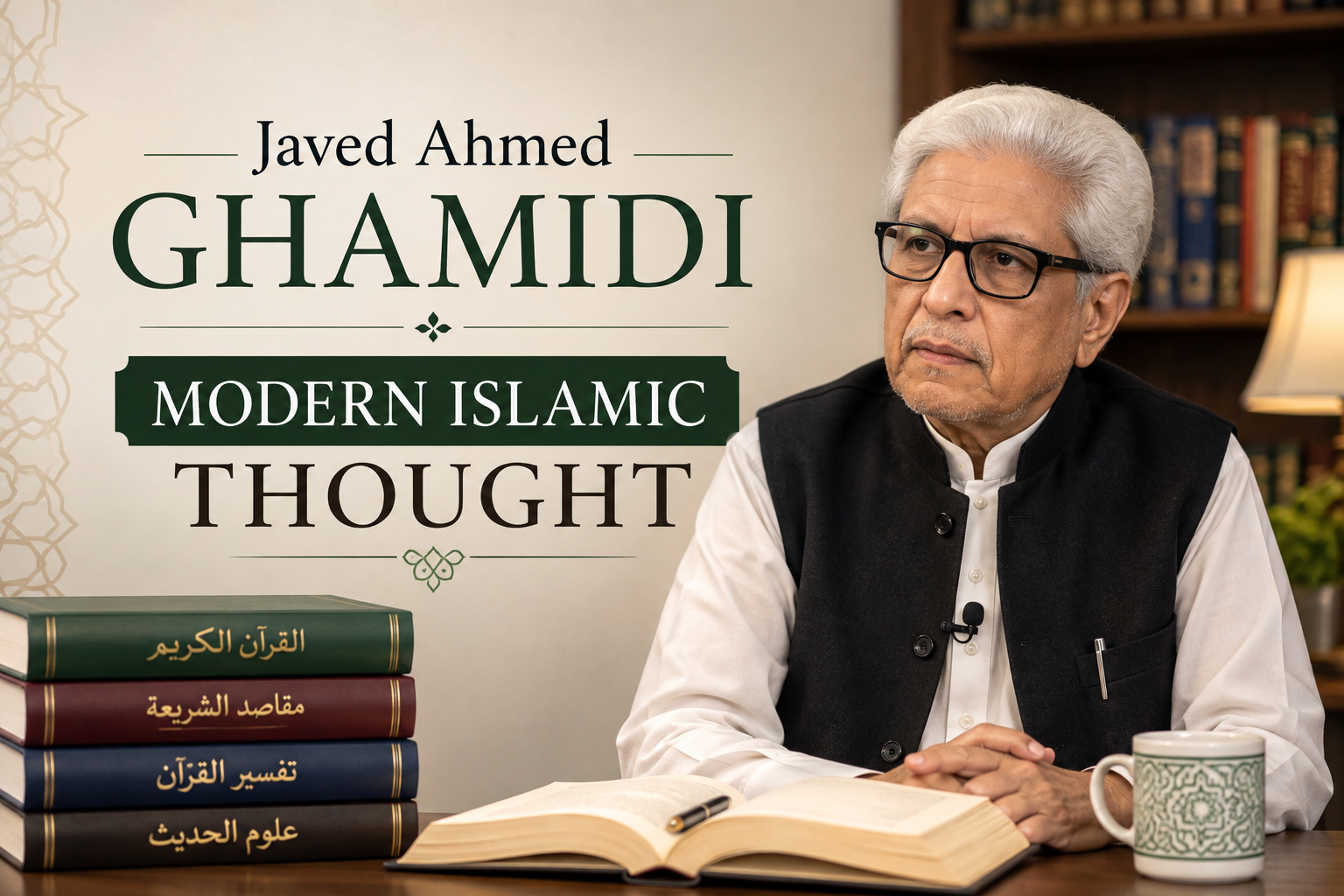
Javed Ahmad Ghamidi stands among the prominent Islamic thinkers of the twentieth and twenty-first centuries who have sought to re-examine traditional paradigms through a systematic, reasoned framework aligned with contemporary requirements. Far from operating solely as a commentator or public speaker, he established a distinct school of thought often designated as the Farahi-Islahi-Ghamidi tradition. Originally initiated by Hamiduddin Farahi (d. 1930) and further elaborated by Amin Ahsan Islahi (d. 1997), this hermeneutical framework was synthesized by Ghamidi into a comprehensive intellectual system. Understanding Ghamidi’s contributions requires an examination of his educational background, core methodological axioms, and perspectives on contemporary socio-religious issues.
Biographical Background and Intellectual Formation
Javed Ahmad Ghamidi was born in 1951 in Sargodha, Pakistan. He completed his early education in Sargodha and Lahore, later earning his master’s degree in English Literature and Philosophy from Government College, Lahore. During his academic pursuits, he established a relationship with Amin Ahsan Islahi, a direct disciple and intellectual heir of Hamiduddin Farahi. Recognizing Ghamidi’s analytical aptitude, Islahi introduced him to the structural and hermeneutical principles of the Farahi school.
Ghamidi spent approximately twenty-five years in close study alongside Islahi, during which he systematically analyzed the Quran, Hadith literature, Islamic jurisprudence (Fiqh), classical philosophy, logic, and modern disciplines. Following Islahi’s passing, Ghamidi codified his conclusions in formal publications. His primary treatise, Mizan, serves as a comprehensive exposition of Islamic theology, worship, ethics, and social law. Additional notable works include Burhan and Islam: An Introduction, complemented by numerous essays, recorded lectures, and structured instructional modules.
Unbound by adherence to any single classical jurisprudence school, Ghamidi’s methodological trajectory relies on direct textual analysis of the Quran and Sunnah, positioning his work as a bridge between classical scholarship and contemporary intellectual inquiries.
Structural Coherence (Nazm-e-Quran) as a Central Hermeneutic
The foundation of Ghamidi’s hermeneutical framework rests on the concept of Nazm-e-Quran (structural coherence), a doctrine initially formulated by Farahi and expanded by Islahi. This principle posits that the Quranic text possesses a deliberative, thematic structure rather than a disconnected arrangement. According to this theory, each Surah revolves around a primary thematic central axis (Amud), to which all constitutive verses systematically relate. Furthermore, a sequential thematic arrangement links adjacent Surahs into deliberate pairings and thematic groups across the text.
For Ghamidi, identifying this structural coherence is the primary key to valid exegesis. He emphasizes that interpreting any passage requires evaluating its immediate and distant textual context. By identifying how a verse functions within its Surah’s thematic arc and historical audience context, its precise normative meaning can be established.
This approach diverges from atomistic commentary methods that analyze verses in isolation or rely heavily on external historical reports (Asbab al-Nuzul) to dictate meaning. Ghamidi maintains that the Quran serves as its own primary contextual authority, yielding an integrated textual narrative when evaluated structurally.
Reinterpreting the Sources: Quran vs. Sunnah
Ghamidi defines Islam as grounded in two authoritative divine sources: the Quran and the Sunnah. However, his definitions and categorization of these sources depart significantly from conventional formulations.
The Quran: Ghamidi views the Quran as the absolute, immutable, and fully preserved baseline of divine revelation (Al-Mizan and Al-Furqan) meant for all humanity. Every other source or interpretation must be evaluated against its explicit text.
The Sunnah: Ghamidi defines the Sunnah strictly as those religious practices established by the Prophet Muhammad among his immediate companions and transmitted continuously across generations via mass consensus and practice (Tawatur-e-Amali). These include core rituals such as the mechanics of Prayer (Salah), Funeral Rites, Fasting, Zakat, and Hajj.
Hadith Literature: Contrary to traditional legal schools that often elevate individual Hadith reports (Ahad) to the status of independent legislative sources, Ghamidi categorizes Hadith as historical records documenting the Prophet’s application of the Quran and Sunnah. Consequently, Hadith literature serves an explanatory and historical function rather than an independent legal one. Under this framework, a Hadith report cannot contradict the Quran or established Sunnah, regardless of the authenticity of its chain of transmission (Isnad).
Ghamidi further differentiates between Shariah (the eternal, unalterable divine law contained in the Quran and Sunnah) and Fiqh (human jurisprudence representing context-bound attempts to apply Shariah). Because Fiqh is a human construct, Ghamidi rejects the absolute authority of classical legal schools (Hanafi, Shafi’i, Maliki, Hanbali), advocating that contemporary scholars must exercise independent reasoning (Ijtihad) directly from primary sources.
The Primacy of Ethics and the Nature of Faith
Ethical consciousness serves as a primary pillar within Ghamidi’s thought. He defines faith (Iman) not merely as passive intellectual assent or traditional conformity, but as a conscious, voluntary submission of human reason and willpower to the Creator.
Flowing from authentic faith is righteous action (Amal-e-Salih), which Ghamidi operationalizes primarily as ethical integrity. He asserts that the central message of divine revelation is moral purification, declaring that rituals performed without underlying ethical consciousness lack spiritual validity.
Ghamidi advocates for moral absolutism, holding that foundational ethical principles are universally embedded in human nature (Fitrah) and explicitly affirmed by revelation. Under this view, divine judgment, salvation, and the ultimate rewards of Paradise are directly linked to moral integrity and authentic faith.
Philosophy of Worship and Legal Wisdom
Ghamidi argues that prescribed acts of worship (Ibadat) are not arbitrary rituals but designed spiritual disciplines intended to cultivate God-consciousness (Taqwa) and moral accountability. Prayer, fasting, almsgiving, and pilgrimage function as structured mechanisms to continuously orient human conduct toward ethical standards.
Regarding legal rulings, Ghamidi maintains that every directive in Shariah carries underlying wisdom (Hikmah) aligned with human nature. The Shariah is fundamentally rational, dynamic, and adaptable in its application across historical contexts, provided its core primary directives remain preserved. This orientation informs his analysis of modern socio-economic challenges, including banking, insurance, bioethics, and civic rights.
The Concept of the Islamic State and Governance
Ghamidi’s political philosophy contrasts with modern Islamist political theories. He contends that establishing an “Islamic State” is not an inherent, absolute religious obligation binding upon all Muslims globally. Rather, the Quran leaves specific structures of governance to human discretion, establishing overarching moral principles such as mutual consultation (Amruhum Shura Baynahum) and justice.
When a Muslim-majority population establishes a state, Ghamidi argues that the government incurs specific institutional duties:
- Providing infrastructure for congregational worship.
- Institutionalizing Zakat collection for public welfare.
- Promoting virtue and curbing vice through statutory legal frameworks.
Crucially, Ghamidi emphasizes that the enforcement of laws and moral order must occur exclusively through formal legal processes—specifically the judiciary and law enforcement—rather than vigilante action or informal moral policing. He advocates for democratic principles where legislation reflects public consensus while upholding foundational Quranic prohibitions. Additionally, he affirms that all citizens within a state, regardless of religious affiliation, possess equal civic and legal rights.
Social Directives and Gender Perspectives
Ghamidi approaches gender relations by affirming the spiritual and ontological equality of men and women in the Quran. Both genders bear identical moral accountability and individual rights. Where functional distinctions occur—such as designated male responsibility for family maintenance (Qawwamness)—Ghamidi frames this as a societal division of labor based on socio-economic obligations rather than an assertion of intrinsic male superiority.
Regarding women’s dress codes, Ghamidi’s position is widely discussed. While he recognizes covering the head as an established cultural tradition within Islamic societies, he argues that the absolute mandatory Shariah directive (Fard) pertains to modest attire and chest coverage as outlined in Surah An-Nur. He interprets specific directives in Surah Al-Ahzab regarding full wrapping (Jilbab) as contextual measures applied to safeguard Muslim women in the distinct socio-political climate of Medina.
Penal Code Framework (Hudud and Tazir)
Ghamidi presents a distinct legal taxonomy regarding Islamic penal laws:
Maximum Sanctions (Hudud): He interprets maximum prescribed penalties stated in the Quran (such as those for theft or adultery) as upper legal ceilings (Maximum Pronouncements). A judiciary possesses the discretion to reduce these sentences based on mitigating circumstances, social conditions, or offender intent.
Diyyah (Blood Money): Ghamidi maintains that Shariah does not fix a permanent, static monetary sum for blood money. Instead, the determination of Diyyah is left to customary practice (Urf) and regional economic realities.
Witness Testimony: Ghamidi asserts that female and male testimonies carry equal weight in general legal proceedings. He interprets the Quranic requirement for two female witnesses in financial transactions as a practical measure to assist memory in historical commercial settings, rather than an absolute statement on legal competence.
Rape and Sexual Violence: Ghamidi categorizes rape under the offense of Hirabah (crimes against public safety and warfare against society) governed by Surah Al-Ma’idah (5:33). Consequently, proving rape does not require four eyewitnesses as mandated for consensual adultery (Zina), allowing the judiciary to utilize forensic evidence and circumstantial proof.
The Quran and Modern Science
Ghamidi maintains a clear distinction between divine revelation and empirical scientific inquiry. He argues that the primary purpose of the Quran is spiritual and moral guidance rather than serving as a scientific textbook.
While the text references natural phenomena to encourage reflection on divine unity (Tawhid) and accountability, Ghamidi cautions against forcefully bending Quranic vocabulary to fit temporary scientific theories, noting that scientific paradigms continuously evolve whereas revelation remains static. The role of an exegete is to understand the language within its original linguistic and historical context.
Summary of Core Hermeneutical Rationale
Ghamidi’s methodology can be summarized by several distinct principles:
- Structural Unity: Analyzing the Quran through thematic coherence (Nazm).
- Contextual Engagement: Evaluating historical settings and immediate textual context.
- Strict Definition of Sunnah: Restricting Sunnah to continuous, consensus-driven practical traditions.
- Shariah vs. Fiqh: Separating divine law from human legal commentary.
- Ethical Primacy: Establishing morality as the baseline for all religious directives.
- Rational Inquiry: Utilizing structured intellectual reasoning over blind imitation (Taqlid).
Critiques and Contemporary Receptions
Ghamidi’s positions have drawn significant critique from traditional clerical bodies. Mainstream critics contend that his restrictive definition of the Sunnah sidelines substantial Hadith literature. Others challenge his reliance on Nazm when it leads to conclusions that diverge from classical consensus (Ijma). Traditionalists also reject his rejection of strict adherence to classical legal schools.
In response, Ghamidi asserts his adherence to primary sources, arguing that scholarly critiques should engage textual arguments rather than rely on traditional consensus as an absolute barrier to independent research.
Institutional Contributions and Public Outreach
Ghamidi has disseminated his ideas through multiple platforms:
- Publications: Major works including Mizan, Burhan, and Al-Bayan (a translation and commentary of the Quran).
- Digital Outreach: Establishing Al-Mawrid Institute and the official platform Ghamidi.com, offering structured courses, lectures, and digital libraries.
- Public Media: Engaging in long-form television broadcasts and international lecture tours to address contemporary religious questions.
In recognition of his intellectual contributions, he was awarded the Sitara-i-Imtiaz by the Government of Pakistan in 2009.
Conclusion
Javed Ahmad Ghamidi’s intellectual framework represents a major reformist endeavor within modern Islamic thought. By prioritizing structural Quranic hermeneutics, re-evaluating the relationship between Hadith and Sunnah, and emphasizing ethical universality, his work offers an alternative approach to traditional jurisprudence. While his conclusions remain a subject of active debate among scholars, his discourse continues to influence modern discussions on faith, law, and society.