Introduction
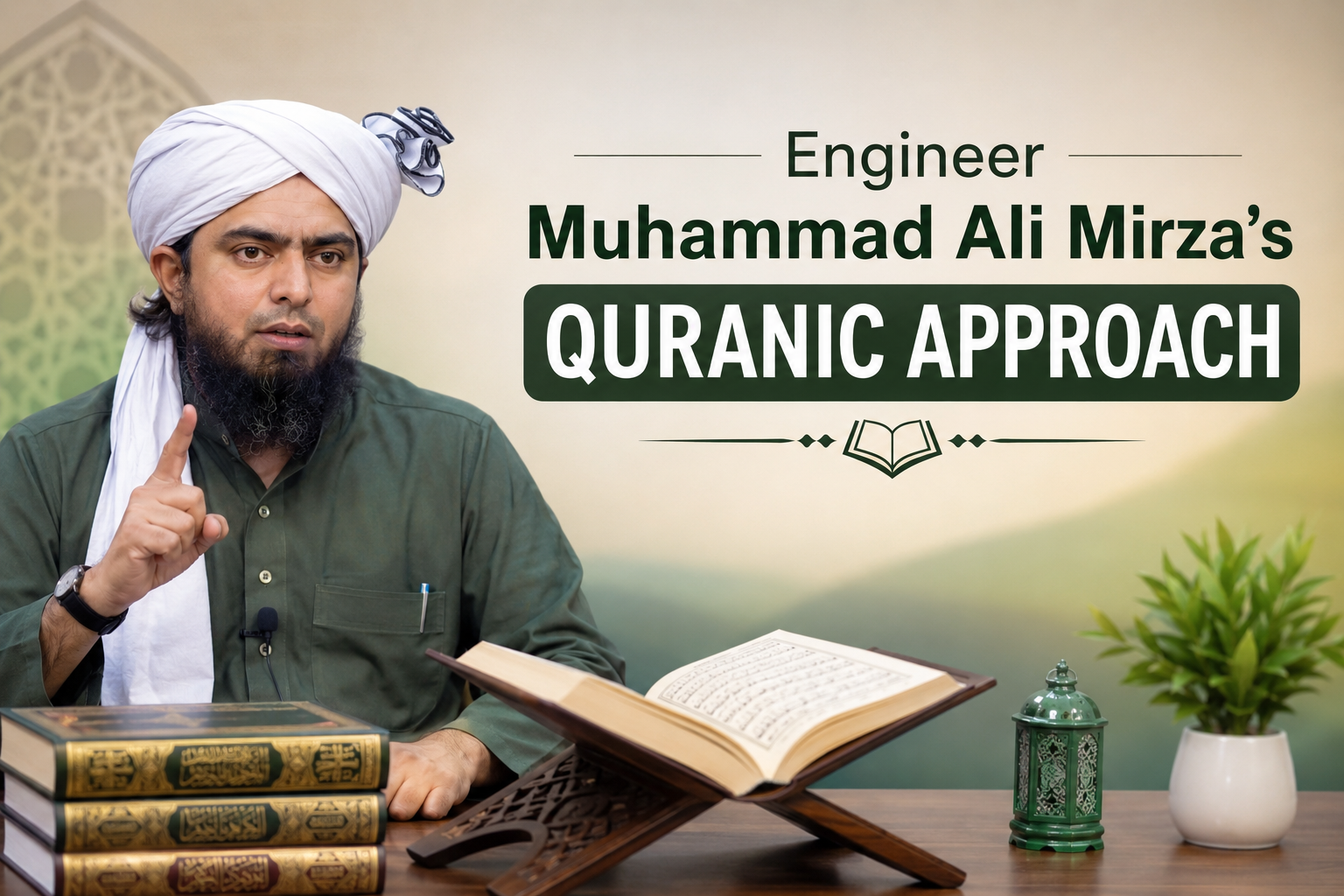
Within the contemporary religious landscape of Pakistan, Engineer Muhammad Ali Mirza occupies a distinct and often polarizing presence. A mechanical engineer by trade who operates as an independent Islamic preacher, he has popularized an analytical approach to Quranic interpretation and Hadith studies that has gathered a significant following. His core identity is encapsulated by the slogan “Main Hoon Muslim, Ilmi Kitabi” (“I am a Muslim, grounded in scholarly literature”), through which he presents himself as independent of traditional sectarian affiliations, relying solely on the Quran and authentic (Sahih) Hadiths.
Mirza’s methodology rests on three primary pillars: the Quran, authentic Hadiths, and rational inquiry. Departing from traditional clerical structures, he advocates for direct engagement with primary Islamic texts while bypassing strict jurisprudential boundaries and sectarian loyalties. He maintains that no single sect possesses absolute truth or total error, asserting that traditional scholars have often selectively presented texts to defend specific sectarian positions.
A Quran and Sunnah-Based Analytical Methodology
A defining feature of Mirza’s discourses is his structured, analytical style—frequently reflective of an engineering background. He presents theological topics as systematic problems requiring empirical textual verification. His lectures typically focus on exegesis of Quranic verses evaluated alongside authentic Hadith compilations and established scholarly consensus.
His framework emphasizes the Quran and Sunnah as the sole authoritative standards for individual religious practice, explicitly rejecting blind adherence (taqlid) to any specific legal school or clergy. Differing from classical tafsir methodologies, his lectures deprioritize complex grammatical disputes or extensive historical commentary in favor of presenting the Quranic message in a direct, contemporary context.
Pan-Islamic Unity and De-emphasizing Sectarian Divides
A major focus of Mirza’s public platform is the promotion of intra-faith unity across Islamic denominations. In his lectures, he regularly calls on Muslims to set aside sectarian divisions and return to foundational source texts. Framing sectarianism as a primary cause of societal decline within the Muslim world, he attempts to engage audiences across diverse traditions—including Sunni, Shia, Ahle Hadith, Deobandi, and Barelvi streams.
He frequently argues that internal jurisprudential differences within major sects are as significant as the broader doctrinal divisions between Sunni and Shia denominations, advocating for mutual dialogue to bridge these gaps. His active engagement with Shia scholars and participation in inter-sectarian dialogues represent a notable departure from mainstream clerical norms in Pakistan.
Controversies, Legal Proceedings, and Public Backlash
Mirza’s non-traditional approach and critical commentary have generated substantial pushback from traditional religious institutions and clerics. Multiple scholars across various sects have issued religious edicts (fatwas) against him, criticizing his methodology and interpretations. Detractors accuse him of disrespecting historical companions of the Prophet, traditional scholars, and venerated figures. In September 2025, the Council of Islamic Ideology (CII) publicly criticized some of his statements as objectionable and religiously impermissible, recommending legal action under applicable penal provisions.
His public commentary has also led to legal challenges and physical attacks. In 2025, he was arrested under blasphemy-related charges, spending approximately three and a half months in custody before being granted bail by the judiciary. This followed a previous arrest in 2020 related to allegations of insulting religious personalities, from which he was also released on bail. Furthermore, Mirza has survived physical targeted attacks, including a knife assault in 2021 that resulted in minor injuries.
Perspectives on Gender and Societal Structures
Academic evaluations of Mirza’s Quranic lectures reveal a specific perspective regarding traditional gender roles. While he affirms the spiritual equality of men and women in accordance with foundational Islamic principles, he maintains traditional frameworks regarding family structures—positioning male family members as economic and administrative heads of the household based on physical and functional responsibilities. Observers note that his discourse generally keeps Islamic social ethics distinct from shifting socio-economic realities, treating foundational social structures as timeless paradigms.
Conclusion
Engineer Muhammad Ali Mirza’s analytical approach to Islamic discourse represents a significant alternative to traditional clerical authority in Pakistan. By prioritizing direct textual engagement, leveraging modern media, and adopting a non-sectarian platform, he has established a substantial audience, particularly among urban youth and digitally connected demographics.
Simultaneously, his sharp critiques of established traditions continue to provoke intense opposition from traditional religious bodies, culminating in legal disputes, formal condemnations, and security concerns. Despite these ongoing controversies, his work remains an influential element of contemporary religious discourse in the region, reflecting broader shifts in how religious knowledge is communicated and consumed in the digital age.