Introduction
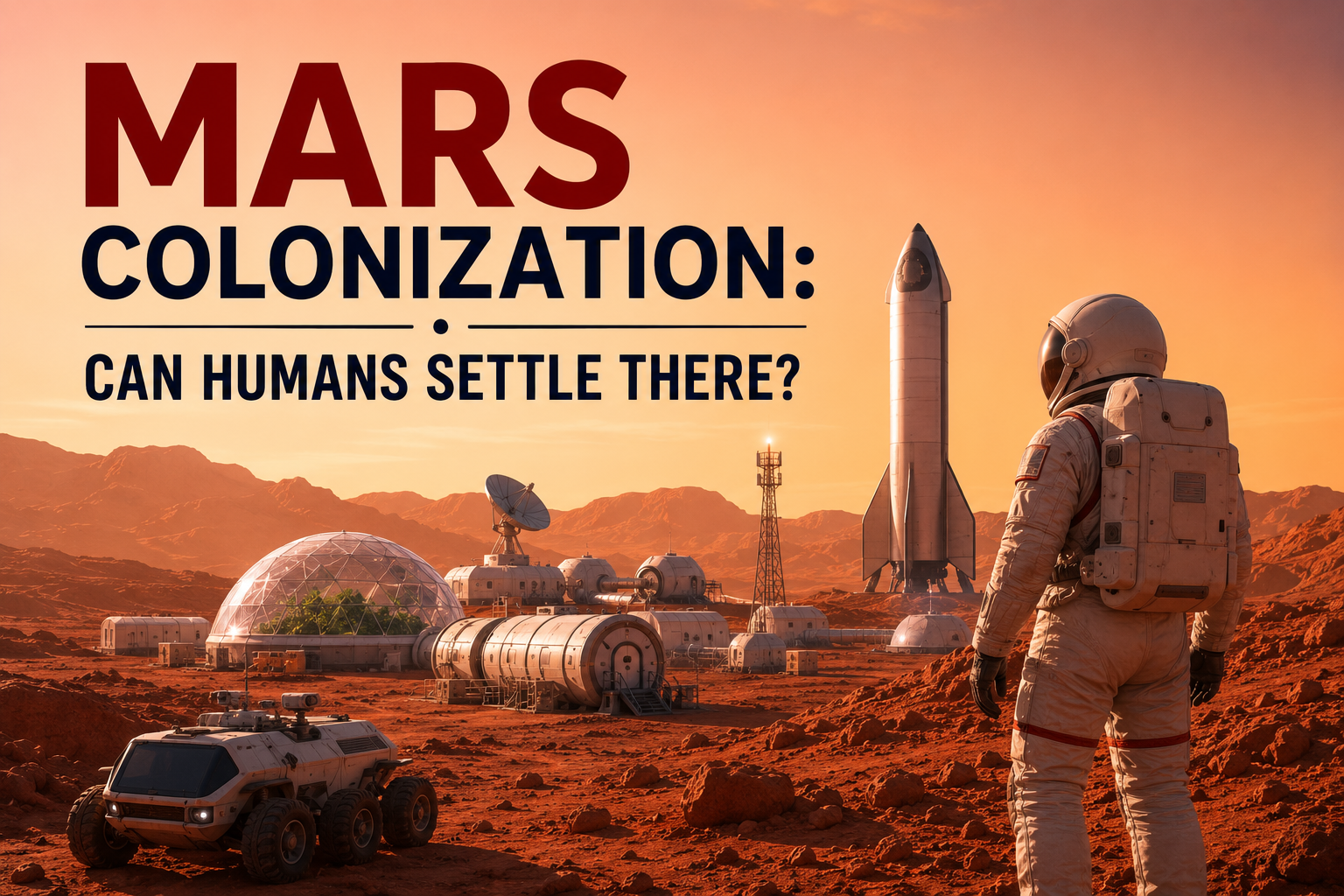
Establishing a human settlement on Mars is a concept as compelling as it is fraught with monumental challenges. It is a vision that has captured humanity’s imagination for generations, yet today it has evolved into a concrete scientific and technological pursuit. Among the celestial bodies in our solar system, Mars presents the closest environmental parallels to Earth—offering a similar day-night cycle, polar ice caps containing water, and surface minerals that could potentially sustain human life.
However, these superficial similarities mask a harsh reality. Mars remains a hostile world where temperatures plunge to -60 degrees Celsius, oxygen is absent from the atmosphere, and cosmic radiation poses severe risks to biological organisms. Despite these barriers, space agencies and private aerospace entities continue to pursue strategies aimed at establishing a permanent human presence on the Red Planet.
This article provides an analysis of the complexities surrounding Martian colonization, examining environmental prerequisites, current technological roadmaps, and the long-term feasibility of making Mars a second home for humanity.
Mars: A Harsh and Hostile Environment
The environmental conditions on Mars differ fundamentally from those on Earth. Its atmosphere consists of 95% carbon dioxide, with a surface pressure measuring less than one percent of Earth’s atmospheric pressure. Unprotected human exposure on the Martian surface would result in fatality within minutes due to rapid depressurization, zero breathable oxygen, extreme cold, and high radiation levels.
Radiation exposure presents a primary hazard to long-term human habitation. Lacking a global protective magnetic field and possessing a thin atmosphere, Mars experiences unmitigated exposure to galactic cosmic rays and solar particle events. Data collected by NASA’s Mars Science Laboratory indicates an average surface radiation dose of 76 mGy per year, compared to Earth’s average natural background radiation of approximately 0.5 mGy per year. However, analytical modeling demonstrates that shielding located approximately 10 meters beneath the Martian regolith reduces radiation exposure to levels comparable to or below Earth baselines, supporting sub-surface habitat designs.
Reduced gravity represents another physiological constraint; Martian gravity is approximately 38% of Earth’s gravity. Prolonged exposure to low gravity accelerates bone density loss and muscle atrophy, with studies indicating potential bone density reductions of up to two percent per month without rigorous counter-measures. Furthermore, Martian soil contains toxic perchlorates that interfere with human thyroid function and complicate agricultural cultivation without extensive soil remediation.
Psychological considerations are equally significant. Transit to Mars requires six to nine months of travel, with a full mission duration spanning over two and a half years. Extended isolation in confined quarters, coupled with communication latencies to Earth, necessitates specialized psychological support systems, structured routines, and virtual reality interventions.
The Feasibility of Terraforming Mars
Terraforming—modifying the Martian environment to support Earth-like life—has transitioned from theoretical science fiction toward formal analytical evaluation. Researchers at Los Alamos National Laboratory have revisited the planetary engineering models required to raise Martian temperatures, increase atmospheric pressure, and generate breathable oxygen.
The theoretical framework for full-scale terraforming involves three major engineering phases:
The first phase focuses on localized thermal containment via advanced structural materials, such as silica aerogels. These materials transmit visible light while insulating against infrared thermal loss, enabling micro-environments where sub-surface ice can melt to supply liquid water. These structures could gradually be expanded into broader enclosed regional habitations.
The second phase involves planetary heating through orbital solar mirrors or engineered atmospheric aerosols. Placing massive solar reflectors in orbit could direct concentrated sunlight toward the polar caps to release stored carbon dioxide. Alternatively, releasing engineered nanostructures into the atmosphere could trap solar radiation to induce a greenhouse effect. However, achieving planet-wide heating via orbital arrays requires reflective surfaces spanning tens of millions of square kilometers.
The third and most resource-intensive phase is oxygen generation. Generating a breathable atmosphere requires producing approximately $8.2 \times 10^{17}$ kilograms of oxygen. While abundant water ice exists across Mars, splitting water molecules via electrolysis to yield atmospheric oxygen requires vast power generation systems that far exceed current off-world energy infrastructure.
Calculations indicate that raising Martian atmospheric pressure by a single millibar requires introducing $3.89 \times 10^{15}$ kilograms of gas—a mass equivalent to the Martian moon Deimos. Constructing a fully habitable global atmosphere demands approximately $10^{18}$ kilograms of volatile material, highlighting that planet-scale terraforming remains an industrial undertaking requiring multi-century timelines.
Current Strategic Frameworks: Paraterraforming and Incremental Steps
Because planetary-scale terraforming requires long-term development, space agencies and commercial developers are prioritizing **paraterraforming**—constructing enclosed, self-sustaining habitats and bio-domes capable of supporting human life without requiring pressurized space suits inside the structures.
Private aerospace entities like SpaceX are pursuing heavy-payload delivery platforms, such as Starship, to establish cargo supply routes to the Martian surface. Initial roadmaps emphasize deploying autonomous robotic systems, including humanoid platforms like Tesla’s Optimus, to construct basic infrastructure—such as power stations, life-support facilities, and shielding—prior to crewed arrivals.
Recent operational adjustments have seen timelines extended as organizations prioritize lunar surface operations as a proving ground. The Moon offers a three-day transit window compared to the multi-month journey to Mars, allowing life-support systems, autonomous construction technologies, and resource extraction methods to be validated close to Earth. Current projections place initial self-sustaining lunar infrastructure development ahead of large-scale Martian surface construction.
Concurrently, international space programs are executing targeted robotic exploration. China’s Tianwen-3 mission aims to execute a Mars sample return operation around the turn of the decade, providing critical geological and environmental data necessary for future crewed landings.
Microbial Applications in Off-World Habitats
Microbiology will play a foundational role in Martian life-support architectures. Extremophilic microorganisms capable of surviving harsh radiation and low-pressure conditions are being engineered to assist in resource utilization and environmental regulation.
Experimental trials indicate that specialized extremophiles retain structural integrity, metabolic functionality, and genomic stability under simulated Martian conditions. Microorganisms configured in microbial biofilms exhibit elevated resistance to desiccation and radiation exposure. These biological systems are being developed to generate oxygen, remediate perchlorates from local regolith, and fix atmospheric carbon dioxide, though the precise impacts of fractional gravity on microbial gene expression remain an active area of research.
Conclusion
Human settlement on Mars represents a major technical frontier. While full planetary terraforming remains a theoretical multi-generational objective, paraterraforming through localized, highly shielded habitats presents a viable engineering pathway for the near future. Addressing radiation hazards, low gravity, resource extraction, and biological support systems requires sustained interdisciplinary innovation.
Whether realized through gradual robotic preparation, lunar testbed validation, or advanced life-support engineering, the pursuit of Martian habitation continues to drive key technological breakthroughs in energy, automation, and environmental closed-loop systems—advancements that ultimately benefit resource management on Earth as well.